
Today, I will describe the Best AI Tools for Financial Anomaly Detection at Scale- integrated platforms that empower organizations to efficiently identify fraud, errors Read More.
When you pair AI-driven systems with assets powered by machine learning, real-time monitoring, and behavioral analytics, they offer highly accurate insights while reducing manual auditing efforts and ensuring compliance.
This excess dependency can suck up time and mental resources, so the right tool offers smarter, faster and scalable financial oversight.
Key Points & Best AI Tools for Financial Anomaly Detection at Scale
MindBridge – AI platform analyzes entire financial datasets to spot anomalies, risks, and unusual patterns effectively.
AppZen Mastermind Platform – Automates finance workflows, flags risks and discrepancies with AI, boosting compliance and accuracy.
Oversight – (General summary since specific search data unavailable) AI monitors financial transactions continuously to detect anomalies, errors, and compliance risks.
SymphonyAI Sensa‑NetReveal – Enterprise AI detects fraud and money‑laundering patterns across channels, reducing false positives.
remQ by VOQUZ Labs – (General overview) AI risk and compliance tool monitors transactions and flags unusual or suspicious behavior patterns.
Fraudio – Centralized AI brain connects ecosystem data to accurately detect complex payment fraud patterns in real time.
Sift – AI fraud solution uses global data network to identify anomalies like scams and account takeovers.
Feedzai – Real‑time machine‑learning platform detects fraud, AML issues, and anomalies across financial transactions at global scale.
Featurespace – Adaptive behavioral analytics learns normal activity to flag transactional deviations and emergent threats.
DataVisor – Unsupervised AI discovers new fraud patterns and coordinated scams without prior example training.
10 Best AI Tools for Financial Anomaly Detection at Scale
1. MindBridge
A higher level of AI-driven financial risk and anomaly detection, an industry-specialized platform that applies advanced artificial intelligence and machine learning to enable in-depth analysis of financial datasets.
Unlike traditional sampling methods, MindBridge reviews all transactions and data (100% sampling) to uncover anomalies, outliers, and potential risks buried in large volumes of financial records.
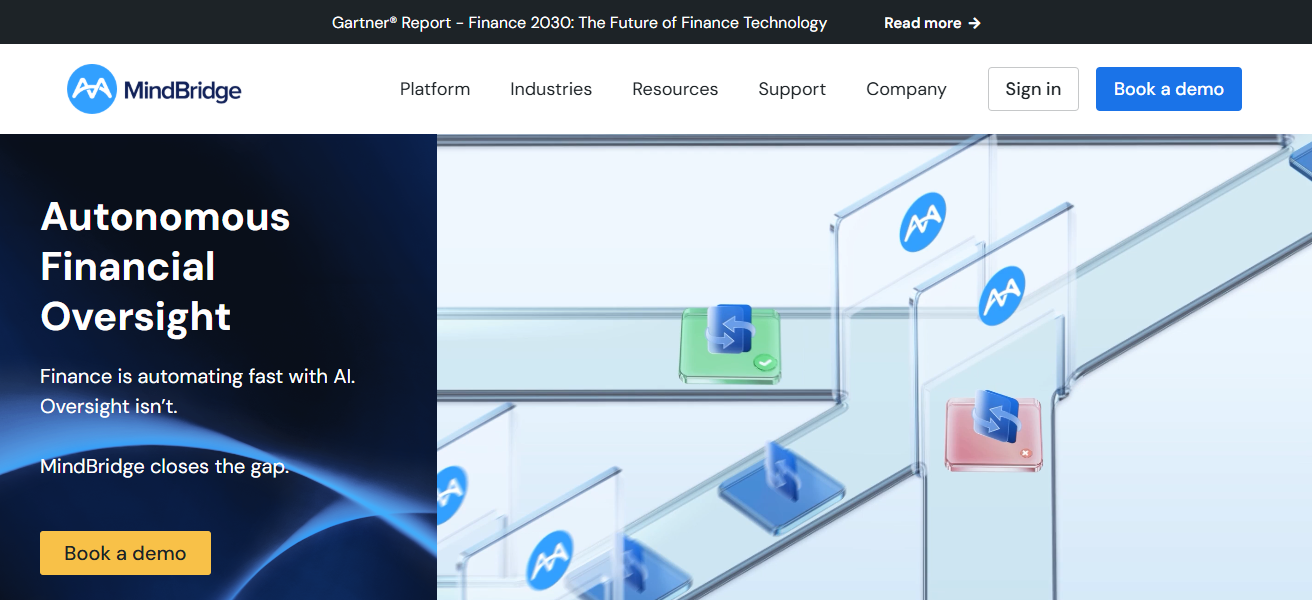
Offering a combination of statistical techniques, deep learning, and pattern recognition for subtle anomaly detection across contextual point and collective data signals, MindBridge’s analytics allow auditors / risk teams to find issues that manual review may miss.
With robust data aggregation capabilities and scalable architecture design, MindBridge provides large enterprises the ability to improve oversight in finance-related systems thereby reduces exposure while driving audit efficiency
| Pros | Cons |
|---|---|
| Analyzes 100% of financial data for complete anomaly detection. | Can be expensive for smaller organizations. |
| Uses AI, machine learning, and pattern recognition for deep insights. | Requires training to interpret complex analytics effectively. |
| Improves audit efficiency and reduces manual review workload. | Integration with some legacy systems may be complex. |
| Scalable for large enterprises and multiple data sources. | May generate false positives if rules are not tuned. |
| Detects subtle and contextual financial risks. | High initial setup and configuration effort. |
2. AppZen Mastermind Platform
AI with AppZen; Overview of the Mastermind AI Automation Platform AppZen | A Subset of Expense data, Addressing Safety & Compliance Its Mastermind platform analyzes invoices,
Receipts, employee expenses and payment data for anomalies, policy violations or suspicious activity using machine intelligence and configurable AI agents that operate in an always-on environment.

AppZen automates risk detection and spend auditing, eliminating the need for manual reviews, speeding up financial governance, and enabling teams to flag abnormal behavior in real-time.
Featuring built‑in integrations and a low‑code environment, the platform adapts to enterprise policies with high compliance rates, reducing fraud and freeing finance teams from operational overload so they can focus on strategic impact.
| Pros | Cons |
|---|---|
| Automates expense auditing and accounts payable processes. | Best suited for medium to large enterprises. |
| Flags policy violations and suspicious transactions in real time. | May require adjustments to existing workflows. |
| Reduces dependency on manual review and human errors. | AI accuracy depends on quality of historical data. |
| Low-code platform allows customization and integration. | Some features may be overkill for small companies. |
| Enhances compliance and fraud prevention across finance operations. | Initial learning curve for finance teams. |
3. Oversight
Oversight is an AI‑based analytics platform built to monitor financial transactions, expense reports and business processes for anomalies or departures from normal as it relates to expected behavior.
Instead, it constantly monitors data across the finance function to identify errors, fraudulent spending, compliance violations and other anomalies that rule‑based systems would miss.
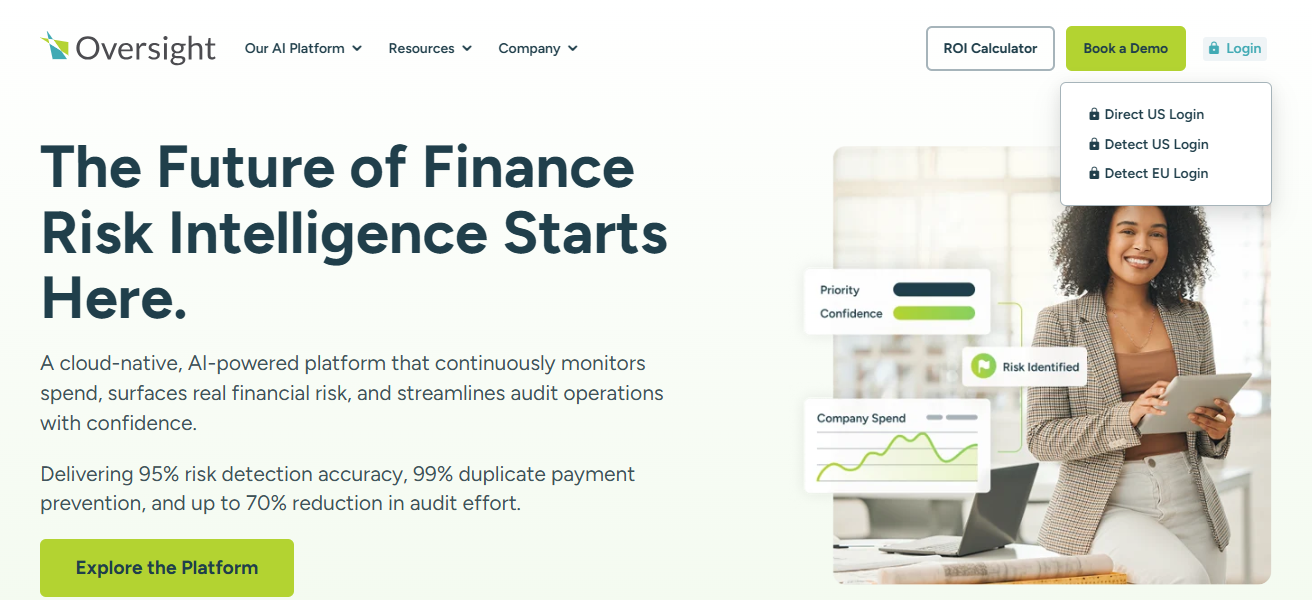
Oversight enables finance and audit teams to prioritize investigations and respond quickly to high-risk enterprise activity by assigning risk scores, then providing customizable dashboards that help identify potential fraud in real time.
Its automation minimizes manual effort, contextualizes spending patterns, and aids in real‑time anomaly detection for enterprise financial operations which drives higher accuracy, compliance, and operational control
| Pros | Cons |
|---|---|
| Monitors financial transactions continuously for anomalies. | Limited advanced AI features compared to specialized platforms. |
| Assigns risk scores to prioritize high-risk activities. | Reporting dashboards may require customization. |
| Reduces manual effort in compliance and auditing. | Integration with non-financial systems can be limited. |
| Supports real-time detection and alerts. | May miss subtle behavioral anomalies without tuning. |
| Improves operational control and financial oversight. | Not ideal for small-scale organizations with simple workflows. |
4. SymphonyAI Sensa-NetReveal
SymphonyAI Sensa‑NetReveal Fraud & Transaction Monitoring is an enterprise‑grade platform that uses AI to detect financial crime, fraud and money‑laundering in large institutions.
It brings together transaction monitoring, case management and analytics into a single system to detect suspicious behaviors, for example; reduce false positives and facilitate investigations.
Unlike systems that learn from historical data, AI models continuously evolve with emerging fraud tactics and evolving risk profiles to facilitate real‑time detection across channels.
Centralized data combined with generative AI assistants allows teams to uncover risk patterns while causing little or no disruption to legitimate processes.
Its scalable architecture meets complex organizational requirements, enabling global financial institutions to react quickly and accurately to threats caused by any financial anomaly.
| Pros | Cons |
|---|---|
| Detects fraud, AML, and money-laundering efficiently. | High cost may deter smaller enterprises. |
| Reduces false positives through advanced AI models. | Complex configuration and training needed for teams. |
| Real-time monitoring across multiple channels. | Implementation can take significant time. |
| Scalable architecture for large financial institutions. | May require expert analysts to interpret results. |
| Centralized platform unifies transaction monitoring and case management. | Advanced features may be underutilized without proper training. |
5. remQ by VOQUZ Labs
remQ is a SAP‑embedded transaction monitoring and internal control automation platform that performs continuous checks of master data and business transactions against green flags, irregularities and risks.
It runs in the SAP environment and examines both financial and operational data to help users detect anomalies that might indicate errors, control violations or potential fraud.

Originally designed for the banking, finance and fintech industries, remQ allows organizations to enforce compliance, automate internal governance and improve quality of audit with pre‑built controls, real‑time monitoring and configurable rules.
Transparency into unusual postings, data changes, or transactional exceptions empowers finance and audit teams to take decisive action in real time for leakage prevention
While preserving strong internal controls without the risk of pushing sensitive information outside existing systems.
| Pros | Cons |
|---|---|
| Embedded in SAP, fully integrated with enterprise systems. | Limited to SAP environments; not for other ERP systems. |
| Real-time monitoring of transactions and master data. | Customization may require technical expertise. |
| Automates internal controls and governance processes. | May involve initial setup complexity. |
| Helps enforce compliance and audit quality. | Not as flexible for non-financial operations. |
| Provides visibility into unusual postings and anomalies. | Advanced analytics capabilities may be limited. |
6. Fraudio
Best AI Fraud Detection Software In 2026 (Along With Fraudio)- A Unified AI-Driven Fraud Detection Platform That Integrates Separate Data Sources To Identify Sophisticated Anomalous
Patterns Across Financial and Payment Ecosystems Built for high‑volume environments, Fraudio employs machine learning to highlight subtle deviations and threats that traditional systems overlook – including coordinated attacks or advanced payment fraud.

Its scalability and rapid processing power allows for real‑time risk scoring and response, allowing institutions to take immediate action on suspicious activity.
Additional information about FraudioBy integrating automated analytics and customizable workflows, Fraudio assists financial companies in detecting and preventing multiple types of fraud at all interaction points, thus boosting accuracy while enhancing operational resilience.
| Pros | Cons |
|---|---|
| Centralized AI platform connects multiple data sources. | Implementation may be complex for smaller teams. |
| Detects complex fraud patterns in real time. | Requires ongoing model tuning to maintain accuracy. |
| Scalable for high-volume transaction environments. | Can be expensive for mid-sized organizations. |
| Supports customizable workflows and risk scoring. | May require specialized expertise to interpret insights. |
| Enhances operational resilience and reduces financial losses. | False positives possible in edge-case scenarios. |
7. Sift
Sift – Sift is an AI‑driven Digital Fraud Prevention & Risk Based Authentication solution that offers risk scoring, behavior analytics, and a global network of data to detect suspicious activity (malicious or unexpected) such as payment fraud, account takeover and abuse.
Based on experience with billions of events each year across thousands of brands, Sift’s machine learning models continually adjust to emerging threats.

It also provides companies the ability to make real‑time decisions and automates blocking suspicious transactions while delivering a better user experience for legitimate users, which enables businesses to grow securely without hindering customer experience.
Its intuitive dashboards and customizable workflows help financial teams identify patterns, automate responses and scale fraud prevention across digital channels.
| Pros | Cons |
|---|---|
| Global data network improves anomaly detection accuracy. | Best for digital transactions; offline monitoring limited. |
| Real-time risk scoring and fraud prevention. | Cost may be high for smaller businesses. |
| Machine learning adapts to emerging threats automatically. | Some complex workflows may require manual oversight. |
| Reduces friction for legitimate users while blocking fraud. | Learning curve for analytics dashboards. |
| Supports scalable fraud prevention across digital channels. | May not cover all financial anomalies outside payments. |
8. Feedzai
Feedzai AI for Fraud & AML Risk Management is an enterprise platform that applies sophisticated artificial intelligence, machine learning, and behavioral modelling in order to monitor, flag and trigger alerts on transactions with detected anomalies as they occur.
Designed for large banks and financial institutions, the RiskOps platform from Feedzai reviews vast data sets through complex models that mix rules with predictive analytics to reveal fraud, money-laundering patterns and other financial crimes.

Its explainable AI capabilities give the ability to analysts to understand how and why decisions are made, reducing false positives and helping prioritize critical alerts.
Flexible models with deployment, rapid response tools allow organizations to remain compliant and operationally efficient across geographies — even at scale — while adapting to emerging threats.
| Pros | Cons |
|---|---|
| Real-time fraud, AML, and anomaly detection. | High complexity can require expert implementation. |
| Behavioral profiling for better accuracy. | Costly for smaller organizations. |
| Explainable AI reduces false positives. | Customization may need specialized data teams. |
| Scalable for large banks and global financial institutions. | Integration with legacy systems may be challenging. |
| Rapid response tools adapt to emerging threats. | Ongoing model maintenance required to stay accurate. |
9. Featurespace
[“Featurespace ARIC Risk Hub overview” : youtube.com] – Featurespace (ARIC) are behavioral and anomaly detection engine which builds an adaptive model of ‘normal’ behavior for every user or account, then raises alerts if a transaction is out of the parameter as an indication that fraud or risk has occurred.
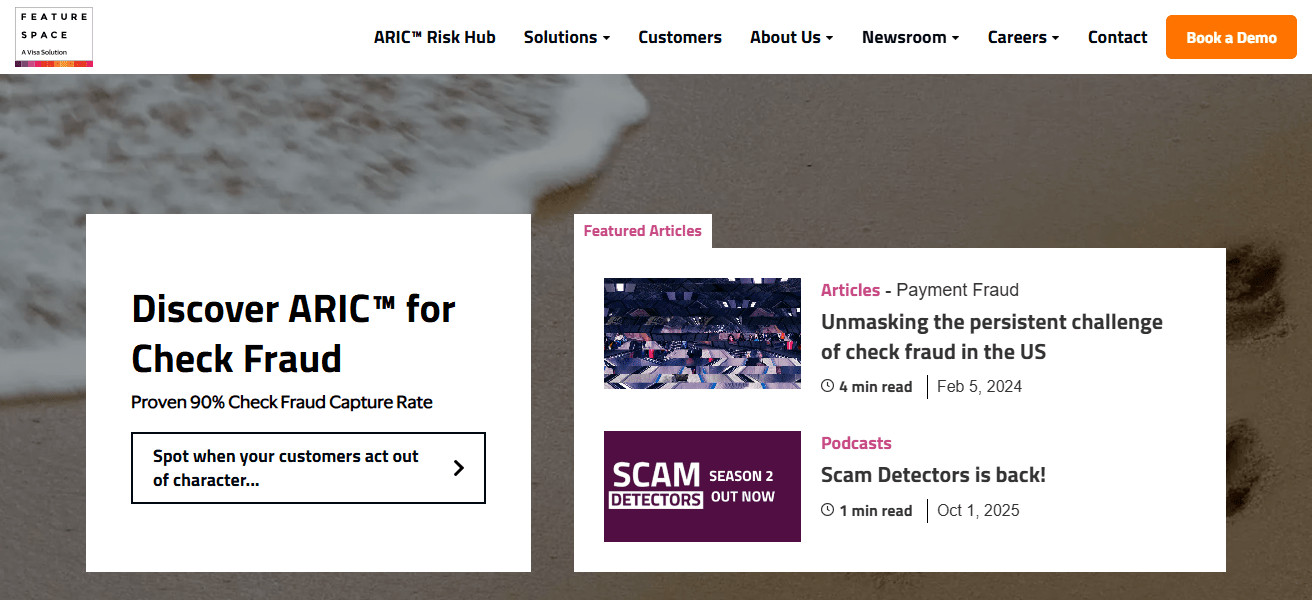
Its self‑learning algorithms adapt in real time and refine detection as patterns evolve. With some of the best real-time monitoring for payments, card transactions and digital channels on the market, Featurespace is adept at risk scoring and alerting teams to anomalous behavior in seconds.
It uses explainable analytics and configurable controls to help financial institutions minimize fraud, enhance authorization decisions and reinforce compliance, but still achieve a frictionless customer experience.
| Pros | Cons |
|---|---|
| Self-learning behavioral analytics adapt continuously. | Primarily optimized for payment and card monitoring. |
| Real-time risk scoring for transactions and accounts. | May require data scientists for optimal use. |
| Explainable analytics support compliance and reporting. | Implementation can be complex for smaller enterprises. |
| Reduces fraud while improving authorization decisions. | Limited offline or non-transactional monitoring capabilities. |
| Supports seamless user experience with minimal friction. | Advanced features may need training to utilize fully. |
10. DataVisor
DataVisor: AI Fraud & Risk Platform overview data science, big data analytics, and machine learning product which utilizes advanced unsupervised machine learning to identify new threats for fraud detection and anti-money laundering (AML).
Their patented technology uncovers unknown networks of suspicious activity by connecting behaviors, devices and entities across data signals in real time.

Perfect for larger companies managing a variety of risk scenarios, DataVisor allows organizations to identify new threats and less depend on historical data patterns to proactively protect against future attack vectors.
When blended with knowledge graphs and automated reporting, it enables risk teams to research advanced fraud networks quickly and at scale.
| Pros | Cons |
|---|---|
| Unsupervised AI detects novel and coordinated fraud. | May require significant data for accurate detection. |
| Links behaviors, devices, and entities across signals. | High technical expertise needed for configuration. |
| Real-time detection without relying on labeled datasets. | Implementation cost can be high for mid-sized firms. |
| Reduces reliance on historical fraud patterns. | May generate false positives for edge cases. |
| Scales efficiently for large enterprises with complex risks. | Setup and tuning can be time-consuming. |
Why use AI for anomaly Detection instead of Manual Auditing?
Scalability – an AI can analyze millions of transactions in seconds, while manual auditing is painstaking and often limited.
Accuracy – machine learning shows subtle patterns and outliers that are missed by human eyes.
Real-time Monitoring – AI identifies anomalies in real-time, while the checks done manually are necessarily periodic.
Efficiency – Decreases manual labor, allowing auditors to concentrate on essential, high-risk situations.
Adaptive Learning – AI models are self-updating and learn new frauds automatically.
Economical at Scale – It requires lesser manpower for large datasets than the manual reviews.
Why Choose Best AI Tools for Financial Anomaly Detection At Scale
- Analyzes 100% of transactions for thorough anomaly detection.
- Detects subtle risks using AI and pattern recognition.
- Enhances audit efficiency and reduces manual review effort.
- Scalable for large enterprises and multiple data sources.
- Automates expense auditing and accounts payable workflows.
- Flags policy violations in real time.
- Low-code platform allows easy customization.
- Reduces human error and boosts compliance.
Conclsuion
To sum up, AI technologies for financial anomaly detection give companies the power to detect fraud, errors and anomalies at scale with unprecedented speed and accuracy.
Tools such as MindBridge, AppZen, Feedzai and DataVisor offer near instant oversight, flexible input learning and enterprise-ready analytics capabilities
That take the grunt work out of compliance to ensure risk is managed more effectively. AI makes it possible to conduct financial oversight on a proactive, efficient, and effective basis.
FAQ
What are AI tools for financial anomaly detection?
AI tools use machine learning and data analytics to identify unusual patterns, fraud, and errors in financial transactions.
Which AI tools are best for large enterprises?
MindBridge, SymphonyAI Sensa-NetReveal, Feedzai, DataVisor, and Featurespace are scalable for high-volume operations.
Can small or mid-sized companies benefit from these tools?
Yes, tools like AppZen, Oversight, and Sift are adaptable for mid-sized finance operations.
Do these tools work in real time?
Most platforms like Feedzai, Sift, Fraudio, and NetReveal provide real-time monitoring and alerts.