
This article reviews leading fraud prevention software that aids companies in detecting and addressing fraud. Leveraging AI, ML, identity verification, and risk analysis tools, the software secures online transactions.
I analyze features and security elements of the software, gauging how each improves fraud risk and customer trust.
Key Points
| Fraud Prevention Software | Explanation |
|---|---|
| Sift | Uses AI-powered detection to prevent payment fraud, account abuse, and scams. |
| Signifyd | Provides guaranteed fraud protection with automated decisions for online transactions globally. |
| Forter | Delivers real-time identity intelligence to reduce fraud and improve approvals. |
| Riskified | Uses machine learning to prevent fraud while maximizing legitimate customer conversions. |
| SEON | Combines digital footprint analysis and AI to detect suspicious activities quickly. |
| Kount | Offers identity verification and fraud scoring for secure digital transactions. |
| Arkose Labs | Protects businesses against bots, scams, and sophisticated online fraud attacks. |
| Stripe Radar | Uses machine learning models to identify and block payment fraud risks. |
| ThreatMetrix | Provides global identity intelligence for preventing fraud and cybercrime threats. |
| BioCatch | Detects fraud using behavioral analytics and advanced biometric intelligence technology. |
1. Sift
Sift is a fraud detection prevention tool that employs the use of machine learning and artificial intelligence. Machine learning models allow Sift to assess user behavior through the lens of their transactions, the signals that devices emit, and the activities of their networks.

Sift’s Digital Trust and Safety platform offers automated risk scoring and the help of customizable fraud controls. With Sift, online stores and marketplaces find it easier to strike the balance of providing customers a seamless experience while approving the fewest legitimate customers.
Sift Features
- Detects digital abuse and suspicious transactions via AI-powered fraud detection.
- Scoring risks in real time analyzes users and their device behaviors and transaction behaviors.
- Identity intelligence assists in blocking account takeovers and other fraudulent actions.
- Machine learning models offer better fraud detection.
- Flexible security controls fulfill different needs.
2. Signifyd
Signifyd offers artificial intelligence fraud detection prevention technology and helps online businesses automate the process of making transactional decisions. Signifyd also offers a form of financial protection in the event that a transaction is ruled as a case of fraud.
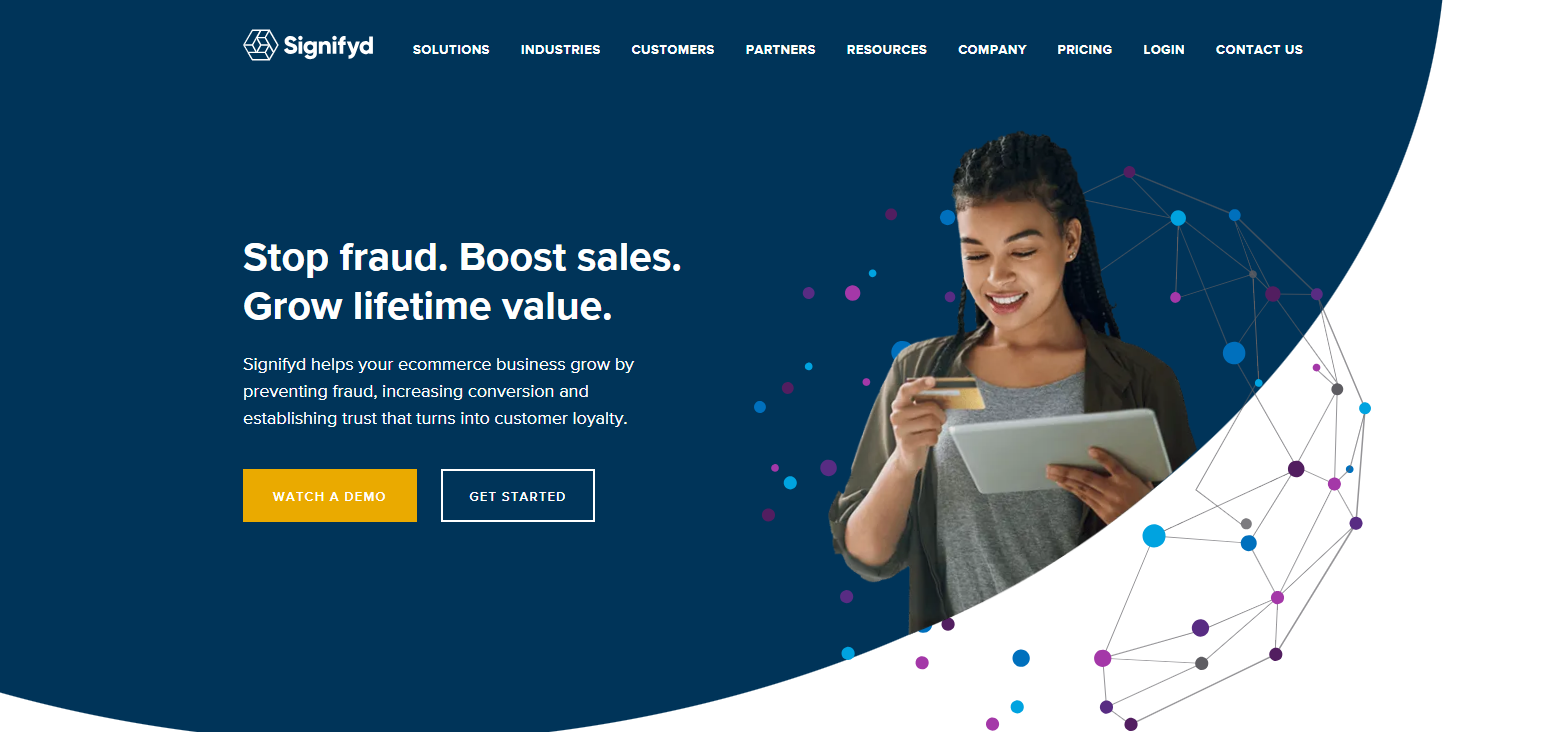
Signifyd’s Commerce Protection Platform delivers various solutions that address the needs of fraud prevention, abuse protection, and payment security. Signifyd’s guarantee of protection against fraud allows businesses to manage the costs of manual reviews by approving more customers.
Signifyd Features
- Fully automates fraud decisions for easy online purchases.
- Chargeback protection alleviates financial burdens due to fraudulent purchases.
- AI analyzes customers and their potentially suspicious behavior.
- Trust goes up and payments become safer with identity verification.
- Improves detection of fraud cases with Global Commerce.
3. Forter
Forter provides businesses with fraud prevention tools and transaction approval enhancement with their real-time identity intelligence. Using AI, Forter analyzes billions of digital interactions to understand customer behavior and identify the difference between legitimate users and fraudsters.

Payment fraud prevention, account protection, prevention of returns abuse, and identity verification are all tools provided by Forter. Their platform reduces fraud for ecommerce retailers and allows marketplaces and financial companies
To meet their goals without hindering the customer’s experience. With Forter, accurate risk decisions are made by merging behavioral insights, transaction data, and worldwide fraud intelligence.
Forter Features
- Provides real-time detection of fraud via identity intelligence.
- Safe transaction approvals lean on AI’s secure nature.
- Protects from access and activity fraud to accounts.
- Customer verification processes are boosted by behavioral insights.
- Precise risk assessments are made possible by the Global Fraud Network.
4. Riskified
Riskified targets fraud using sophisticated technology that evaluates customer interactions to maximize transactional approvals while minimizing risk. Their platform focuses on the fraudsters’ digital behavior to identify more false positives.
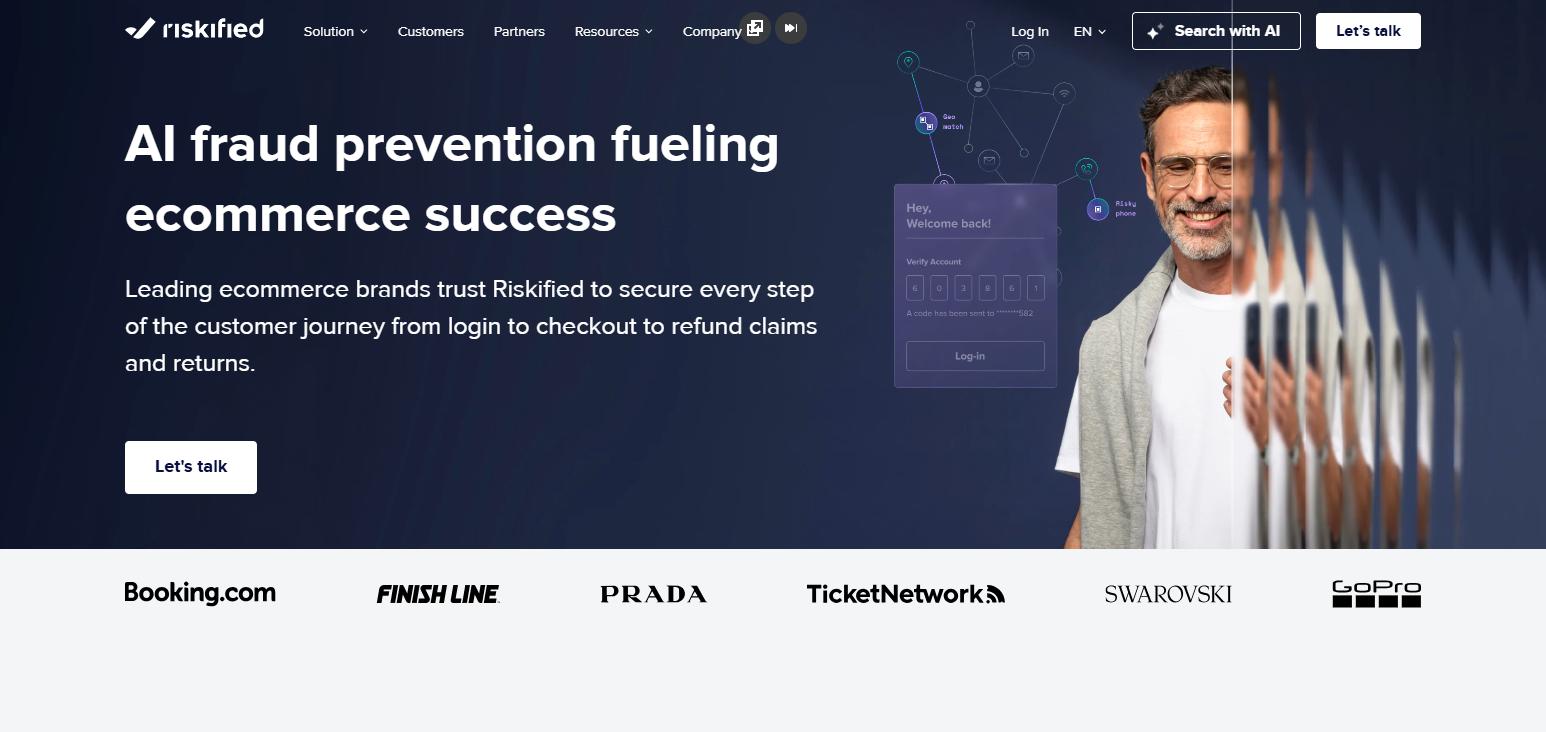
Payment fraud prevention, chargeback protection, account security, and policy abuse prevention are all tools offered by Riskified. Their platforms provide more sales opportunities for ecommerce companies while maintaining security.
Using the constant learning AI models from Riskified, companies improve the customer experience and maximize the protection of their fraudulent transactions.
Riskified Features
- Fraud detection via the learning of machine behavior.
- Protects merchants from chargeback losses.
- AI models authorize more transactions for customers that are not fraudulent.
- Provides automatic fraud detection for high-risk transactions.
- Optimizes revenue and balances security with customer satisfaction.
5. SEON
SEON utilizes digital footprint, artificial intelligence, and behavioral intelligence to rapidly detect anomalies in online behavior.
The platform helps businesses assess the likelihood of fraudulent behavior by examining emails, phone numbers, social profiles, device data, and behavioral data. SEON offers fraud detection and customer verification solutions that are applicable to ecommerce, fintech, and other online enterprises.
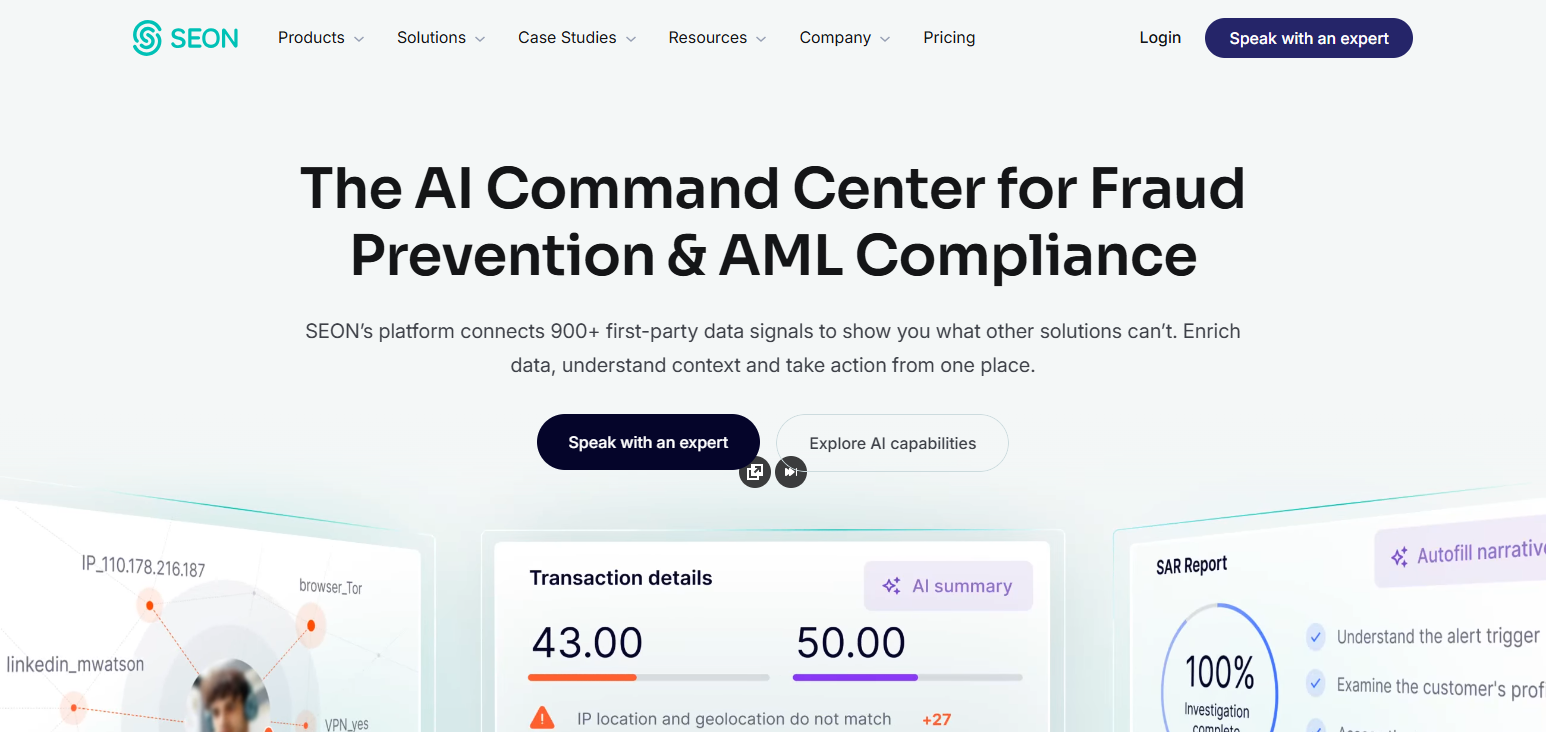
With its highly customizable APIs, companies can easily embed SEON’s fraud prevention tools into their existing workflows. SEON aids companies in minimizing their fraudulent exposure, decreasing the creation of bogus accounts, and optimizing security choices with real-time risk evaluations.
SEON Features
- Analyzes digital footprints to spot suspicious customers.
- AI boosts security decisions when fraud is suspected.
- Risk scores aid businesses in deciding the level of trust presented by customers.
- Fraud detection frameworks are smoother with flexible APIs.
6. Kount
Kount is an advanced, AI-based fraud prevention platform that offers secure digital transactions through identity verification and risk scoring. Kount analyzes behaviors and devices through the lenses of machine intelligence to preemptively safeguard enterprises from the effects of problematic situations.
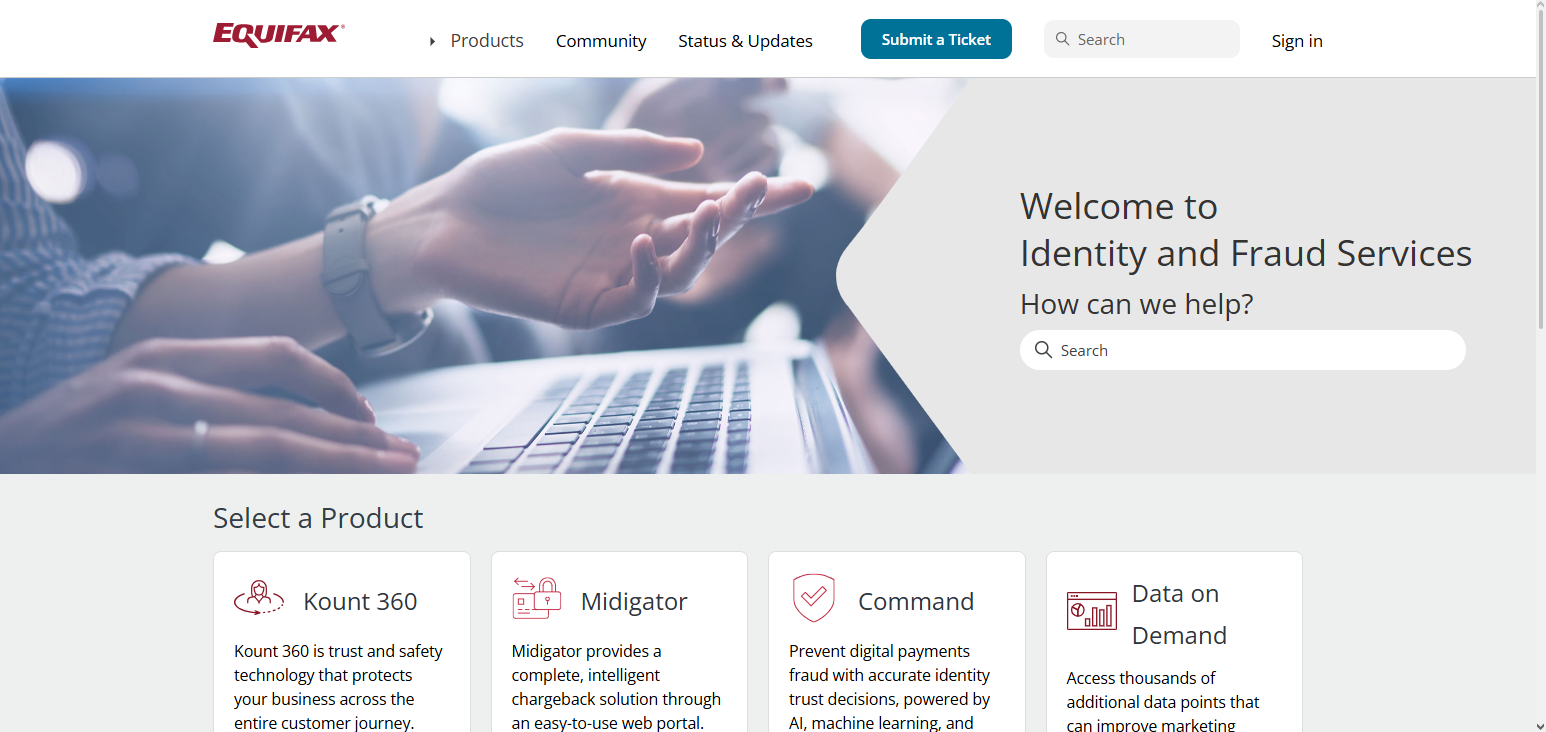
Kount defends organizations from the financial and operational fallout resulting from payment processing fraud, account takeovers, and illegitimate transactions in all sectors.
Its Identity Trust Global Network assesses accurate fraud risks based on significantly large data set sampling and automation. Kount provides a fraud decision, automated, low trust operation and high digital customer satisfaction platform.
Kount Features
- Efficient detection of fraudulent transactions through AI.
- The strength of digital transactions increases with the capability of identity verification.
- Device intelligence is used to identify abnormal behaviors and devices.
- Automated decisions lead to less tedious reviews for suspected fraud cases.
- The global identity network is foundational for accurate fraudulent transactions.
7. Arkose Labs
Arkose Labs protects businesses from threats like bot attacks, scams, account takeovers, and other forms of online fraud. Their platform uses AI, adaptive challenges, and risk-based authentication to identify bad actors.

Arkose Labs’ security solutions raise the cost and effort of fraud while preserving the ease of use for their clients’ customers. This solution is popular with firms in financial services, ecommerce, gaming, and technology.
Arkose Labs counters online abuse, automated attack vectors, account creation spam, and credential stuffing with its fraud and threat intelligence.
Arkose Labs Features
- The successful blocking of bots is key to ensuring automated fraud is not a threat.
- Adaptive authentication systems thwart attempts to gain unauthorized access to accounts.
- Continuous detection of harmful users is possible through AI systems.
- Rapid analysis of threat intelligence leads to the adoption of the latest fraud countermeasures.
- Risk-based challenges safeguard companies from the misuse of the internet.
8. Stripe Radar
Stripe Radar is a fraud prevention solution that uses machine learning to protect online payment and digital transaction processing. It solves the modern payment conundrum by analyzing transactional data and user behavior and mapping global fraud to identify and block suspicious activity in an automated fashion.
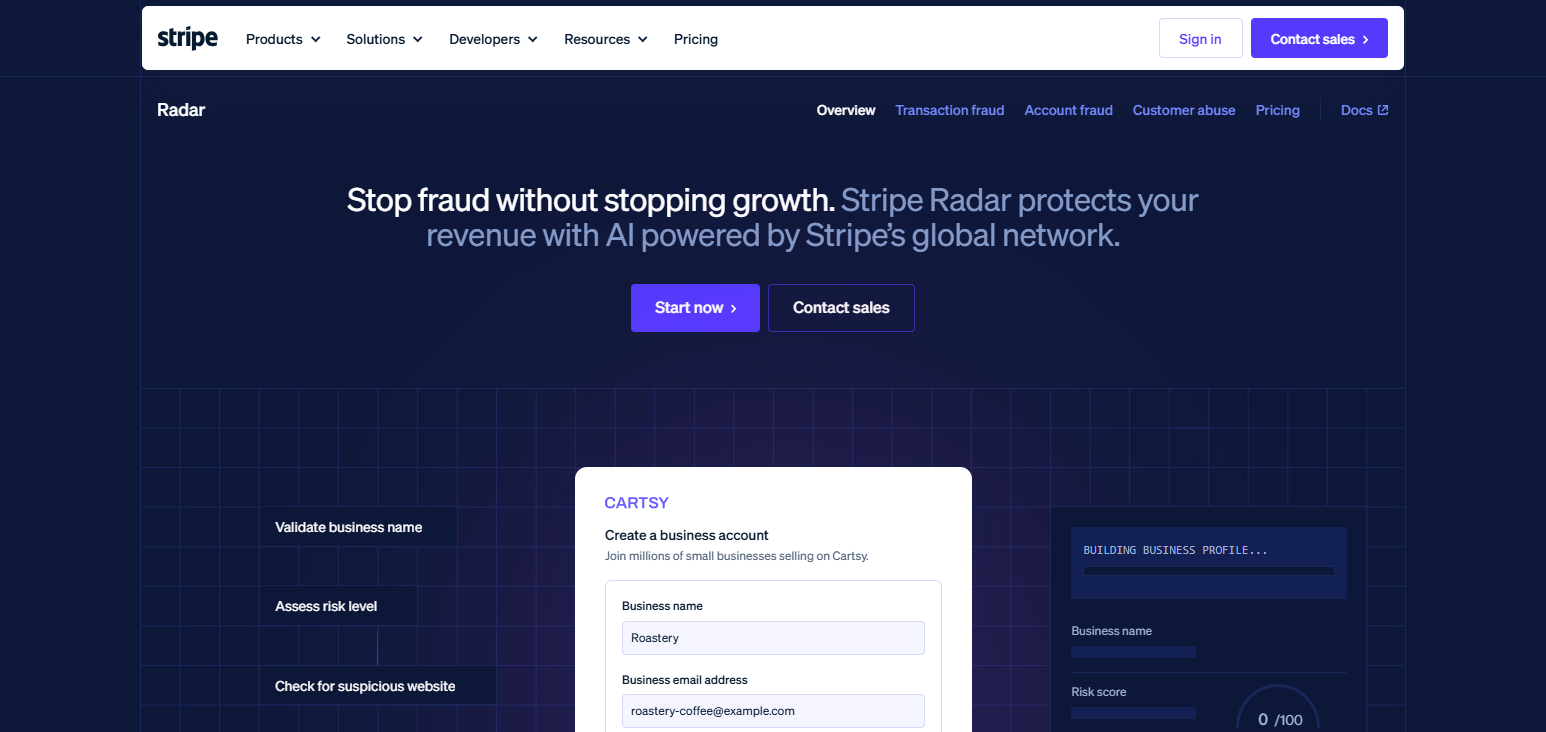
Stripe Radar is embedded in the Stripe payment processing system, and as such, businesses avoid the complexity of an external system to manage fraud.
The platform offers online merchants configurable fraud rules, risk scoring, and detection models to decrease chargebacks and fraudulent transactions while keeping payment friction to a minimum.
Stripe Radar Features
- Machine Learning unearths payment fraud in a wholly automated manner.
- Transaction security is ensured though flexible, user-defined, anti-fraud rules.
- Threats to payment security are assessed with real-time scoring.
- Prevention of payment losses and chargebacks is achieved through automation.
9. ThreatMetrix
ThreatMetrix enables organizations to mitigate the risks of fraud, cybercrime, and unauthorized access by offering worldwide digital identity intelligence. Their platform evaluates how users can be identified, characterized, and localized by devices and behavioral tendencies to perform instantaneous risk analyses.

ThreatMetrix is useful across the banking, ecommerce, insurance, and government services industries as it refines authentication and fraud detection. Their Digital Identity Network allows companies to determine trusted users and suspicious activity.
This solution mitigates the risk of account takeover, focuses on the enhancement of customer verification, and promotes the safe engagement of users in all digital markets.
ThreatMetrix Features
- Digital crime and fraud risk prevention is possible through the fusion of cyber and digital identities.
- Unusual activity of users is detected through the analysis of behaviors.
- The security of the authentication process is enhanced through real-time assessments of risk.
- Attempt to gain access in a suspicious manner is flagged through the recognition of devices.
10. BioCatch
BioCatch uses behavioral analytics fused with cutting-edge biometric technologies to reveal fraud. Their platform examines how users interact with and manipulate digital devices and the unique patterns of their behavior and navigation in the digital sphere to detect potentially harmful behaviors.
BioCatch is especially useful in combating takeovers of digital banking and other nefarious social engineering techniques as it offers protection from online banking fraud. Its behavioral biometrics create a unique user profile that leaves a minimal footprint.
The technological infrastructures of AI and BioCatch create a digital environment that is both customer-centric and secure while preventing attempts to defraud in real time.
BioCatch Features
- Detection of fraudulent interactions on users is possible through Behavioral Biometrics.
- Rapid unveiling of account takeovers is achieved through AI solutions.
- Security models are personalized with the profiling of users.
- Activities related to financial fraud are thwarted through constant oversight.
- Enhanced protection of the digital space increases confidence to transact online.
Conclusion
In conclusion Selecting optimal Fraud Prevention Software enables organizations to shield shifting threats of fraud to transactional and customer data that plagues digital domain fraud prevention.
Fraud prevention software employs AI, machine learning, behavioral analytics, and identity intelligence to deliver rapid identification and prevention of suspicious activities.
Organizations that deploy appropriate online fraud prevention platforms are able to reduce financial costs, risks, and liability while retaining customers and developing online security throughout the digital domain.
FAQ
How does Fraud Prevention Software work?
It uses AI, machine learning, and analytics to identify and block fraudulent activities.
Why should businesses use Fraud Prevention Software?
It helps prevent financial losses, secure transactions, and protect customer information from fraud.
What features should Fraud Prevention Software have?
Important features include risk scoring, identity verification, real-time monitoring, and AI detection.
Can Fraud Prevention Software reduce payment fraud?
Yes, it detects suspicious transactions and prevents unauthorized payments effectively.