In this article, I will discuss the Compliance Software Brands Businesses Trust Most for security, governance, and regulatory management in 2026.
These platforms help companies automate audits, manage risks, improve cybersecurity monitoring, and maintain compliance efficiently.
From startups to global enterprises, businesses increasingly rely on advanced compliance software solutions to simplify operations, strengthen data protection, and achieve faster certification processes with modern AI-powered automation tools.
Key Poinst & Compliance Software Brands Businesses Trust Most
| Compliance Software Brand | Word Explanation |
|---|---|
| Vanta | Automates security compliance monitoring, helping businesses maintain audit readiness continuously across platforms. |
| Drata | Simplifies compliance workflows using real-time monitoring, automated evidence collection, and risk management tools. |
| OneTrust | Provides privacy management solutions supporting regulatory compliance, data governance, and enterprise risk visibility. |
| AuditBoard | Streamlines audit, risk, and compliance processes with collaborative cloud-based reporting dashboards efficiently. |
| Secureframe | Helps startups achieve security certifications quickly using automated compliance tracking and integrations seamlessly. |
| Sprinto | Automates security compliance tasks, reducing manual efforts while improving operational efficiency for organizations. |
| MetricStream | Offers enterprise-grade governance, risk, and compliance solutions with advanced analytics and automation features. |
| LogicGate Risk Cloud | Enables customizable risk management workflows, helping organizations improve governance and compliance operations effectively. |
| Hyperproof | Delivers integrated governance and compliance workflows, improving enterprise-wide operational transparency and accountability. |
| ServiceNow | Delivers integrated governance and compliance workflows improving enterprise-wide operational transparency and accountability. |
10 Compliance Software Brands Businesses Trust Most
1. Vanta
Since then, Vanta has grown to be one of the world’s fastest-growing compliance automation platforms serving SaaS startups and enterprise businesses worldwide.
The company’s latest AI automation tools provide continuous monitoring of security controls to reduce manual audit tasks and speed up SOC 2 or ISO 27001 certifications.

Businesses love Vanta for its sweet real-time compliance visibility, 400+ integrations, and robust trust management capabilities.
Meta on GoToWebinar 2023 Vanta launched not just once but twice from 2026, with expanded capability of AI Agent in its solution to enable security teams to automate all types of remediation workflows and governance operations at scale across the enterprise.
| Pros | Cons |
|---|---|
| AI-powered automation reduces manual compliance workload significantly. | Premium pricing may challenge smaller startups initially. |
| Supports 400+ integrations for streamlined security monitoring. | Advanced enterprise features require learning and setup time. |
| Continuous monitoring improves real-time audit readiness efficiency. | Limited customization compared to enterprise-focused GRC platforms. |
| Strong SOC 2 and ISO 27001 automation capabilities. | Some integrations need additional configuration support occasionally. |
2. Drata
Drata is very well-known as an easy compliance management solution that offers automation, evidence collection, and continuous monitoring systems.
The company enables faster audit readiness while continuing to stay security-ready throughout the year.
Drata stands out for businesses due to its easy dashboards, customizable workflows, and increasing AI-driven automation capabilities.
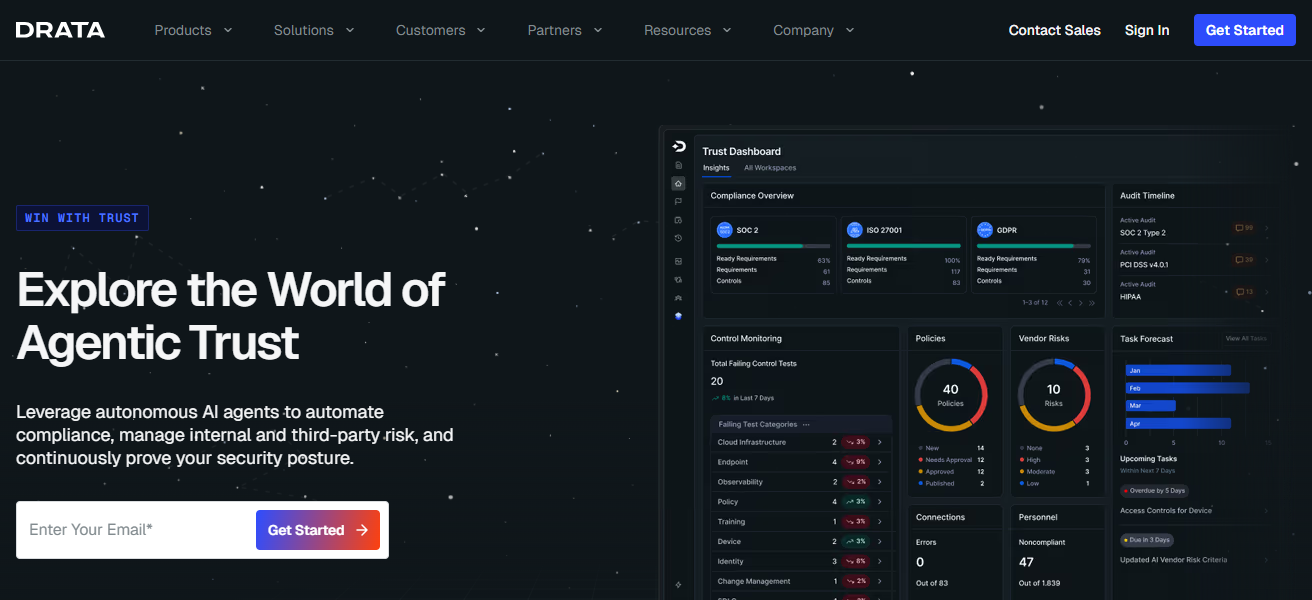
This is the first of several updates improving trust center functionality and integrations with systems that many cloud-native businesses are using today.
Drata hits that sweet spot for many mid-sized organizations, providing powerful compliance automation capabilities that are very affordable while boasting robust support for SOC 2, HIPAA, ISO 27001, and GDPR frameworks, as well as other standards.
| Pros | Cons |
|---|---|
| User-friendly dashboards simplify compliance management processes greatly. | Advanced analytics features remain less mature than competitors. |
| Automated evidence collection saves valuable operational time. | Enterprise customization options can feel slightly restricted. |
| Supports major frameworks, including HIPAA and GDPR, efficiently. | Pricing increases as organizational compliance needs expand. |
| Excellent cloud-native integrations for modern SaaS businesses. | Some reporting tools need deeper customization flexibility. |
3. OneTrust
OneTrust is now the world’s largest enterprise platform to manage privacy, governance, and regulatory compliance.
Enterprise organizations also seek OneTrust to tackle enterprise risk programs and complex privacy regulations (including GDPR and CCPA).

It has a modular architecture that operates across vendor risk assessments, policy management, and compliance reporting.
Major adoption of OneTrust for AI-powered trust intelligence and risk management combined in a single platform.
At the same time, enterprises enjoy its scalability, comprehensive reporting dashboards, and sophisticated privacy automation developed for some of the world’s most regulated sectors.
| Pros | Cons |
|---|---|
| Excellent privacy compliance support for GDPR and CCPA. | A complex implementation process for smaller organizations initially. |
| Scalable platform designed for enterprise-level governance operations. | Premium enterprise pricing may exceed startup budgets. |
| Strong AI-assisted risk analysis and privacy automation tools. | User interface can appear overwhelming for beginners sometimes. |
| Detailed reporting dashboards improve compliance visibility organization-wide. | Requires training for maximizing advanced governance capabilities. |
4. AuditBoard
AuditBoard are still landing clients who want better internal audit and risk management. It helps businesses to centralize audit workflows, automate reporting, and for different departments within a business to get operational transparency on the same platform.
AuditBoard is extremely common among financial institutions and other large organizations with SOX compliance needs.
Comparisons in the industry have shown that it is stronger for governance and audit functions, although an AI automation process is not as mature yet as newer feature-rich compliance platforms.
AuditBoard continues to have strong credibility in the industry with its mature audit ecosystem, collaborative tools, and enterprise-grade risk visibility capabilities.
| Pros | Cons |
|---|---|
| Strong internal audit and SOX compliance management features. | AI automation capabilities lag behind newer competitors today. |
| Centralized workflows improve enterprise audit collaboration efficiently. | The initial onboarding process can consume considerable organizational resources. |
| Trusted by financial institutions managing regulatory requirements globally. | Customization options sometimes require technical implementation support. |
| Enterprise-grade reporting enhances operational transparency significantly. | Initial onboarding process can consume considerable organizational resources. |
5. Secureframe
Headquartered in San Francisco, Secureframe enables startups and high-growth enterprise technology companies with faster compliance certificates using automated workflows and evidence monitoring.
Companies trust Secureframe because we streamline complicated audit preparation workflows with no massive compliance teams required.
They cover more than 30 security and privacy frameworks, which makes it a natural choice for super-fast-scaling B2B SaaS organizations.
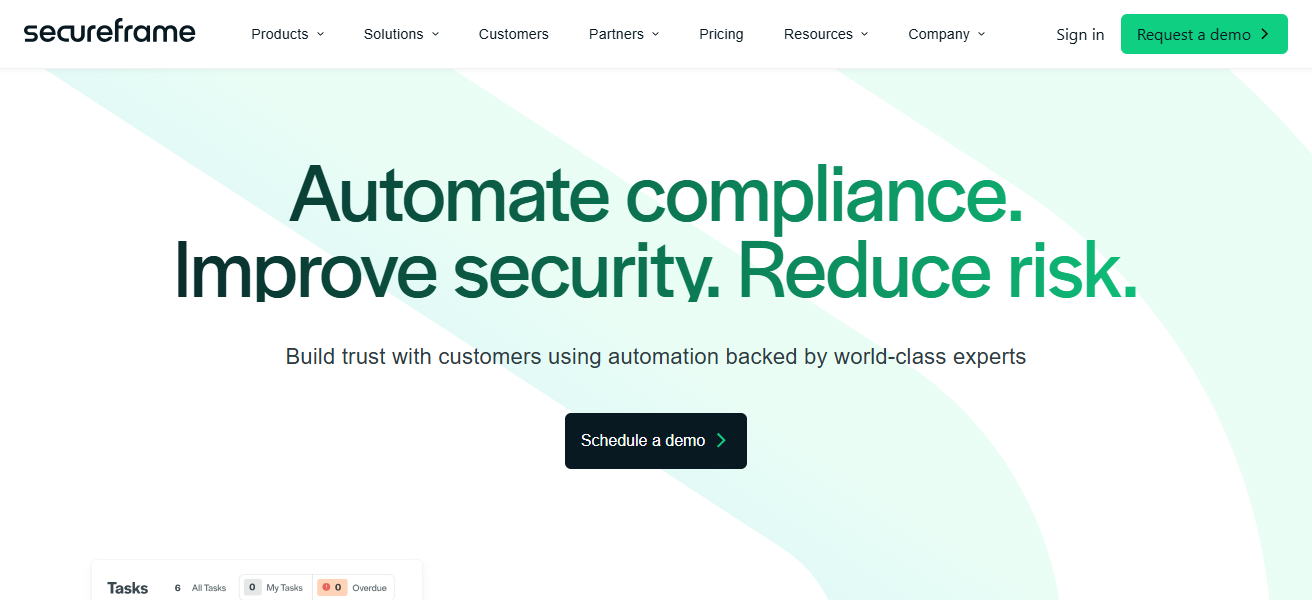
Secureframe got a lot of publicity in 2026 due to better automated remediation guidance and centralized compliance management.
Its clean interface, audit-ready dashboards, and the ability to eliminate repetitive manual tasks during security assessments are very highly valued by companies.
| Pros | Cons |
|---|---|
| Fast certification workflows help startups achieve compliance quickly. | Advanced enterprise governance tools remain somewhat limited. |
| Supports over 30 security and privacy compliance frameworks. | Custom reporting capabilities could improve for larger organizations. |
| Automated remediation guidance simplifies audit preparation tasks greatly. | Pricing may rise with additional compliance framework usage. |
| Clean interface improves usability for growing SaaS businesses. | Fewer enterprise integrations compared to larger compliance platforms. |
6. Sprinto
Sprinto is gaining momentum among startups that are cloud-native, requiring compliance with security frameworks and seeking cost-effective and efficient tools for automation in audits.
Businesses depend on Sprinto to automate the mundane compliance tasks, while security observability continues across applications & systems.
Guide — The intuitive dashboard, guided workflows, and framework mapping capabilities reduce the complexities of compliance with SOC 2, ISO 27001, and HIPAA.
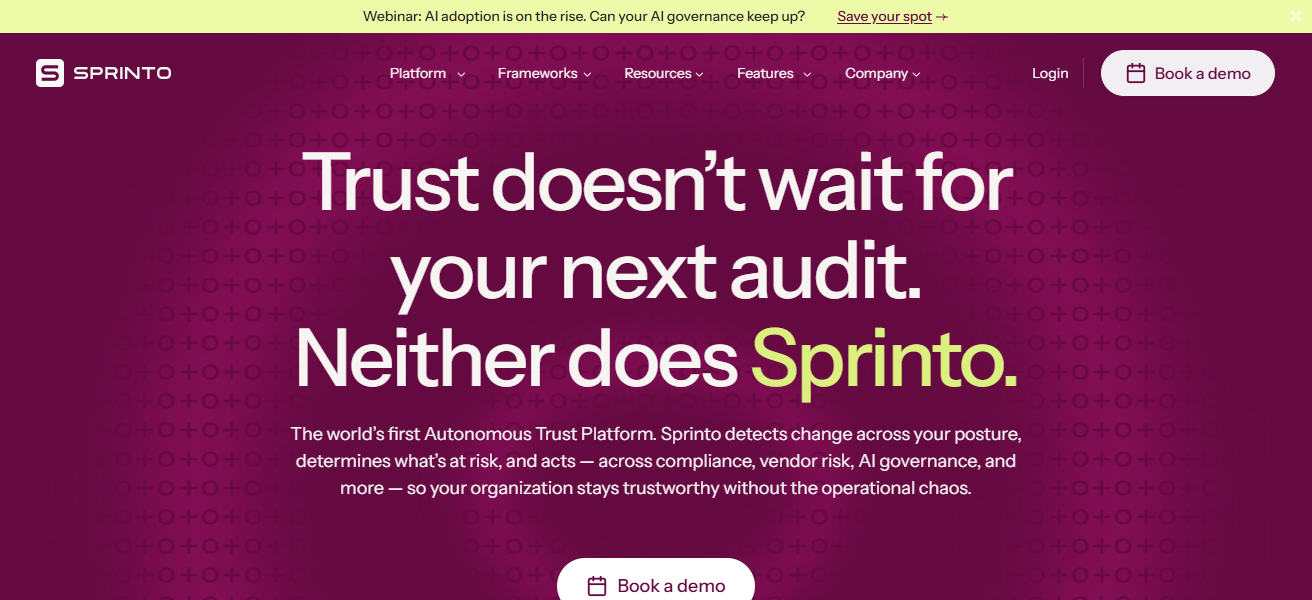
Community reviews for Sprinto in 2026 cited ease-of-use, speed of automation, and startup-friendly onboarding as the best features.
Today, several scaling tech startups view Sprinto as a real-life alternative to scaled-down enterprise compliance platforms.
| Pros | Cons |
|---|---|
| Affordable pricing attracts startups and mid-sized technology companies. | Enterprise-level governance features remain relatively limited currently. |
| Guided workflows simplify SOC 2 compliance implementation effectively. | Fewer advanced analytics compared to premium GRC competitors. |
| Continuous monitoring improves overall security posture management efficiently. | Smaller integration ecosystem than established compliance providers currently. |
| Startup-friendly onboarding reduces technical setup complexity significantly. | Scaling enterprises may eventually require broader governance capabilities. |
7. MetricStream
Enterprises around the world rely on MetricStream for integrated governance, risk, and compliance solutions.
It provides AI-driven analytics and tracks operational risk and regulatory compliance over challenging business landscapes.
MetricStream is chosen by large corporations since it allows for implementing integrated risk management programmes via customizable dashboards and predictive insights.
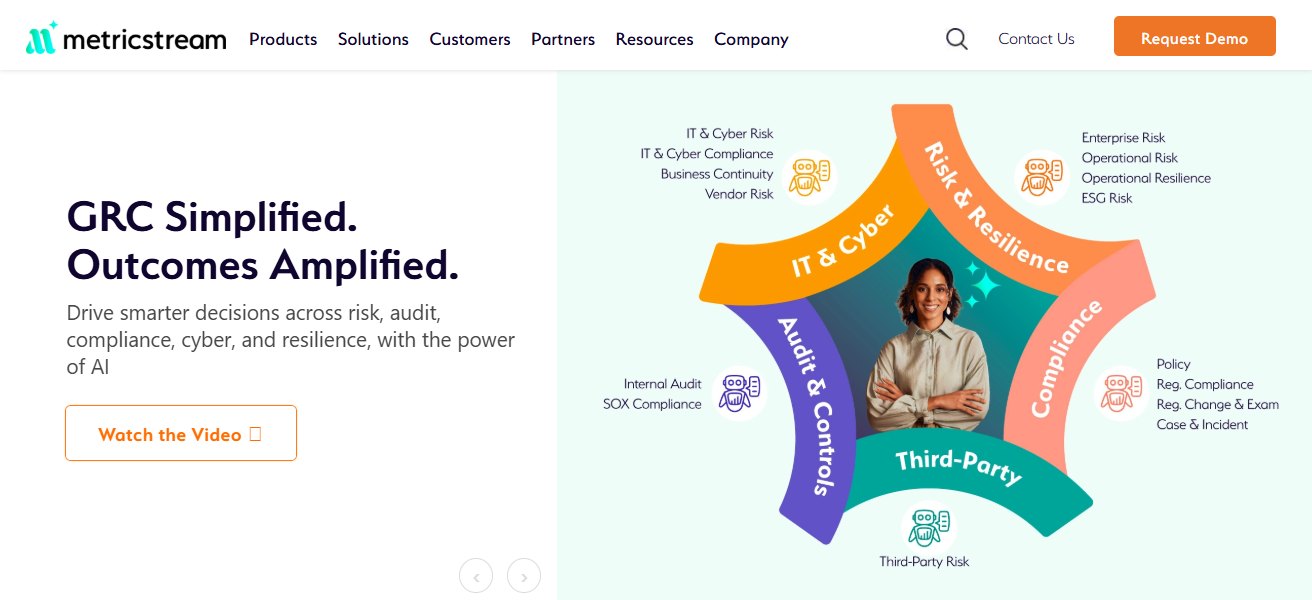
More recently, MetricStream added automation capabilities that help organizations with cybersecurity and third-party risk management as well as policy governance.
The enterprise-class architecture makes it highly relevant for banks, healthcare organizations, and multinational enterprises that deal with large compliance operations on a daily basis.
| Pros | Cons |
|---|---|
| Advanced AI analytics improve enterprise risk management visibility. | The user interface may feel outdated for modern users. |
| Highly scalable for multinational businesses and regulated industries. | Expensive pricing unsuitable for smaller organizations or startups. |
| Strong cybersecurity and third-party risk monitoring capabilities. | User interface may feel outdated for modern users. |
| Integrated governance tools centralize compliance operations efficiently. | Longer deployment timelines compared to lightweight compliance platforms. |
8. LogicGate Risk Cloud
LogicGate Risk Cloud can help organizations build comprehensive, customized governance and compliance workflows to meet the needs of their unique operational requirements.
The platform delivers flexible risk management automation and centralized compliance visibility—and is trusted by businesses.
LogicGate unites cybersecurity, operational risk, and vendor assessments all into one connected ecosystem for modern enterprises.

Conversations within the security community reveal that it is becoming increasingly important for modern DevSecOps and AppSec.
BBC Full-Sized allows companies to leverage the benefits of LogicGate’s no-code workflow builder, scalable integrations, and advanced reporting capabilities that all lead to better decisions with much less complexity around compliance.
| Pros | Cons |
|---|---|
| No-code workflow builder increases operational flexibility significantly. | Smaller businesses may underutilize the enterprise-level functionality available. |
| Centralized risk visibility improves compliance decision-making efficiency. | Smaller businesses may underutilize enterprise-level functionality available. |
| Scalable integrations support DevSecOps and AppSec environments effectively. | Pricing structure may become costly for expanding teams. |
| Customizable governance workflows fit unique organizational requirements perfectly. | Requires strategic planning for optimal workflow implementation success. |
9. Hyperproof
Hyperproof – Centralize evidence collection and tools to collaborate with auditors to help organizations operate compliance more efficiently.
Hyperproof provides value to businesses by diminishing the need for spreadsheet-based compliance management and enhancing communication with security teams, auditors, and stakeholders.

This platform is built to automate recurring tasks for gathering evidence pertaining to multiple compliance frameworks.
Hyperproof has gained great traction with mid-sized organizations looking for both scalability in compliance operations without an overscale of complexity.
Enterprises trust its capabilities to automate workflows, manage policy, and continuously monitor compliance across distributed business environments more easily.
| Pros | Cons |
|---|---|
| Simplifies evidence collection through centralized compliance management tools. | Limited advanced AI automation compared to market leaders. |
| Supports multiple compliance frameworks with automated monitoring capabilities. | Enterprise reporting customization could improve significantly further. |
| Improves collaboration between auditors and internal security teams. | Integration library is smaller than that of major compliance competitors currently. |
| Reduces spreadsheet dependency across compliance operations efficiently. | The integration library is smaller than that of major compliance competitors currently. |
10. ServiceNow
ServiceNow is the market leader in the worldwide enterprise IT governance, risk, and compliance management (GRCM) and workflow automation solutions markets.
Enterprise-level businesses utilize ServiceNow as an ecosystem to consolidate and integrate security operations, IT governance, risk assessment, and compliance management.
The infra, after all, does provide its own AI-powered workflows that help organizations reduce operational bottlenecks while improving incident response and audit readiness.
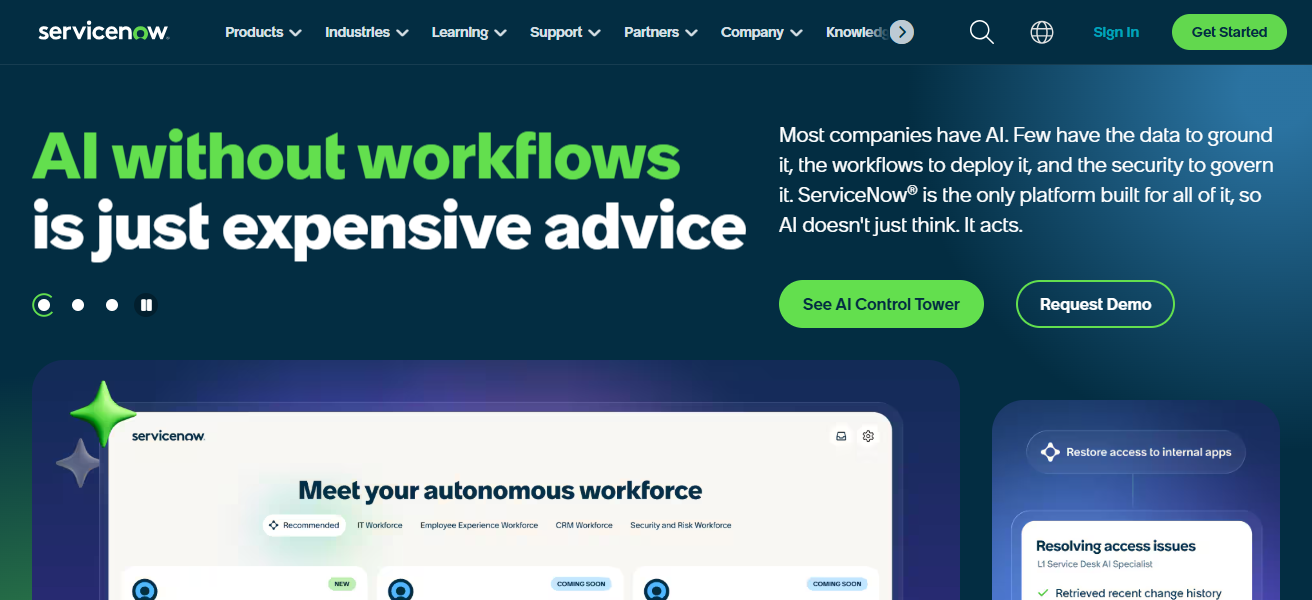
Discussions around cybersecurity are increasingly focused on the importance of ServiceNow for enterprise-scale AppSec and continuous compliance programs.
The enterprises like it for its scalability, advanced automation prowess, and how easily it integrates with the larger digital transformation strategy of global operations.
| Pros | Cons |
|---|---|
| Enterprise-scale automation streamlines governance and compliance operations globally. | Implementation complexity requires dedicated technical expertise frequently. |
| AI-powered workflows improve incident response and audit readiness. | Expensive licensing structure may challenge smaller organizations financially. |
| Integrates seamlessly with enterprise IT and security ecosystems. | Extensive features can overwhelm first-time platform users initially. |
| Highly scalable for multinational enterprise digital transformation initiatives. | Customization and maintenance may increase operational overhead costs. |
Conclusion
All said and done, Compliance software brands are changing the way businesses deal with security and governance, as well as regulatory requirements in 2026.
Platforms such as Vanta, Drata, and ServiceNow are made to make audits easy for the organization, so they may achieve their compliance goals while reducing risks and trimming down on operational burden.
To meet the rising worldwide compliance requirements, organizations are turning to AI-driven compliance solutions to enhance security posture, simplify certifications, and achieve ongoing compliance preparedness across data-rich digital environments.
FAQ
What is compliance software?
Compliance software helps businesses manage regulations, audits, security controls, and risk monitoring efficiently.
Why do companies use compliance automation tools?
Companies use them to reduce manual work, improve security, and simplify audit preparation processes.
Which compliance software is best for startups?
Vanta, Sprinto, and Secureframe are popular startup-friendly choices.
Which platform supports enterprise compliance management?
ServiceNow and MetricStream are widely trusted by large enterprises.