
In the Best Multi-Agent Orchestration Tools for Complex Workflows document, I will explain the changes occurring with the new AI automation systems.
The new systems allow multiple intelligent agents to work together to tackle problems and execute tasks.
These tools simplify difficult processes, improve productivity, and help scalable systems throughout industries for future AI. These tools apply from small startups to large enterprises.
Key Points & Best Multi-Agent Orchestration Tools for Complex Workflows
- LangGraph enables structured multi-agent workflows with stateful graph-based orchestration supporting cycles
- Microsoft AutoGen simplifies multi-agent conversation systems for collaborative task automation at scale
- CrewAI coordinates role-based agents for efficient workflow automation and delegation of tasks
- OpenAI Assistants API provides tool-using agents with persistent memory and orchestration support
- LangChain Agents enable flexible tool calling and multi-step reasoning pipelines execution flow
- Semantic Kernel integrates AI agents with plugins for an enterprise workflow orchestration layer
- SuperAGI delivers autonomous multi-agent frameworks for scalable task execution systems in production
- AutoGPT runs autonomous agents that break down goals into subtasks, iteratively planning
- Vertex AI Agent Builder creates scalable, production-ready multi-agent systems quickly deployed
- IBM WatsonX Orchestrate automates complex workflows using AI-driven agents, efficiently scaling
10 Best Multi-Agent Orchestration Tools for Complex Workflows
1. LangGraph
LangGraph is exciting developers because it builds multi-agent systems that enable complex workflows. These workflows can go beyond simple parallel processes.
They can include loops and memory. Developers leverage LangGraph to implement complex workflows, persistent memory systems, and branching logic.

Additionally, because LangGraph is integrated with LangChain, it is a great choice for workflows requiring a controlled orchestration of AI components, especially within production and enterprise environments.
| Feature | Description |
|---|---|
| Stateful Graph Orchestration | stateful graph orchestration enables cyclical workflows and persistent agent memory handling contexts |
| Branching Logic Support | supports branching logic enabling complex decision trees and adaptive execution flows in a system |
2. Microsoft AutoGen
Microsoft AutoGen is a multi-agent system that supports AI systems built on top of multiple interacting agents.
It implements a programming model where agents improve and critique the quality of the output via dynamic conversation.
It has recently been used in enterprise automation and in software development, and in research assistance.

Also, because of its design, it is extensible and integrates with different tools, APIs, and LLMs. For that reason, it is an appealing automation platform to build intelligent systems for startups.
| Feature | Description |
|---|---|
| Multi-Agent Conversations | multi-agent conversation framework enabling collaborative reasoning and iterative refinement processes at scale |
| Tool & API Integration | integrates tools APIs, allowing agents to critique and improve outputs dynamically and quickly |
3. CrewAI
CrewAI has thought about role-based multi-agent orchestration. In this case, AI agents are assigned the roles of being a researcher, a producer, or an analyst.
This workforce structure improves clarity of workflow and the efficiency of task distribution. It has gained traction in content generation, business intelligence, and automation pipelines.
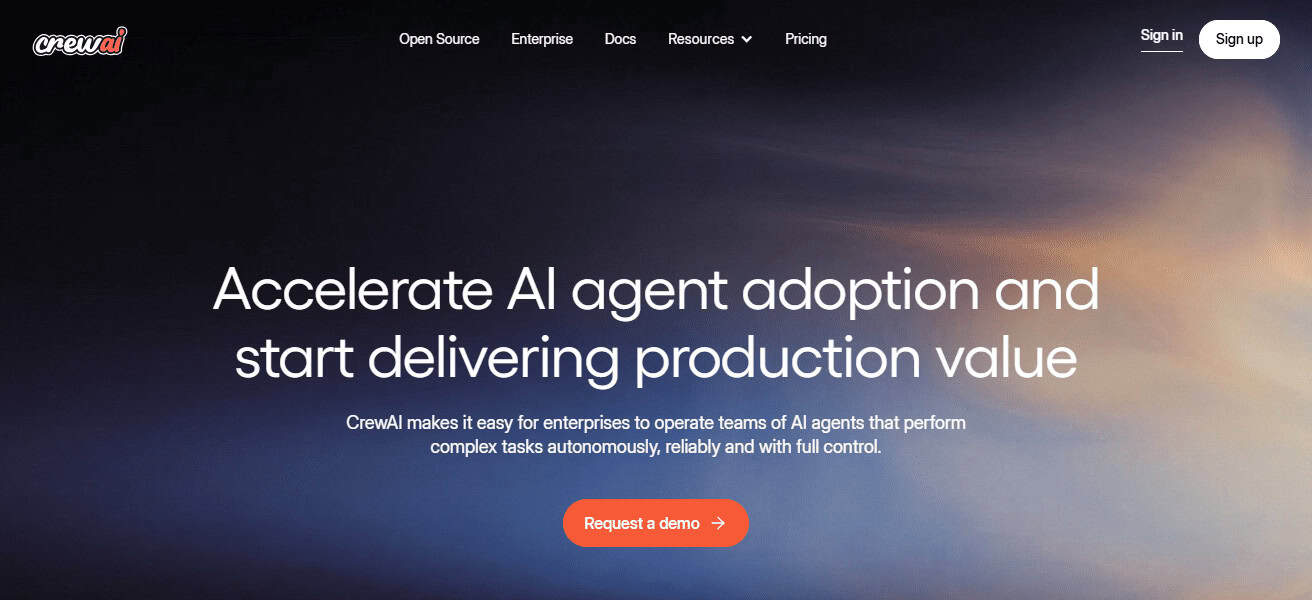
Due to its lightweight setup and solid compatibility with modern LLMs, CrewAI allows startups to build AI teams that are aligned, operate organizationally, and that humans. This increases productivity and automates the execution of custom tasks at scale.
| Feature | Description |
|---|---|
| Role-Based Delegation | role-based agent delegation improves structured teamwork across AI workflows efficient task execution |
| Lightweight Orchestration | lightweight framework supports rapid multi-agent deployment and orchestration systems for production-ready use |
4. OpenAI Assistants
OpenAI Assistants API offers a bounded environment for the construction of tool-using AI agents that have memory, function calling, and retrieval abilities.
It simplifies multi-agent orchestration by embedding reason, file handling, and API use into the workflows of developers.

The constructor has recently updated features that enhance persistence as well as the use of tools. This makes it quite effective for the construction of customer support bots, research bots, and workflow automation solutions.
Its reliability and large-scale applicability make it the best choice for the construction of production-grade AI solutions across industries.
| Feature | Description |
|---|---|
| Tool Calling & Memory | built-in tool calling enables persistent memory and structured function execution capabilities layer |
| File & API Support | supports file retrieval API integration for advanced contextual reasoning workflows at scale |
5. LangChain Agents
LangChain Agents support the automation of reasoning workflows, in which AI decides what tools to employ and when.
It supports chaining multiple, distinct operations that include the search, the execution of arithmetic, and data retrieval.

With recent improvements, LangChain now possesses many features, including improvements in memory, controlled, structured output, and the collaboration of multiple agents.
It is a system that supports the rapid construction of intelligent assistants, automation solutions, and complex data integration systems.
For the rapid construction of sophisticated AI orchestration solutions, it is best suited for early-stage companies.
| Feature | Description |
|---|---|
| Dynamic Reasoning Engine | dynamic reasoning enables tool selection for multi-step task execution pipelines efficiently designed |
| Ecosystem Integration | extensive ecosystem supports memory, tools, and integrations for AI applications at scale |
6. Semantic Kernel
Semantic Kernel is an AI orchestration framework developed by Microsoft that targets the enterprise vertical.
It affords planners the ability to divide complex tasks into smaller, executable steps to be performed by agent AIs.
Two of its most recent upgrades include improved memory connectors and support for multiple models at the same time.

Businesses have adopted it for automation of workflows, productivity applications, and intelligent decision capture systems.
Its deep integration with enterprise systems makes it a prime candidate for instances of AI that require security and scale.
| Feature | Description |
|---|---|
| Enterprise Orchestration | enterprise AI orchestration connects models with plugins and external services secure integration |
| Task Planning System | decomposes complex tasks into structured executable steps efficiently at scale |
7. SuperAGI
SuperAGI is an open-source framework for the development of autonomous self-improving AI systems. It facilitates the simultaneous collaboration of multiple agents in a feedback-driven, task-executing framework.

SuperAGI’s memory for agents, integration of tools, and deployment to the cloud have extended its attraction to more automation-centric workflows.
It is a useful framework for startups that want to operate autonomously by building systems that scale and thus continuously enhance the performance and efficiency of the system.
| Feature | Description |
|---|---|
| Autonomous Agent System | autonomous agent framework enables self-learning and task automation workflows continuous improvement loop |
| Scalable Deployment | supports cloud deployment, memory tools, and scalable agent coordination a production-grade system |
8. AutoGPT
AutoGPT is believed to be the first autonomous agent framework that popularized AI task decomposition based on goals set by users.
AutoGPT can break down the high-level goals set by users into smaller tasks and execute them step by step by making use of the reasoning capabilities of a large language model.
Although it was an early experimental project, AutoGPT inspired the modern orchestration frameworks we see today.
It is particularly useful for the automation of research, content generation, and the creation of experimental AIs.
Its self-prompting and self-correcting capabilities are part of the foundations of many multi-agent systems we see today.
| Feature | Description |
|---|---|
| Goal Driven Agents | goal-driven autonomous agents break tasks into iterative subtask execution self prompting system |
| Recursive Reasoning | Self-prompting architecture enables recursive reasoning and task automation loops in an experimental AI framework |
9. Vertex AI
Google Vertex AI is a reliable managed service for developing, deploying, and scaling multi-agent AI systems. It integrates model development, orchestration, and MLOps Pipelines.
Vertex AI’s recent improvements center around generative AI and include tools to construct agents and automate workflows.
The platform is ideal for predictive analytics, chatbots, and intelligent applications. Its infrastructure is designed to optimize the performance, security, and seamless integration of Google Cloud services.
| Feature | Description |
|---|---|
| Managed AI Platform | managed AI platform supports scalable model deployment and orchestration pipelines cloud native |
| MLOps Automation | Integrated MLOps tools enable an end-to-end machine learning workflow automation and an enterprise-ready system |
10. IBM WatsonX
AI platform watsonx is built for the next generation of automation and multi-agent orchestration for the enterprise. Watsonx combines governance and foundation models to offer workflow orchestration.
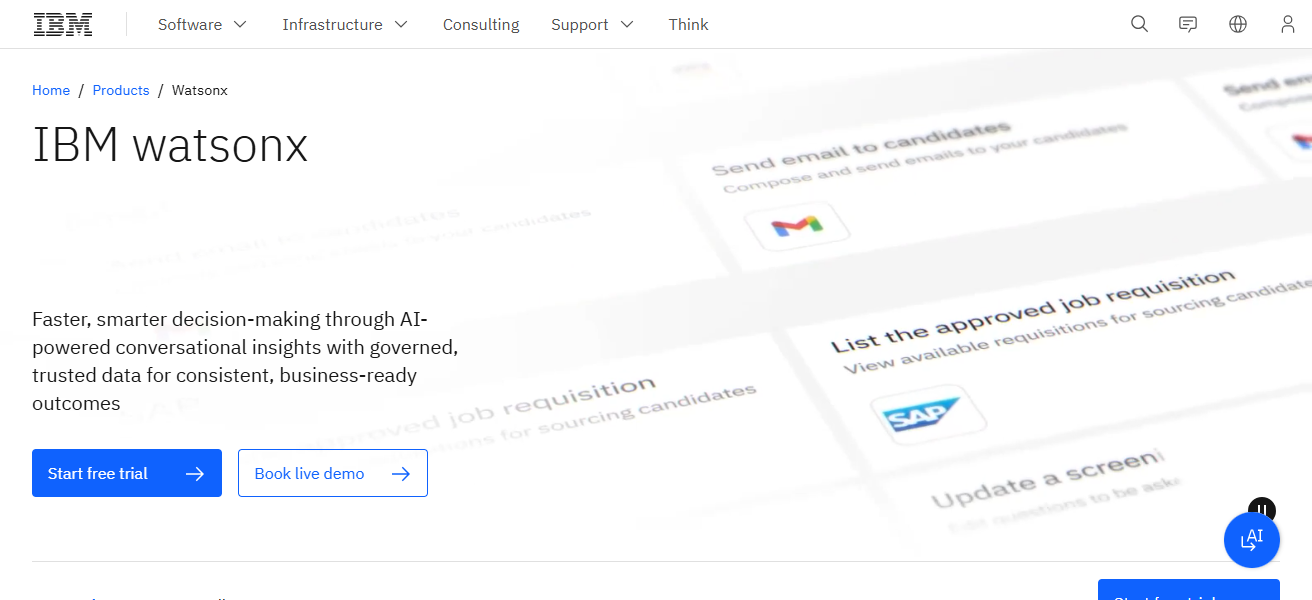
The platform is used to create intelligent agents to automate data-intensive decision processes. Watsonx is designed to meet the demands of the most stringent industries with its focus on Compliance, Security, and Transparency.
Automated workflows and enterprise-scale transformation continue to strengthen IBM’s focus on AI with watsonx.
| Feature | Description |
|---|---|
| Enterprise AI Governance | enterprise AI platform combines governance foundation models and orchestration secure compliant system |
| Intelligent Automation | enables intelligent automation with strong compliance and data transparency for regulated enterprise use |
Conclusion
In closing, multi-agent orchestration tools are changing the way artificial intelligence systems work with increased efficiency. Intelligent agents are capable of combining their abilities to automate and manage complex contexts.
These tools come in a range of technologies, from sourceless to enterprise products. The evolution of AI systems means these tools will help create adaptable and potent automated systems globally.
FAQ
What are multi-agent orchestration tools?
They coordinate multiple AI agents to complete complex tasks collaboratively.
Why are these tools important for startups?
They automate workflows, reduce workload, and improve productivity efficiently.
Which tool is best for beginners?
CrewAI and LangChain Agents are easiest for beginners.
Is LangGraph better than LangChain?
LangGraph is better for complex, stateful, graph-based workflows.
What is Microsoft AutoGen used for?
It enables AI agents to collaborate and solve problems conversationally.