
In this post, I explore the Legal Brands Investors Are Betting On In 2026 — how innovations in AI, automation, and digital transformation are changing existing law firms/corporate legal services organisations into leading companies.
You will learn why platforms such as Clio, Ironclad, and Harvey—as well as others that are disrupting how legal workflows function, how contracts get managed with utmost care, or using AI for intelligent decision-making across global markets, supported by a strong push from investors.
Key Poinst & Legal Brands Investors Are Betting On In 2026
Clio provides cloud legal practice management software trusted by global law firms.
Ironclad automates contract lifecycle management, helping enterprises streamline legal document workflows efficiently.
Harvey delivers AI-powered legal assistant tools transforming research, drafting, and litigation workflows.
Legora offers a collaborative AI legal platform improving research, drafting, and case workflows globally.
Everlaw provides a cloud litigation platform enabling document review, discovery, and legal analytics solutions.
Darrow uses AI to detect legal violations and uncover high-value litigation opportunities globally.
Evisort delivers AI contract intelligence software automating document extraction, analysis, and compliance tracking.
LegalOn Technologies LegalOn Technologies specializes in AI contract review tools, improving legal accuracy and efficiency.
Kalshi is a regulated prediction market platform enabling trading on legal and economic outcomes.
Cyril Amarchand Mangaldas Cyril Amarchand Mangaldas is a leading Indian law firm advising major corporate and investment transactions.
10 Legal Brands Investors Are Betting On In 2026
1. Clio
Today, Clio is the global leader in legal practice management software and supports over 150,000 legal professionals across more than 130 countries.
Investors believe it can expand into AI-assisted legal workflows after its landmark purchase of vLex – a source of more than 1 billion documents for research intelligence – in 2026.
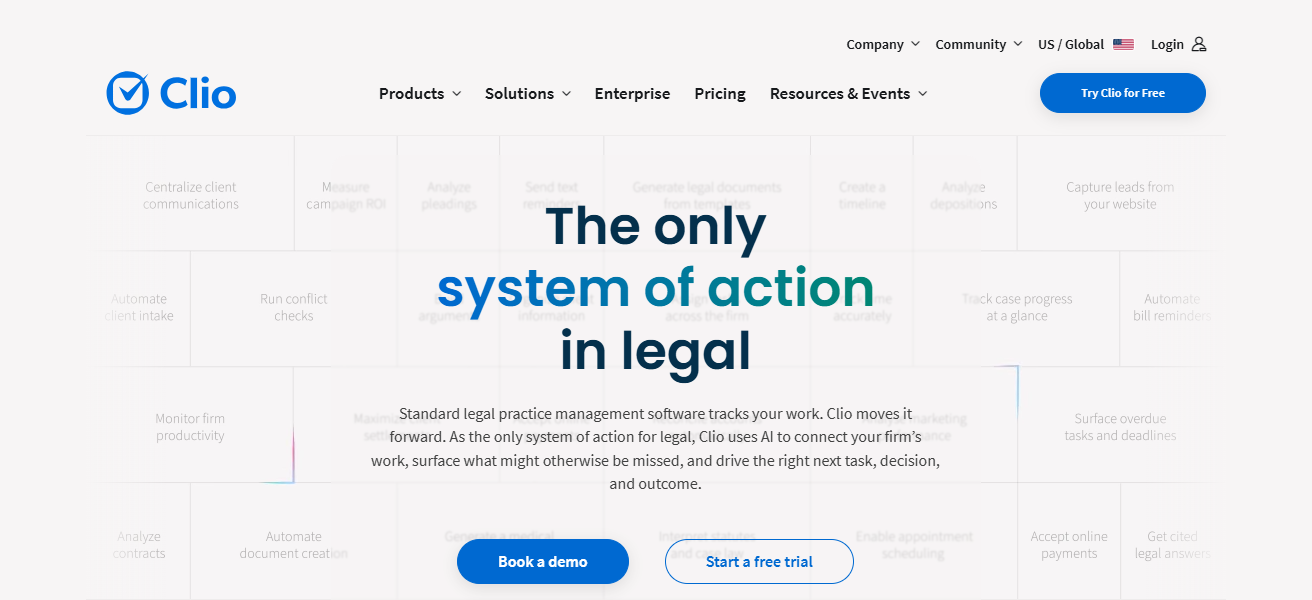
Clio has evolved from practice management into a full-stack legal operating system, stitching together billing, case management, and AI-driven legal research into a combined cloud ecosystem.
| Pros | Cons |
|---|---|
| All-in-one legal practice management platform | Can feel complex for small solo practitioners |
| Strong AI integration after vLex acquisition | Advanced features require higher pricing tiers |
| Trusted globally across 130+ countries | Heavy dependency on cloud connectivity |
| Excellent billing and case management tools | Customization still limited for niche workflows |
2. Ironclad
Ironclad helps you redefine your Contract Lifecycle Management with high-quality AI-driven automation trusted by the Fortune 500s.
Investors are betting on its potential to replace manual contract workflows with systems that automatically draft, negotiate, and track compliance contracts as far out as 2026.

Ironclad is a new breed of contract lifecycle management software that was founded by former law and engineering specialists and has continued to expand as enterprises call for faster deal cycles on top of risk reduction demands.
Its integration with enterprise systems is what makes it the centerpiece infrastructure layer of new-age digital contracting.
| Pros | Cons |
|---|---|
| Powerful AI-driven contract lifecycle automation | Enterprise pricing can be expensive |
| Reduces manual contract drafting time significantly | Learning curve for non-technical legal teams |
| Strong enterprise integrations (CRM, ERP systems) | Less suitable for small law firms |
| Trusted by Fortune 500 companies | Implementation may take time |
3. Harvey
In 2026, Harvey is one of the most discussed legal AI platforms, powered by OpenAI and leading venture capital funds.
The AI assistant is quickly becoming the go-to tool for corporate legal departments and large law firms.

Jon Hirst is an investing on its multi-agent system managing and executing research, drafting, litigation prep, and contract analysis.
Dominating the global law firm landscape in adoption, Harvey has become the “AI lawyer copilot” to transform elite legal workflows.
| Pros | Cons |
|---|---|
| Advanced AI legal assistant backed by OpenAI | Still evolving, not fully error-free |
| Supports research, drafting, litigation prep | High demand may limit access for smaller firms |
| Strong adoption among elite law firms | Requires careful human verification |
| Multi-agent AI workflow system | Dependent on data quality and prompts |
4. Legora
Legora is a high-growth legal AI startup rapidly scaling its footprint in Europe and the USA. Investors are drawn to its collaborative workspace for AI that combines document review, bottom-up research, and draft mode in a single interface.

Coming into 2026, Legora appears to be continuing to build traction among mid-to-large-sized law firms looking for alternatives to legacy legal software.
This growth in valuation illustrates a growing demand for AI tools that offer workflow automation alongside live legal intel.
| Pros | Cons |
|---|---|
| Collaborative AI legal workspace | Still building global brand trust |
| Integration ecosystem is still expanding | Limited long-term track record |
| Flexible and modern interface | Competes with larger established platforms |
| Strong workflow automation tools | The integration ecosystem is still expanding |
5. Everlaw
Perhaps most importantly, Everlaw stays strong at the top of the pile as a leading cloud-native eDiscovery and litigation technology platform.
Investors are betting that by 2026, it will transform how gigantic documents are reviewed for litigation and regulatory cases.

It’s an indispensable tool for legal discovery workflows thanks to its AI-powered search, narrative building, and case collaboration features.
The fact that so many government agencies and law firms are using it also reflects its status as a reliable litigation infrastructure platform.
| Pros | Cons |
|---|---|
| Industry leader in eDiscovery solutions | Focus mainly on litigation use cases |
| Powerful AI document review tools | Can be expensive for small firms |
| Strong government and enterprise adoption | Steep learning curve for beginners |
| Excellent case collaboration features | Limited broader legal practice tools |
6. Darrow
Investors are showing interest in Darrow’s AI-powered legal intelligence platform, which can identify unnoticed violations and litigation opportunities.
It shows that way, 2026 is special for transforming raw data to actionable litigation, particularly class action, and compliance.
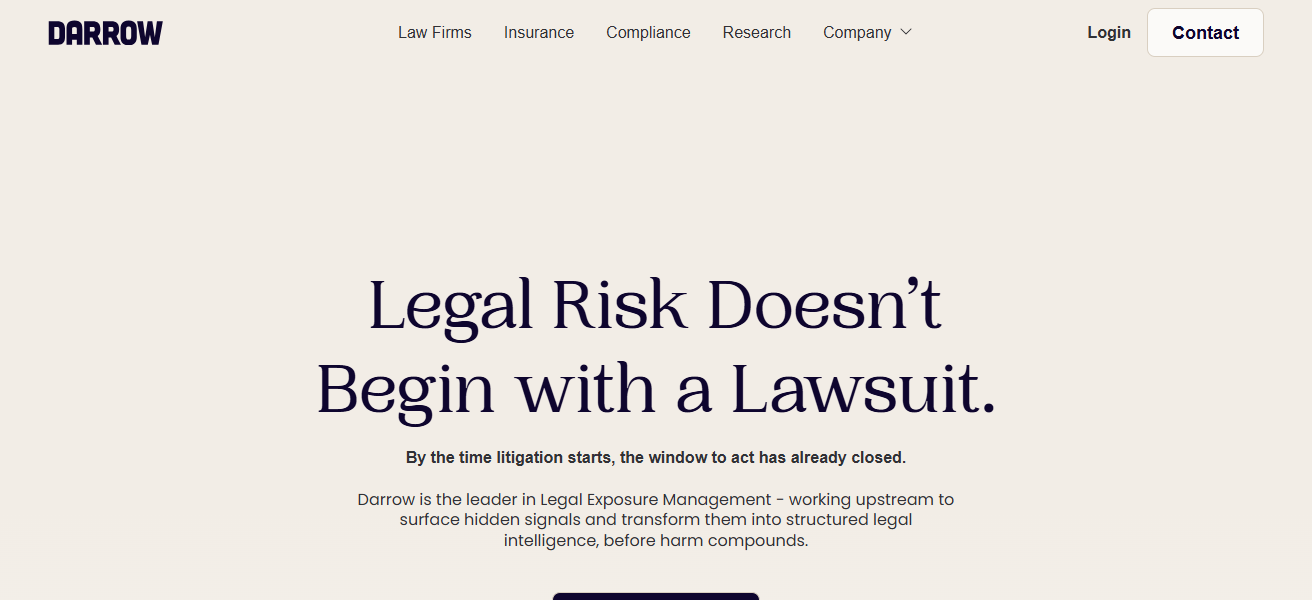
Predictive Legal Analytics its model that helps law firms in early identification of high-value lawsuits. To the investors, Daree is Rocket — a revolutionary legal data mining and proactive litigation discovery technology.
| Pros | Cons |
|---|---|
| AI detects hidden legal violations early | Highly dependent on data availability |
| Creates new litigation opportunities | Still niche and evolving market |
| Strong predictive legal analytics | Requires legal validation before use |
| Attractive for class-action firms | Still a niche and evolving market |
7. Evisort
Evisort is the AI contract intelligence leader that is focused on document extraction automation, compliance, and contract analytics.
By 2026, demand from enterprise adoption within legal and procurement teams will drive greater investor interest.

This allows its AI system to review thousands of contracts in the space of seconds, rather than relying on a manual process.
Having started to serve enterprise SaaS ecosystems more broadly, Evisort becomes a dominant player in the areas of contract lifecycle intelligence and risk management automation.
| Pros | Cons |
|---|---|
| Fast AI contract analysis at scale | Enterprise-focused pricing model |
| Reduces manual contract review workload | Limited small business usability |
| Strong compliance automation features | Requires clean data for best performance |
| Integrates with enterprise SaaS systems | Customization can be complex |
8. LegalOn Technologies
LegalOn Technologies has raised $30.2m of funding from investors to expand a legally focused as-a-middleman service powered by legal Artificial Intelligence ( AI ) and locate its origin in the global expansion space.
By 2026, it is known for its AI-powered contract review systems used by thousands of businesses and law firms globally.

Its platform offers faster, contextual legal contract analysis and custom legal playbooks. Investors are banking on its blistering global growth and aggressive embedding of generative AI into enterprise legal processes and compliance tools.
| Pros | Cons |
|---|---|
| High-accuracy AI contract review system | Less known in Western markets |
| Strong global expansion strategy | Competition from larger AI legal firms |
| Custom legal playbooks for enterprises | Requires onboarding and training |
| Trusted by thousands of companies | Less well-known in Western markets |
9. Kalshi
Kalshi is the first regulated prediction market platform that enables users to buy and sell outcomes in the real world, even around economic or regulatory events.
In 2026, investors see a contorting financial-legal hybrid platform that seamlessly connects markets to law and forecasting.

It’s a unique product in the space of betting and prediction economy, primarily due to its regulated structure within the US.
Most types of institutional participants at Kalshi are using the platform for risk assessment, policy forecasting, and macroeconomic prediction modeling.
| Pros | Cons |
|---|---|
| Regulated prediction market platform | Market adoption still developing |
| Unique legal + financial forecasting model | Limited event categories in some regions |
| Strong institutional interest | Regulatory scrutiny risk |
| Useful for risk and policy forecasting | Not a traditional legal tech tool |
10. Cyril Amarchand Mangaldas
Cyril Amarchand Mangaldas is one of the leading national law firms in India, assisting in corporate law, mergers, and related regulatory advisory.
In 2026, this is attractive to both investors and global clients alike, demonstrating an increasing level of integration with legal technology, FINRA compliance, and AI-assisted workflows in high-value transactions.
The firm advises large domestic and international corporations, consolidating its presence in the Indian legal market.
As a result, no time to waste; innovation focus and institutional brand lead it to the solid legal advisor powerhouse in Asia.
| Pros | Cons |
|---|---|
| Top-tier Indian corporate law firm | Services mainly India-focused |
| Strong reputation in mergers & acquisitions | High-cost advisory services |
| Increasing use of legal tech tools | Not a product-based legal tech platform |
| Trusted by global corporations | Limited accessibility for small clients |
Conclusion
To sum up, the legal brands like Clio(FindLaw), Ironclad, Harvey, Legora Everlaw, Darrow, Evisort LegalOn Technologies, Kalshi, Cyril Amarchand Mangaldas are really transforming the delivery of legal services represented by AI automation, data, and intelligence table stakes.
These platforms are attracting significant investment as the demand for quicker, smarter, and more efficient legal workflows increases.
Together, they embody the future of legal services; a synergy of technology, compliance, and innovation aligned with macro trends in international markets.
FAQ
What legal brands are investors betting on in 2026?
They are AI-powered legal tech and law firms transforming legal workflows, automation, contracts, and research globally.
Why is Clio attracting investors in 2026?
Clio is expanding into AI legal workflows and unified practice management systems with global adoption growth.
What makes Ironclad popular among enterprises?
Ironclad automates contract lifecycle management, reducing manual work and improving deal speed for large companies.
How is Harvey changing the legal industry?
Harvey uses advanced AI to assist with legal research, drafting, litigation preparation, and contract analysis.