In this article, I will describe the Best Crypto APIs for On-Chain Data and Blockchain Analytics. I want to help developers, businesses and blockchain lovers pick the right solution. You will discover key features for each API, the networks each
API supports, pricing, pros and cons, and the most suitable use cases for each API. This guide should help you compare the top API solutions for building Web3 applications. These applications can be built easily, securely, and at scale.
What Are Crypto APIs for On-Chain Data?
Crypto APIs enable developers to mine and analyze data permanently inscribed on blockchain networks. There is a lot on chain data that is not practical to extract unless you run a full node on the particular blockchain network.
These APIs reduce the burden on developing a Web3 by providing a practical means to access a variety of data. You can just call the API and get data. Crypto APIs also help you to customize the scalability and retrieval frequency of the data to meet the demands of your application.
How To Choose Best Crypto APIs for On-Chain Data and Blockchain Analytics
- Determine Your Blockchain Needs – Understand the use case and data needs of your project and choose the relevant API.
- Analyze Supported Blockchains – Make sure the API provides access to the required blockchains, for example, Ethereum, Solana, Polygon, BNB Chain, etc.
- Examine the Different Pricing Models – Take a look at the paid and free plans and the features associated and request thresholds considering your budget.
- Determine the API Flexibility – Make sure the API you choose can handle greater traffic and work at an enterprise level.
- Diagnose the API Documentation – Make sure the API provides clear documentation, guides and code snippets.
- Consider Availability and Speed – Choose an API that provides the required services with good speed and availability.
- Investigate the Developer Experience – Analyze the free plan and see how fast the API is and how seamless the integration is from a development standpoint.
Key Points & Best Crypto APIs for On-Chain Data and Blockchain Analytics
| Crypto API | Explanation |
|---|---|
| Moralis API | Provides real-time blockchain data, wallet tracking, NFTs, and cross-chain analytics for developers. |
| Alchemy API | Delivers scalable blockchain infrastructure, enhanced APIs, reliable node access, and analytics tools. |
| QuickNode API | Offers high-performance blockchain nodes, fast RPC requests, and comprehensive on-chain data services. |
| Infura API | Enables secure Ethereum access, decentralized application connectivity, reliable infrastructure, and blockchain analytics. |
| Covalent API | Aggregates multi-chain blockchain data through unified APIs for powerful analytics and reporting needs. |
| Bitquery API | Supplies advanced blockchain indexing, SQL-like queries, real-time analytics, and transaction monitoring capabilities. |
| Blockchair API | Supports blockchain search, address exploration, transaction tracking, and detailed network statistics globally. |
| Glassnode API | Provides institutional-grade on-chain metrics, market intelligence, and blockchain analytics for investors worldwide. |
| Dune Analytics API | Enables custom blockchain dashboards, SQL queries, visual analytics, and comprehensive ecosystem insights efficiently. |
| Token Terminal API | Delivers crypto financial metrics, protocol revenue analytics, valuation insights, and performance comparisons. |
10 Best Crypto APIs for On-Chain Data and Blockchain Analytics
1. Moralis API
Moralis API is one of the most complete blockchain developer solutions for retrieving real-time cross-network on-chain data. It is incredibly easy to use for developers, REST APIs, on-chain wallet tracking, NFT metadata, token balances, transaction histories, and DeFi data.
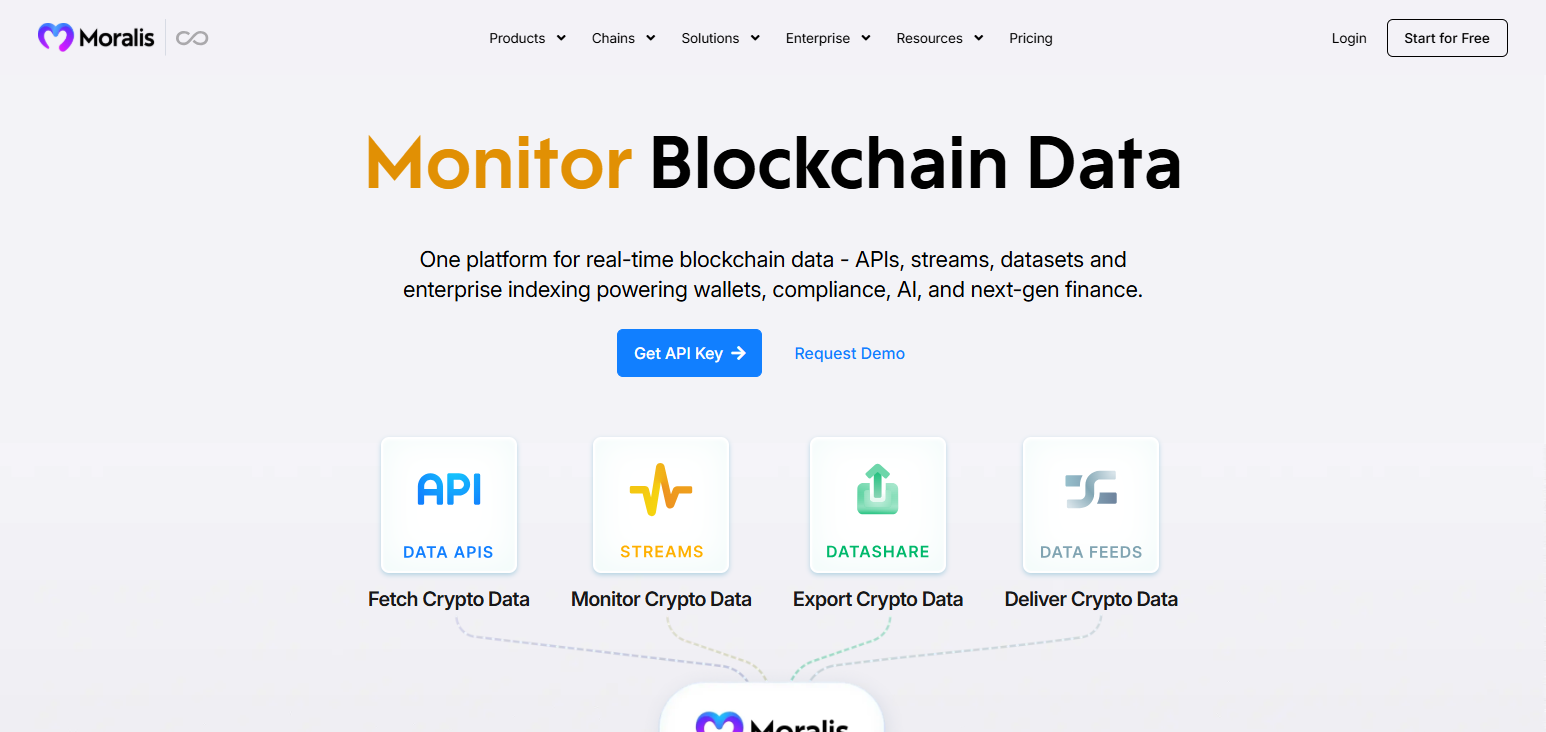
It is compatible with popular blockchains like Ethereum, Polygon, BNB Chain, and Solana. With Moralis, developers will build wallet and portfolio trackers, blockchain explorers, Web3 apps, and more in no time. It allows developers to build quickly and easily with low latency required for modern dApps.
Moralis API – Key Features
- Enabling tracking wallet balance and transactions in real-time across multiple blockchains.
- Cross-chain support for Ethereum, Solana, Polygon, and BNB Chain.
- APIs for NFT metadata, NFTs ownership and marketplaces.
- REST APIs and a Cloud backend built for speed and scalability.
- DeFi integrations with token pricing and portfolio analytics.
| Pros | Cons |
|---|---|
| Supports multiple blockchain networks through one API. | Advanced features require premium subscription plans. |
| Excellent NFT and DeFi data support. | Free tier includes usage limitations. |
| Easy REST API integration for developers. | Some niche blockchains receive updates later. |
| Real-time wallet and token tracking. | Enterprise pricing may be expensive for startups. |
| Comprehensive Web3 development toolkit. | Learning advanced APIs takes time. |
2. Alchemy API
Alchemy API is one of the most trusted and used blockchain infrastructures among developers. Alchemy provides very reliable node services, boosted RPC APIs, blockchain indexing, and real-time monitoring for Ethereum and many Layer 2 blockchains.
The developer experience is improved dramatically with simulated transactions, advanced debugging, and analytics.
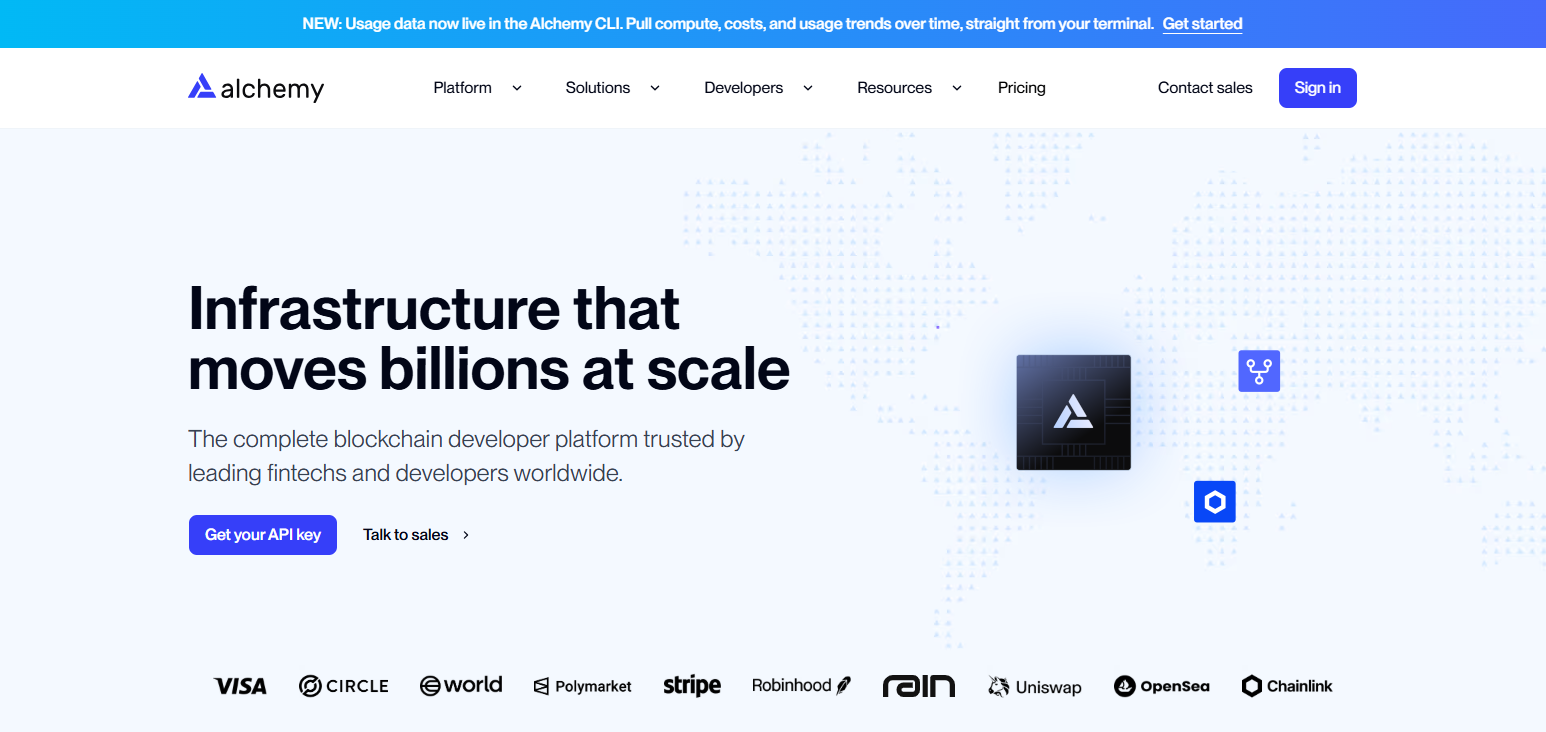
Alchemy’s enterprise infrastructure drastically reduces downtime and directly improves the performance of blockchain applications, making it a perfect solution for scalable DeFi applications, NFT marketplaces, blockchain games, and on-chain analytics.
Alchemy API – Key Features
- Provides premium, high performance blockchain nodes with great uptime.
- Enhanced RPC APIs for accelerated interaction with a blockchain.
- Real-time monitoring of blockchain events with webhooks.
- Advanced tools for transaction simulations and debugging.
- Ethereum and Layer-2 networks and Web3 scaling are supported.
| Pros | Cons |
|---|---|
| Highly reliable enterprise-grade infrastructure. | Best features available on paid plans. |
| Powerful debugging and developer tools. | Primarily optimized for Ethereum ecosystem. |
| Fast RPC performance and scalability. | Complex features may overwhelm beginners. |
| Excellent documentation and SDK support. | Request limits apply on free accounts. |
| Real-time monitoring and webhooks. | Pricing increases with heavy API usage. |
3. QuickNode API
QuickNode API is an extremely fast blockchain node infrastructure aimed for applications with high transaction demands and low latency requirements. Developers can quickly connect to dozens of blockchains and optimized RPC and WebSocket.

Access to standard nodes has expanded for QuickNode with blockchain indexing, NFT and token APIs, and developer tools to streamline Web3 Development.
With its excellent global coverage and uptime, QuickNode is ideal for crypto exchanges, wallets, blockchain explorers, trading apps, and enterprise blockchain analytics.
QuickNode API – Key Features
- Extremely fast RPC and WebSocket access.
- Global nodes for low latency performance.
- NFT, token and blockchain indexing APIs.
- Enterprise level security and infrastructure.
- Supports the vast majority of blockchain ecosystems.
| Pros | Cons |
|---|---|
| Extremely low-latency blockchain access. | Premium plans can become costly. |
| Supports numerous blockchain networks. | Some advanced add-ons require extra payment. |
| Strong global infrastructure coverage. | Free plan offers limited requests. |
| Easy deployment and setup. | Analytics features are less extensive than competitors. |
| Excellent uptime for production applications. | Custom enterprise solutions require higher budgets. |
4. Infura API
Infura API assists developers creating Ethereum-based dApps by providing a seamless way to link their applications to the Ethereum blockchain.
Infura provides developers with API endpoints and the ability to connect to the IPFS and various layer 2 solutions, all without requiring developers to run and maintain their own nodes.
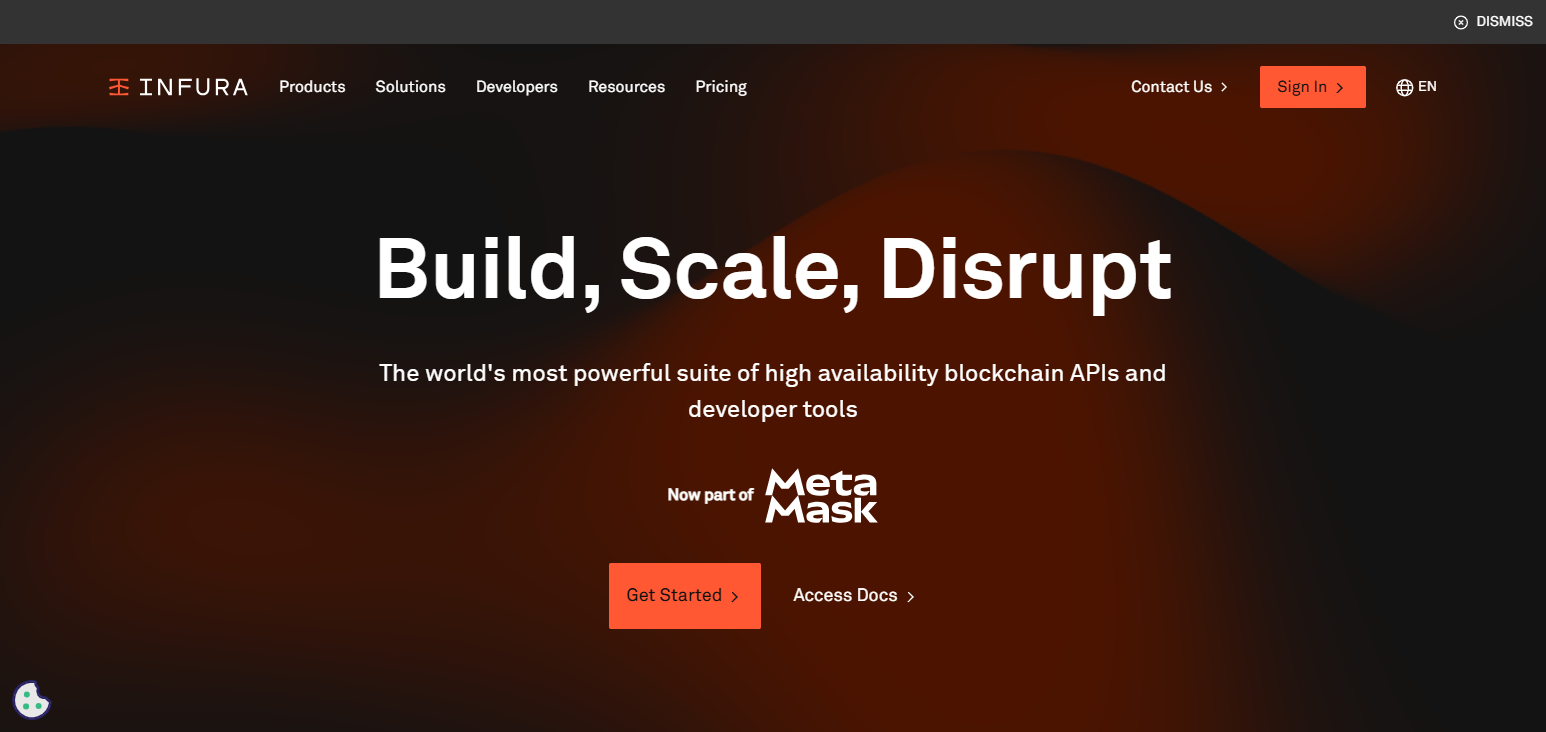
Every day, Infura processes millions of requests with industry-leading security and uptime. Startups and enterprises can build applications like wallets, DeFi applications, NFT marketplaces, and even dedicated blockchain analysis tools, all with guaranteed access to decentralized networks.
Infura API – Key Features
- Services dependable infrastructure for Ethereum and IPFS.
- No need to maintain your own blockchain nodes.
- High availability with enterprise level scalability.
- Supports Ethereum Layer-2 and distributed storage.
- Simple integration with dApps, wallets and NFT services.
| Pros | Cons |
|---|---|
| Trusted Ethereum infrastructure provider. | Limited native support for some blockchains. |
| No need to manage blockchain nodes. | Heavy reliance on centralized infrastructure. |
| High uptime and performance. | Advanced analytics are limited. |
| Supports IPFS integration. | Free plan includes request quotas. |
| Easy integration with popular wallets. | Enterprise features require paid subscriptions. |
5. Covalent API
Covalent API presents blockchain analytics in a easy and simple manner. It has consolidated unstructured on-chain data across multiple blockchain networks and made it structured and accessible through a single API.
There is no longer a need for developers to make separate requests to multiple blockchains for basic information such as wallet balances, transaction histories, NFTs, tokens, and even decentralized finance (DeFi) positions.

Not only does this save a substantial amount of time, but it also is far superior to the previous methods for building cross chain analytics.
It is for these reasons Covalent has taken the lead in constructing portfolio trackers, blockchain analysis tools, crypto tax computation applications, business intelligence dashboards, and multiplayer analytics tools.
Covalent API – Key Features
- One API to access multiple blockchains.
- Standardization of wallets, NFTs and tokens.
- Historical blockchain data and detailed indexing.
- Cross-chain portfolio and DeFi analytics.
- Blockchain reporting and BI made easy.
| Pros | Cons |
|---|---|
| Unified API across multiple blockchains. | Data updates may occasionally experience delays. |
| Excellent historical blockchain data. | Premium features require paid plans. |
| Simplifies cross-chain development. | Limited customization for specialized queries. |
| Ideal for portfolio analytics. | Some blockchain coverage varies by network. |
| Well-structured standardized responses. | Documentation may require careful reading. |
6. Bitquery API
Bitquery API is a leader in advanced blockchain indexing. It combines blockchain intelligence with data querying capability, all via a flexible interface where GraphQL meets SQL. Developers have the ability to interrogate almost any on-chain data including wallet and token transfers, decentralized exchanges, smart contracts
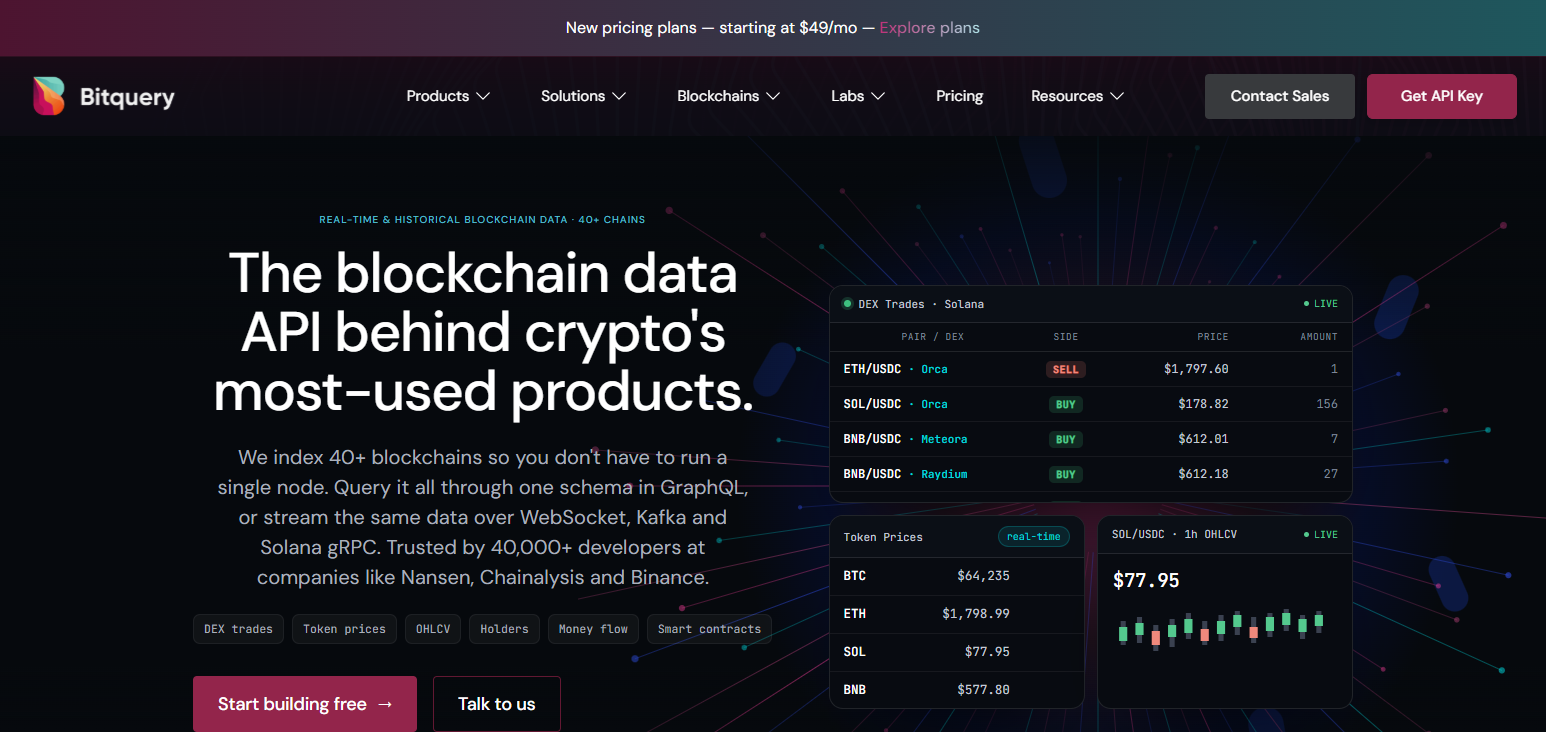
NFTs, and blockchain events with a high degree of flexibility and even real-time monitoring of on-chain events across multiple networks. Bitquery API is also frequently used in data analysis and compliance projects for trading, research, and blockchain technology.
Bitquery API – Key Features
- Advanced blockchain queries via powerful GraphQL and SQL.
- Subscription based real-time blockchain event queries.
- Advanced analytics for smart contracts and tokens.
- Cross-chain transaction monitoring.
- Designed for compliance and blockchain research.
- Transaction monitoring for various blockchains.
| Pros | Cons |
|---|---|
| Powerful blockchain querying capabilities. | GraphQL queries have a learning curve. |
| Excellent real-time blockchain monitoring. | Premium pricing for high-volume usage. |
| Supports multiple blockchain ecosystems. | Beginners may find configuration challenging. |
| Advanced smart contract analytics. | Free tier has request limitations. |
| Ideal for compliance and research. | Complex queries may affect response costs. |
7. Blockchair API
Blockchair API functions as a detailed blockchain search engine, enabling access to addresses, transactions, blocks, tokens, and blockchain statistics, for a number of leading cryptocurrencies. Blockchair’s API is developer-friendly, allowing the easy retrieval of historical network data and address balance lookups.
Blockchain data is easy to access with Blockchair’s indexed, transparent, and advanced-search filtering system. Due to its ability to provide precise historical data, Blockchair is frequently integrated into blockchain explorers, cryptocurrency wallets, research and compliance systems, and blockchain monitoring applications.
Blockchair API – Special Features
- Multi-cryptocurrency blockchain explorer.
- Search transactions and addresses with ease.
- Comprehensive search and filtering for blockchains.
- Metrics and statistics for various blockchains.
- Easy-to-use REST API with clear data.
| Pros | Cons |
|---|---|
| Rich historical blockchain information. | Limited advanced analytics compared to competitors. |
| Supports multiple cryptocurrencies. | Real-time features are less comprehensive. |
| Easy-to-use REST API. | Premium access needed for higher limits. |
| Advanced blockchain search functionality. | Enterprise customization options are limited. |
| Transparent blockchain statistics. | Developer tools are relatively basic. |
8. Glassnode API
Glassnode API provides premium, on-chain, institutional analytics, and data construction services for investors, analysts, hedge funds, and crypto research organizations.
The analytics services of Glassnode provide data and analysis of wallet and exchange activity and flow, market and network sentiment and health, supply and demand distribution, and the on-chain analysis of investor behavior and actions.

Glassnode is frequently employed by professional traders and financial institutions, as it provides advanced on-chain data analysis and macro-modeling services for analysis of the crypto market.
Glassnode API – Special Features
- On-chain market insights for institutions.
- Analyzes flows and movements across exchanges and wallets.
- Insights and metrics for network health and market sentiment.
- Monitors trends in the crypto market over time.
- Provides investment-oriented metrics and data.
| Pros | Cons |
|---|---|
| Institutional-grade blockchain metrics. | Expensive premium subscription plans. |
| Excellent market intelligence insights. | Designed mainly for professional users. |
| Reliable historical on-chain analytics. | Limited free metric availability. |
| Trusted by financial institutions. | Less suitable for application development. |
| Strong investment research capabilities. | API focuses more on analytics than infrastructure. |
9. Dune Analytics API
Dune Analytics API provides advanced, user-friendly tools for the community to create custom blockchain dashboards with extensive datasets and the ability to perform SQL queries.
Dune makes it easy to display on-chain analysis of DeFi activity, market participation, voting actions, protocol engagement, wallet activity, and token and economic data analysis through community, interactive dashboards.

Dune Analytics API is a favorite of blockchain and crypto researchers, crypto startups, and investment firms who require detailed and customized reports of analysis on the blockchain.
Dune Analytics API – Special Features
- Blockchain data queries via SQL.
- Create and view blockchains with advanced dashboards.
- Community-based datasets and reports for blockchains.
- Detailed analytics for DeFi and NFTs.
- Publish dashboards for blockchain research.
| Pros | Cons |
|---|---|
| Highly customizable SQL queries. | Requires SQL knowledge for advanced usage. |
| Interactive blockchain dashboards. | Query execution may take time. |
| Large community-generated datasets. | Some dashboards depend on community maintenance. |
| Excellent DeFi analytics capabilities. | Enterprise features require paid access. |
| Easy visualization and reporting. | Not intended for blockchain node infrastructure. |
10. Token Terminal API
Token Terminal API helps with blockchain financial analytics. They provide metrics similar to traditional financial markets using standardized metrics. They record protocol revenue, fees, total value locked (TVL), earnings, active users, market cap, and valuation models of several top crypto projects.
Investors and analysts can use Token Terminal data to compare blockchain protocols based on their real business fundamentals instead of just their speculation.
Token Terminal is particularly useful in institutional research and investment analysis and also helps with the management of portfolios. Lastly, it helps evaluate the performance of the blockchain ecosystem over a prolonged period.
Token Terminal API – Special Features
- Metrics for crypto financial performance.
- Revenue and value metrics for blockchain projects.
- Compare value with other markets.
- Understand the growth of users and projects.
- Detailed metrics for research and investment.
| Pros | Cons |
|---|---|
| Professional crypto financial metrics. | Premium subscription can be expensive. |
| Strong protocol valuation analysis. | Limited focus on blockchain infrastructure. |
| Useful for institutional investors. | Best suited for financial research. |
| Standardized blockchain financial data. | Fewer developer-focused integration tools. |
| Excellent long-term protocol comparisons. | Some advanced metrics require higher-tier plans. |
Conclusion
In Conclusion The optimal cryptocurrency API for on-chain data and blockchain analytics will most likely hinge on criteria such as: project specific requirements; supported networks; scalability; and of course, budget.
Whether developing a Web3 application, a DeFi tool, an NFT marketplace, or a blockchain analytics dashboard, each of the listed examples will offer favorable access to real-time and historical blockchain data.
Feature comparisons, as well as the costs and performance will help guide the decision of the best option for support. This will also help with anticipated growth.
FAQ
Which is the best crypto API for blockchain analytics?
Moralis, Alchemy, Bitquery, Glassnode, and Dune Analytics are among the top choices.
Can I use these APIs for free?
Most providers offer free plans with limited API requests and features.
Which API supports the most blockchain networks?
Moralis, QuickNode, and Covalent support multiple major blockchain ecosystems.
Are on-chain data APIs suitable for DeFi applications?
Yes, they provide real-time DeFi transactions, token balances, liquidity, and protocol analytics.