In this article, I will present the Best Cryptocurrency APIs for Real-Time Market Data and Prices. These APIs assist developers, traders, and businesses in obtaining accurate cryptocurrency information.
Cryptocurrency APIs provide live pricing, market movement, trade volume, and analytics of historical data and the blockchain. We will analyze the benefits, the key features, pros and cons, and support for innovative cryptocurrency apps.
What Are Cryptocurrency APIs?
Cryptocurrency application programming interfaces (APIs) are software tools designed to enable a connection between applications and cryptocurrency exchanges, blockchain networks, and other tools that provide networks with digital asset information in real-time. Crypto APIs provide information as live price feeds, trade volumes, market capitalization, historical transactions, and transaction information.
Crypto APIs are used to build crypto wallets, trading applications, financial applications, and portfolio trackers. APIs enable the integration of data in the simplest way and assist businesses in providing blockchain-based services to their clients in a timely and accurate manner. Crypto APIs make service provision and integration easy.
Key Points & Best Cryptocurrency APIs for Real-Time Market Data and Prices
| Cryptocurrency API | Explanation |
|---|---|
| CoinGecko API | Provides real-time crypto prices, market data, rankings, and historical information globally. |
| CoinMarketCap API | Offers accurate cryptocurrency prices, volume data, market capitalization, and exchange statistics. |
| CryptoCompare API | Delivers live cryptocurrency prices, trading data, news, and blockchain metrics. |
| Binance API | Provides real-time trading data, prices, order books, and market updates. |
| Coinbase API | Enables cryptocurrency price tracking, trading information, and account data access. |
| Kraken API | Supplies live crypto market prices, trading pairs, and transaction information. |
| Messari API | Provides advanced cryptocurrency analytics, market insights, and blockchain research data. |
| Kaiko API | Delivers institutional-grade crypto market data, pricing, and trading analytics. |
| Nomics API | Offers fast cryptocurrency market data, prices, volume, and exchange information. |
| CoinAPI | Provides unified cryptocurrency market data from multiple global exchanges instantly. |
10 Best Cryptocurrency APIs for Real-Time Market Data and Prices
1. CoinGecko API
CoinGecko is prominent among reliable cryptocurrency APIs. Providing developers with real-time statistics on thousands of digital assets, CoinGecko offers data on trading volume, exchange data, and market caps, along with historical charts and token information.

CoinGecko API is multi-currency friendly. Free API access is ideal for entrepreneurs, and paid plans provide an improved limit on requests and enhanced analytics.
CoinGecko covers the rapidly expanding areas of DeFi and NFTs, as well as blockchain projects that are still in development. This makes CoinGecko a leading API to integrate into your crypto app.
CoinGecko API – Features Overview
Live Updates on Cryptocurrency Prices Constantly tracks and updates price and trade information for all the cryptocurrencies with available market data.
Comprehensive Market Data Includes all the data related to market cap, market volume, ranking, available trading platforms, and historical data.
Multi-Currency Functionality Easily integrates an option for displaying the value of a cryptocurrency in any of the world’s currencies.
Access to Historical Data Users can easily access all price data and graphs to analyze the market.
DeFi and NFT Data Includes data for all DeFi and NFT apps, and data for the whole blockchain.
| Pros | Cons |
|---|---|
| Provides extensive cryptocurrency coverage with thousands of supported digital assets. | Free plan has limited API requests for high-volume applications. |
| Offers reliable real-time prices, historical data, and market statistics. | Advanced analytics features require paid subscription plans. |
| Supports multiple currencies and global crypto market tracking. | Some newly launched tokens may have delayed data updates. |
| Provides developer-friendly documentation and easy API integration. | Enterprise users may need higher-tier pricing for scalability. |
| Includes DeFi, NFT, and blockchain ecosystem data insights. | Limited customization options compared with institutional APIs. |
2. CoinMarketCap API
CoinMarketCap API is an accurate and well-established cryptocurrency data service. Sourcing data from numerous digital assets and exchanges, CoinMarketCap API enables developers access to live trading volumes, market caps, and exchanges, as well as historical data and prices.
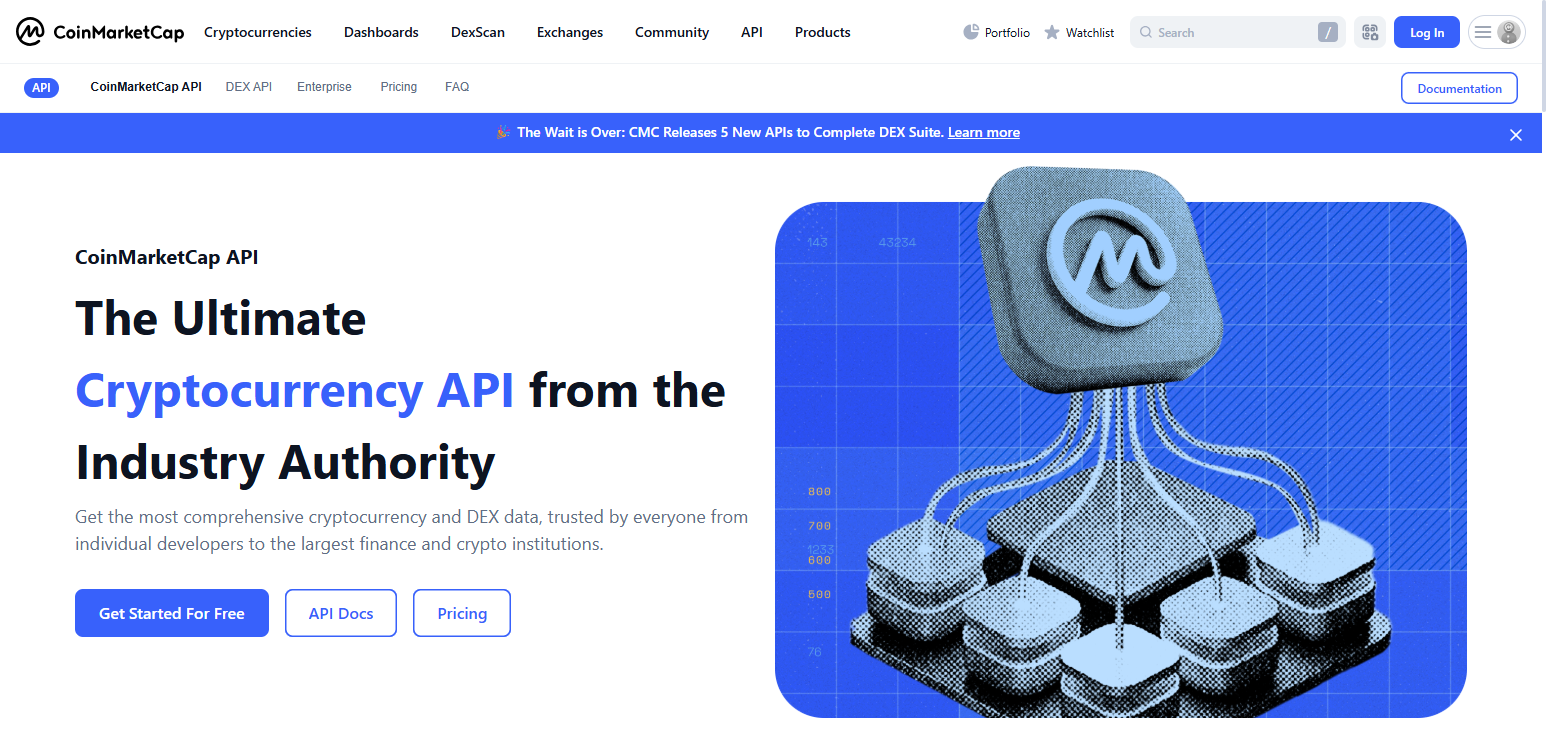
Trustworthy crypto data makes this API ideal for trading and finance tools, as well as research. CoinMarketCap API is designed for ease of implementation on mobile apps and websites
as well as trading and finance tools, with multiple endpoints that address global market concerns, the fear and greed index, and blockchain metrics.
CoinMarketCap API – Features Overview
Real-Time Updates on Crypto Markets Constant market updates on price, rank, volume, and market cap.
Data from All Global Exchanges Provides data from all exchanges, including all trading pairs and their liquidity.
Historical Market Data Access all historical data on market movements and price history of any cryptocurrency.
Market Data Enhancements Includes all global market data, including market dominance, and metrics for the crypto market.
Easy Developer Integration Well structured API endpoints for ease in web and app development.
| Pros | Cons |
|---|---|
| Delivers accurate cryptocurrency prices and market ranking information. | Free API access includes strict monthly usage limitations. |
| Provides extensive exchange, volume, and historical market data. | Premium plans can become expensive for large businesses. |
| Offers trusted data used by many crypto applications globally. | Some advanced metrics require higher subscription levels. |
| Includes powerful global market analytics and conversion tools. | API requests may slow during extremely high demand periods. |
| Provides structured data formats for simple integration. | Requires account registration before accessing API services. |
3. CryptoCompare API
CryptoCompare API caters to traders and developers with its extensive collection of market data. CryptoCompare API features streaming market prices, historical market data, and comparisons. It also provides statistics on the blockchain, mining, and news.

To calculate prices and liquidity accurately, CryptoCompare API combines exchange data. Portfolio applications, trading applications, and research applications are some of the use cases for CryptoCompare API.
CryptoCompare API supports thousands of digital currencies, has multiple endpoints, and is widely used in the industry for its market data.
CryptoCompare API – Features Overview
Cross Exchange Price Verification Displays accurate price information by consolidating data from all exchanges.
Market Data Updates Provides up to the minute price and volume data, with market movement information.
Blockchain and Network Data Provides data and insights on blockchain, mining, and network performance.
Market Sentiment and News Data Access to news and sentiment data via the API.
Portfolio Management Support Assists developers in building applications for tracking cryptocurrency and managing their investments.
| Pros | Cons |
|---|---|
| Provides detailed cryptocurrency prices, news, and blockchain metrics. | Free version has limited API call availability. |
| Aggregates data from multiple exchanges for better accuracy. | Some advanced features require paid enterprise plans. |
| Supports portfolio tracking and market research applications. | Data coverage can vary between different cryptocurrencies. |
| Offers historical pricing and exchange comparison features. | Beginners may find extensive features slightly complex. |
| Provides useful mining and blockchain analytics information. | Pricing structure may be costly for startups. |
4. Binance API
Binance API supports developers building trading applications and market analysis tools. It has extensive offerings, from real-time trading data to order books, candlestick charts, exchange data, and even account management.

It includes data and support for advanced trading and futures markets, attracting professional and algorithmic traders. Binance API’s speed and extensive documentation allow businesses to build automated trading applications, portfolio tracking, and real-time market monitoring tools.
Binance API – Key Features
Fast Market Data Delivers near real time cryptocurrency updating and exchange market data.
Comprehensive Trade Support Covers spot trade, futures trade, and supports automated cryptocurrency trade systems.
Order Book Data Offers real time bidding, asking, and market depth.
Trading Pair Accessibility Covers thousands of cryptocurrency trading pairs available in the markets.
Automated Trade Systems Gives developers the capability to design trading bots and automated investing systems.
| Pros | Cons |
|---|---|
| Provides extremely fast real-time trading and market data updates. | Mainly focused on Binance exchange ecosystem only. |
| Supports spot, futures, and advanced trading functionalities. | API access can be affected by exchange restrictions. |
| Offers detailed order books and trading information. | Requires technical knowledge for advanced integrations. |
| Provides extensive cryptocurrency pair coverage worldwide. | Regulatory changes may impact service availability. |
| Ideal for automated trading and algorithmic strategies. | High-frequency usage requires careful API management. |
5. Coinbase API
Coinbase API provides an assortment of features related to trading, pricing, and accounts. As such, Coinbase provides developers the ability to integrate trading and payment systems to manage and track digital assets.

With Coinbase, developers and businesses are able to utilize real-time data related to the market, transactions, trading, and even currency conversion with historical records.
Fintech companies love the streamlined documentation and security related to the Coinbase API. The infrastructure provided by Coinbase is a great starting point to manage and mitigate the risks related to digital currency.
Coinbase API – Key Features
Protected Access to Cryptocurrency Data Covers secure crypto prices, account details, and transactions.
Payment Systems Support Allows businesses to provide cryptocurrency payment and transaction systems.
Wallet Systems Support Allows crypto wallet and digital asset management in applications.
Instant Conversion RatesCovers real time crypto exchange rates and prices updates.
User-Friendly Guides Provides simple guides to the API for developers in the cryptocurrency space.
| Pros | Cons |
|---|---|
| Provides secure cryptocurrency data and payment integration features. | Supports fewer cryptocurrencies compared with larger APIs. |
| Offers beginner-friendly documentation for developers. | Advanced trading features may have limited availability. |
| Provides reliable pricing, wallet, and transaction information. | Higher usage limits require paid plans. |
| Trusted infrastructure with strong security standards. | API performance depends on Coinbase platform stability. |
| Suitable for fintech and payment applications. | Less suitable for complex trading analytics. |
6. Kraken API
Kraken API offers developers access to real-time market data, trading pairs, order books and transactions. Kraken’s API is professional grade as it offers in-depth data along trade histories, and account management.
Kraken has built a reputation for security, which is complemented by their advanced trading API’s, making their API’s great for constructing bots, management tools, and analytics.

Kraken offers developers data on a multitude of digital assets, and provides up to date market data. This infrastructure makes Kraken API a favorite among serious cryptocurrency developers.
Kraken API – Key Features
Continuous Trading Data Covers real time exchange prices and trading pair data.
Advanced Trade Systems Supports trade systems requiring advanced data.
Order Book Data Provides data of market depth, trade history, and shaping of trade.
Safe API Systems Provides safe access for cryptocurrency focused applications.
Multiple Asset Coverage Covers multiple crypto assets for trading and portfolio needs.
| Pros | Cons |
|---|---|
| Provides accurate cryptocurrency market and trading information. | API documentation may feel complex for beginners. |
| Supports professional trading applications and automation. | Limited cryptocurrency coverage compared with some competitors. |
| Offers strong security and reliable exchange infrastructure. | High-volume users may face rate limitations. |
| Provides detailed order book and transaction data. | Requires technical expertise for advanced features. |
| Suitable for institutional and professional traders. | User experience is less beginner-focused. |
7. Messari API
The Messari API is excellent if you are looking to analyze market trends, research the crypto sphere, or take a close look at blockchain transactions. This API allows you to assemble crypto asset profiles, look at pricing and networking metrics, and examine financials.
Messari API specializes in professional market analysis, so if you are a developer trying to come up with a research tool, a dashboard, or an analytics framework with a workspace, you might want to try their API.

Their market data and blockchain analysis go hand in hand, and with crypto analysis on the rise, their API allows you to generate a lot of data so you can make informed decisions.
Messari API – Key Features
Advanced Crypto Research Data Provides research and analytics and market intelligence for the crypto industry.
Asset Profile Information Provides information on crypto projects and blockchain networks.
Network Performance Metrics Provides statistics on the activity, adoption, and health of a blockchain network.
Institutional Analytics Support Provides tools to build professional crypto research and investment platforms.
Market Intelligence Tools Provides analytics and insights for investors and market analysts.
| Pros | Cons |
|---|---|
| Provides advanced cryptocurrency research and blockchain analytics. | Primarily focused on research rather than trading data. |
| Offers detailed asset profiles and network metrics. | Premium access can be expensive for small businesses. |
| Helps investors analyze long-term crypto trends. | Free features are limited compared with competitors. |
| Provides institutional-quality market intelligence. | May not suit simple price tracking applications. |
| Combines market data with professional research insights. | Requires understanding of advanced crypto analytics. |
8. Kaiko API
If you are an institution or large enterprise looking for upper-tier quality crypto market data or analytics, the Kaiko API is for you. It provides comprehensive market data such as prices, trade data, and details on order books.

You can even find metrics on the various exchanges and their liquidity. This is professional grade data that hedge funds and financial institutions use to create and optimize their proprietary trading algorithms and tactics.
Their focus on significant and trustworthy data makes their API perfect for large enterprises. Having data from nearly all traded exchanges allows an institution to see liquidity and volatility in each crypto and all markets. They are one of the best APIs for institutional market intelligence.
Kaiko API – Key Features
Institutional Market DataProfessional-grade crypto data for financial institutions and businesses.
Real-Time Order Book DataProvides information on the trading activity and depth of the market.
Exchange Data AggregationGathers accurate data from various crypto exchanges around the world.
Historical Trading AnalyticsComprehensive historical trading data.
Liquidity Monitoring ToolsProvides the ability to assess market conditions and the liquidity for crypto.
| Pros | Cons |
|---|---|
| Provides institutional-grade cryptocurrency market data solutions. | Pricing is mainly designed for enterprise users. |
| Offers accurate liquidity, order book, and trade analytics. | Not ideal for small developers or beginners. |
| Aggregates data from multiple global exchanges. | Requires technical expertise for implementation. |
| Supports professional trading and financial research platforms. | Limited free access options are available. |
| Provides high-quality transparent market information. | Advanced features may require customized solutions. |
9. Nomics API
The Nomics API offers developers building crypto applications fast and reliable access to crypto market data. They provide customers with real time access to pricing data and trading volume, market capitalization data and records, as well as data pertaining to exchanges and the history of the market.

Nomics focuses on publishing transparent and clean data. This is especially helpful for trade and finance related websites. Nomics API offers thousands of crypto assets and claims easy integration via developer-centered endpoints. The Nomics API offers a fast and reliable option for businesses who want an easy and data based solution for crypto assets.
Nomics API – Key Features
Fast Cryptocurrency Data Delivery Access to real-time pricing and market data in a timely manner.
Clean Market Data Structure Well-structured data that simplifies API integration for cryptocurrencies.
Exchange Information Access Information about exchanges, their trading volume, and crypto data.
Portfolio Tracking Support Allows the development of crypto portfolio tracking applications.
Historical Price Data Past market data for research and analysis of trends.
| Pros | Cons |
|---|---|
| Provides fast cryptocurrency market data delivery. | Platform availability and support may be limited. |
| Offers clean and developer-friendly API structures. | Less popular compared with CoinGecko and CoinMarketCap. |
| Supports portfolio tracking and market applications. | Some advanced features require paid subscriptions. |
| Provides transparent pricing and exchange information. | Data coverage may be smaller for niche assets. |
| Suitable for lightweight crypto applications. | Enterprise-level analytics options are limited. |
10. CoinAPI
CoinAPI offers a unified crypto data solution by aggregating data from hundreds of crypto exchanges around the world. They capture real time pricing, trading volume, and order book data and provide other historical market data and exchange APIs in a single framework.
Developers use CoinAPI to easily access rich data for the fragmented and complex crypto markets. This offers the ability to build and develop financial apps, trading systems and other enterprise analytic solutions with confidence.
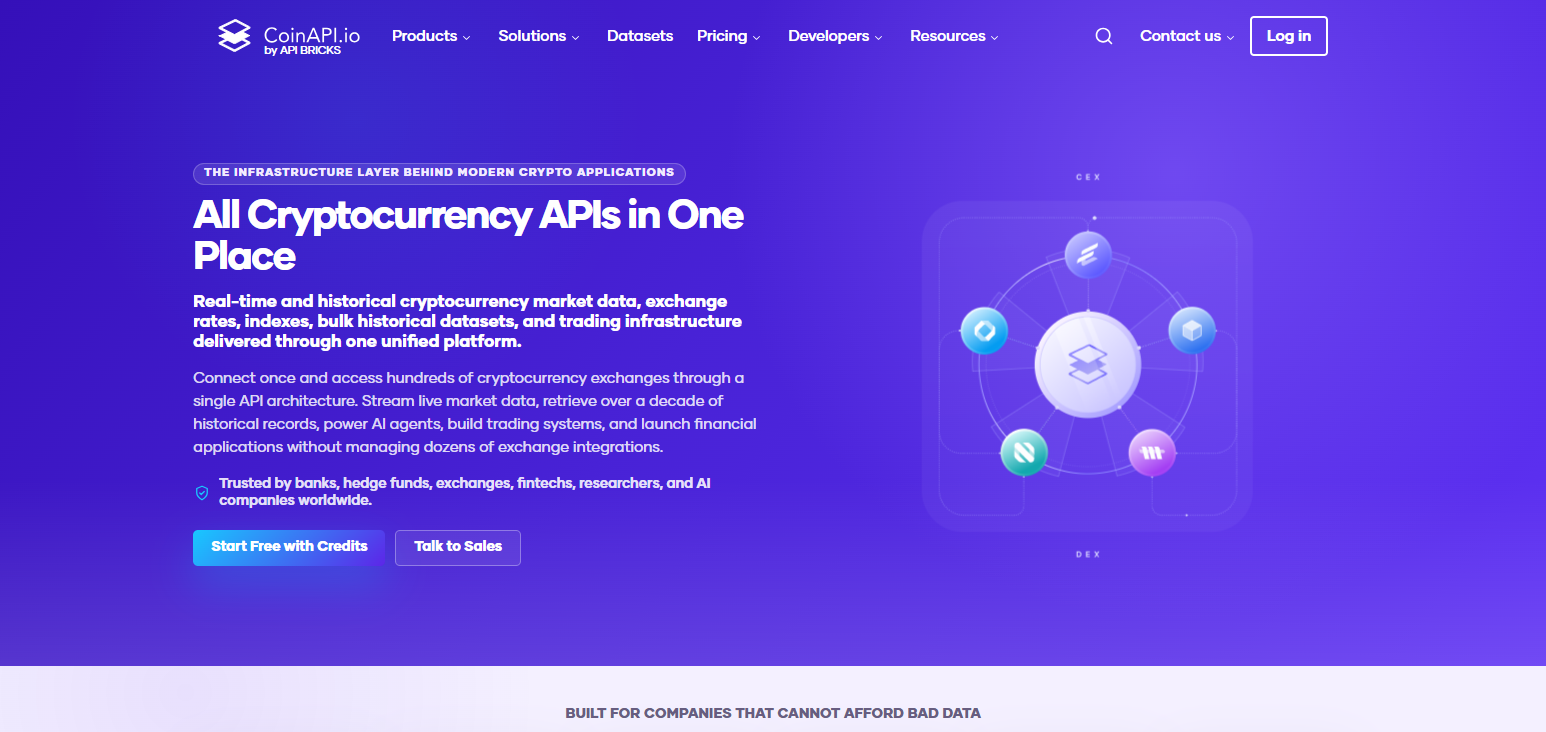
The comprehensive coverage of data enables businesses to build and offer reliable and safe crypto solutions at scale and aid in the development of sophisticated market structures.
CoinAPI – Key Features
Unified Exchange Data AccessProvides a single API that covers data from hundreds of crypto exchanges.
Real-Time Market Information
Real time market information provides live prices, volumes, and exchange rate information.
Historical Crypto Data
Historical Crypto Data gives market history and data for analysis and forecasting.
Enterprise-Level Infrastructure
Enterprise-Level Infrastructure provides reliable data computation for scalable cryptocurrency applications.
Algorithmic Trading Support
Algorithmic Trading Support provides market data designed for automated trading systems and strategies.
| Pros | Cons |
|---|---|
| Provides unified access to multiple cryptocurrency exchanges. | Pricing can be expensive for high-volume users. |
| Offers accurate real-time and historical market information. | Free access provides limited request capacity. |
| Supports professional trading and financial applications. | Integration requires technical development skills. |
| Provides extensive exchange coverage and market data. | Beginners may find features overwhelming initially. |
| Helps simplify multi-exchange data management efficiently. | Enterprise plans are required for maximum scalability. |
Conclusion
In conclusion, Cryptocurrency APIs provide important information to buyers, sellers and makers of businesses because they give real and accurate information and statistics in their APIs. The best APIs usually provide pricing, indicative data, data from exchanges, and analytics.
While building applications from scratch using APIs to build trading platforms, portfolio trackers, financial applications, etc, helps to improve efficiency and also improve decision-making
it is important to choose the best and the most appropriate cryptocurrency APIs in the financial applications as their flexibility helps to create long-term confidence and success in the cryptocurrency financial markets.
FAQ
Why use Cryptocurrency APIs for market data?
They help access accurate prices, trading volumes, historical data, and real-time market movements for better analysis.
Which is the best Cryptocurrency API for beginners?
CoinGecko API and CoinMarketCap API are popular choices due to simple integration and reliable data.
Are Cryptocurrency APIs free to use?
Many APIs offer free plans with limited requests, while advanced features require paid subscriptions.
Can Cryptocurrency APIs support trading applications?
Yes, APIs like Binance API and Kraken API help build automated trading platforms and crypto applications.