In this article, I discuss the Best Crypto Risk Platforms, which assist companies, exchanges, and Web3 with the detection of fraud, compliance, and the safety of business digital asset transactions.
Utilizing blockchain analytic tools paired with A.I. monitoring systems, AML Screening, and Risk Assessment tools, these platforms identify threats and avoid financial crime by strengthening transparency. Here are the most innovative options about crypto security in 2026.
What Are Crypto Risk Platforms?
Crypto Risk Platforms monitor, assess, and manage the risks related to blockchain cryptocurrency transactions.
These platforms incorporate a combination of blockchain analytics, artificial intelligence, and machine learning to identify not only fraud, but also suspicious behavior, money laundering, scams and general regulatory violations.
They assist crypto exchanges, financial institutions, Web3 companies and even government agencies to better comply with regulations by implementing AML screening, wallet risk scoring, transaction monitoring, and real-time threat detection.
Why Crypto Risk Management Is Important In 2026
- Evolving Crypto Regulations: Businesses are better positioned to satisfy new and changing global compliance and regulatory requirements.
- Fraud and Cybercrime Protection: Crypto risk management protects against hacks, ransomware, scams, and illicit activities in the crypto space.
- Instant Risk Detection: Crypto risk management allows organizations to identify threats in blockchain and suspicious transactions in real-time.
- Enhanced Blockchain Visibility: Still a new emerging technology in investable assets, Blockchain Transparency builds confidence in the trust of the digital asset systems.
- KYC and AML Procedures: Provides a structure of identity checks, anti-money laundering (AML), and sanctions screening.
Key Points & Best Crypto Risk Platforms
| Company | Explanation |
|---|---|
| Chainalysis | Industry-leading blockchain analytics platform for tracing funds and ensuring regulatory compliance globally. |
| Elliptic | Provides crypto risk management, transaction screening, and AML compliance solutions for businesses. |
| TRM Labs | Enables cross-chain monitoring, fraud detection, and investigations against crypto financial crimes. |
| Solidus Labs | Protects crypto markets through surveillance, manipulation detection, and risk monitoring solutions. |
| Scorechain | Offers wallet risk scoring, compliance tools, and Travel Rule readiness solutions. |
| Merkle Science | Uses predictive intelligence for behavioral threat detection and blockchain security analysis. |
| Crystal Intelligence | Applies AI analytics to monitor blockchain risks and regulatory compliance requirements. |
| Global Ledger | Provides AML surveillance and risk assessment against illicit financial activities worldwide. |
| Blockpass | Delivers digital identity verification solutions for DeFi and crypto onboarding processes. |
| Sumsub | Provides identity verification and fraud prevention tools for crypto companies scaling securely. |
10 Best Crypto Risk Platforms
1. Chainalysis
Chainalysis aids governments, exchanges, financial firms, and Web3 businesses in managing blockchain risks. With its tools, firms can trace transactions, suspicious behavior, and the movement of funds, as well as ensure compliance with the law.
Chainalysis provides blockchain intelligence to support anti-money laundering (AML) compliance, sanctions, and crypto investigations.
Chainalysis is a vendor of choice for digital asset compliance, as it continues to enhance its platform by integrating artificial intelligence (AI) and other insights with the ability to monitor and analyze data in a timely manner.
Chainalysis Key Features
- Chainalysis allows monitoring of suspicious crypto transactions.
- It has advanced risk analytics to assess blockchain and monetary risk.
- It has tools for compliance with AML regulations.
- It has a sanctions screening feature.
- They provide investigative support to law enforcement for crypto crime.
| Pros | Cons |
|---|---|
| Industry-leading blockchain intelligence trusted by global organizations. | Premium pricing may be expensive for small businesses. |
| Powerful transaction tracking and investigation capabilities. | Requires technical expertise for advanced features. |
| Supports AML compliance and regulatory reporting. | Limited transparency about pricing plans. |
| Covers multiple blockchain networks and digital assets. | Can be complex for beginners. |
| Provides accurate risk detection and analytics tools. | Best features are available mainly for enterprise users. |
2. Elliptic
Elliptic provides clients with the tools necessary to analyze and manage risks associated with crypto. With Elliptic, crypto-based firms and financial technology (fintech) firms can meet AML compliance and monitor transactions, watch lists, and the flow of crypto.
Elliptic’s technology is the most advanced for analyzing crypto and detecting suspicious behavior in the vast networks of the blockchain.
As regulation of cryptocurrency spreads, Elliptic is among the most popular providers for firms operating digital assets focused on safe practices and improving confidence in crypto.
Elliptic Key Features
- Elliptic has immediate risk analysis of crypto transactions.
- Elliptic wallet activities through risk classification.
- Elliptic provides AML and financial crime preventive tools.
- Elliptic supports multiple blockchains.
- Elliptic provides automated crypto compliance.
| Pros | Cons |
|---|---|
| Advanced crypto risk assessment and compliance solutions. | Higher costs compared with smaller compliance tools. |
| Real-time transaction screening improves security. | Setup process may require professional assistance. |
| Strong AML and sanctions monitoring capabilities. | Some features are designed mainly for enterprises. |
| Supports multiple cryptocurrency networks. | Learning curve for new users. |
| Trusted by fintech and financial institutions worldwide. | Custom integrations can require additional resources. |
3. TRM Labs
TRM Labs is focused on blockchain intelligence and analytics, and the monitoring of cross-chain crypto and blockchain-based technologies for the prevention of crime. With TRM Labs, firms can track the risk of financial crime across the networks of blockchain, theft of funds, and suspicious transactions.
Its tools give the power to screen and analyze risks to numerous banks, exchanges, government agencies, and Web3 firms. TRM Labs is among the most advanced platforms for monitoring and analyzing the many networks of blockchains.
TRM Labs Key Features
- TRM Labs has the capability to monitor activities in multiple blockchains.
- TRM Labs has advanced techniques to identify fraud.
- TRM Labs provides tools to conduct crypto investigations.
- TRM Labs offers near instantaneous risk detection.
- TRM Labs provides assistance in tracking lost crypto.
| Pros | Cons |
|---|---|
| Excellent cross-chain monitoring and blockchain intelligence. | Pricing details are not publicly available. |
| Helps detect fraud, scams, and stolen assets. | Mainly targeted toward professional organizations. |
| Provides real-time risk alerts and investigations. | Advanced tools require training and expertise. |
| Supports regulators, exchanges, and Web3 companies. | May be costly for startups with limited budgets. |
| Strong coverage of emerging blockchain threats. | Smaller companies may not use all features. |
4. Solidus Labs
Solidus Labs offers crypto-centric market surveillance and risk monitoring services. Their mission is to provide protection against the manipulation and fraudulent actions in digital asset markets.
Their services provide crypto business the ability to automate the detection of market manipulation or other suspicious trading behavior and risky transactions.
Solidus Labs employs both machine learning and behavioral analytics and services the Web3 market. Their services create a trading environment that is both safer and more compliant.
Solidus Labs Key Features
- Solidus Labs monitors markets for suspicious activities in crypto trading.
- Solidus Labs has the capability to detect market manipulation.
- Solidus Labs uses AI to assess risk.
- Solidus Labs offers trading platforms real time verification of compliance.
| Pros | Cons |
|---|---|
| Specialized crypto market surveillance technology. | Focused mainly on trading-related risks. |
| Uses AI for manipulation and fraud detection. | Not designed for basic wallet verification needs. |
| Helps maintain digital asset market integrity. | Enterprise pricing can be expensive. |
| Provides real-time monitoring capabilities. | Requires knowledge of crypto market operations. |
| Supports exchanges and financial institutions effectively. | Limited suitability for individual users. |
5. Scorechain
The core services of Scorechain include compliance and risk assessment services for crypto businesses, exchanges, and Web3 projects. Their offerings include wallet risk scoring, transaction monitoring, AML screening, and Travel Rule services.
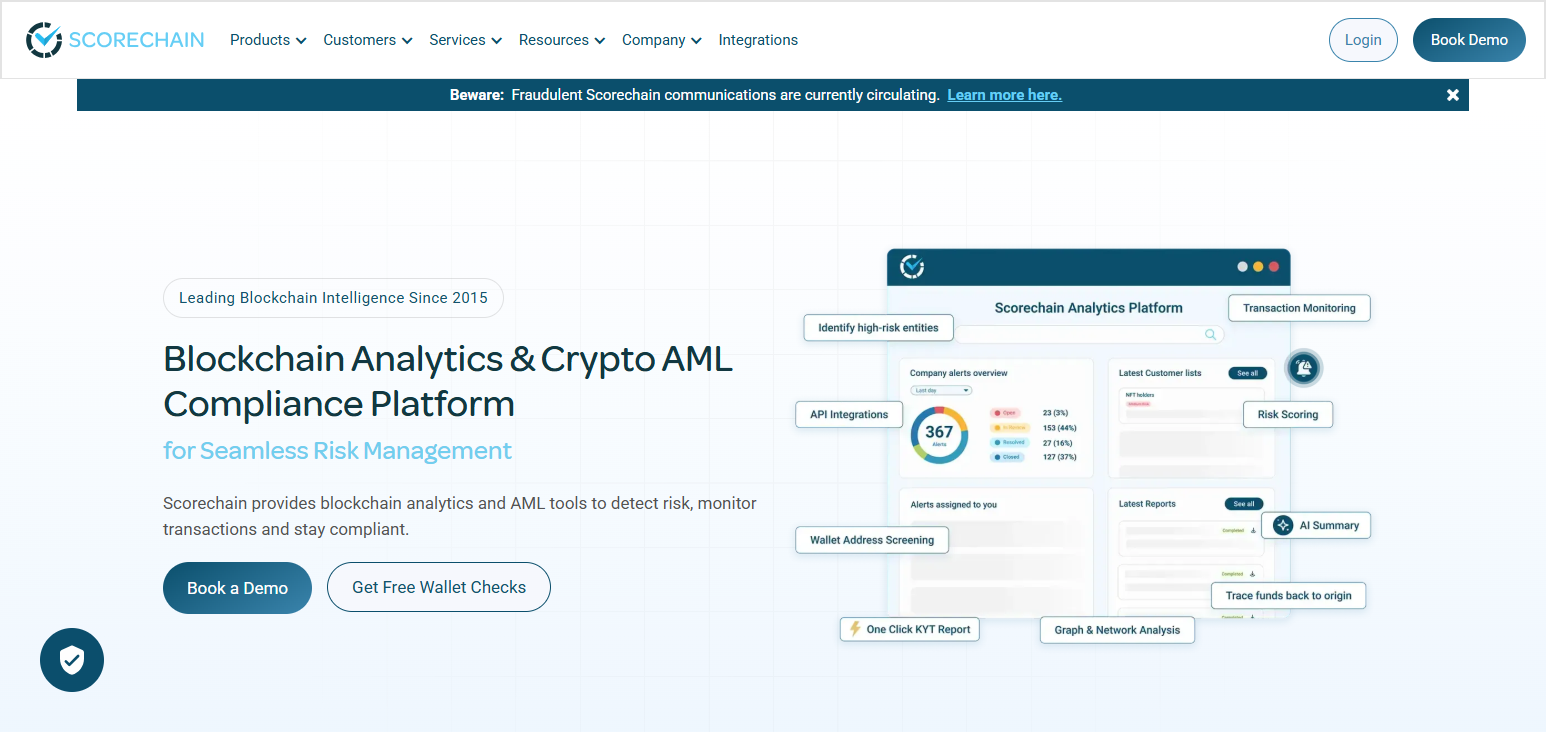
Scorechain makes compliance and risk assessment more flexible for businesses and Web3 projects by allowing the customization of risk rules. Scorechain also makes compliance and risk mitigation assessment more effective with transaction monitoring on multiple blockchains.
Scorechain – Key Features
- Wallet Risk Scoring: Customized reputation and risk assessments of crypto wallets.
- Transaction Monitoring: Surveys blockchain movements for anomalies.
- Travel Rule Compliance: Assists companies in adhering to all crypto regulations.
- Custom Risk Rules: Establish chosen risks for monitoring.
- Multi-Asset Support: Supports all currencies and all blockchain systems.
| Pros | Cons |
|---|---|
| Customizable wallet risk scoring solutions. | Smaller brand recognition compared to Chainalysis. |
| Supports Travel Rule and AML compliance. | Advanced customization may require technical skills. |
| Provides flexible transaction monitoring features. | Pricing information is not openly available. |
| Suitable for Web3 startups and exchanges. | Limited features for non-crypto businesses. |
| Supports multiple blockchain networks. | Enterprise features may increase overall costs. |
6. Merkle Science
Merkle Science is a blockchain analytics platform that offers highly sophisticated threat detection and advanced crypto risk analysis. They provide behavior analytics and machine learning models to identify suspicious behavior and risky transactions.
Their target clientele includes exchanges, financial institutions, and government organizations. Merkle Science provides threat assessments of crypto transaction and behavior for a fast and more highly changing and compliance sensitive blockchain environment.
Merkle Science – Key Features
- Predictive Threat Detection: Foresees crypto threats prior to large scale events.
- Behavioral Analytics: Risk assessment of behavior based on transaction evaluation.
- Blockchain Intelligence Tools: Provides tools and data for criminal investigations.
- Fraud Prevention Solutions: Provides services that diminish financial crime in crypto.
- Automated Risk Monitoring: Perpetually assesses the threat level to finance in crypto.
| Pros | Cons |
|---|---|
| Uses predictive analytics for crypto threat detection. | Platform learning curve can be challenging. |
| Helps identify suspicious activities proactively. | Pricing may not suit small companies. |
| Provides strong blockchain investigation capabilities. | Requires trained compliance teams for usage. |
| Supports financial institutions and governments. | Less publicly known than larger competitors. |
| Advanced behavioral analysis improves security. | Some features require enterprise subscriptions. |
7. Crystal Intelligence
Crystal Intelligence offers a risk monitoring and compliance solution for blockchain based on artificial intelligence and machine learning.
This platform allows organizations to conduct transactional analyses and visualizations of blockchain activities to identify financial crimes. Crystal Intelligence fosters the achievement of institutional compliance for sanctions and anti-money laundering efforts.
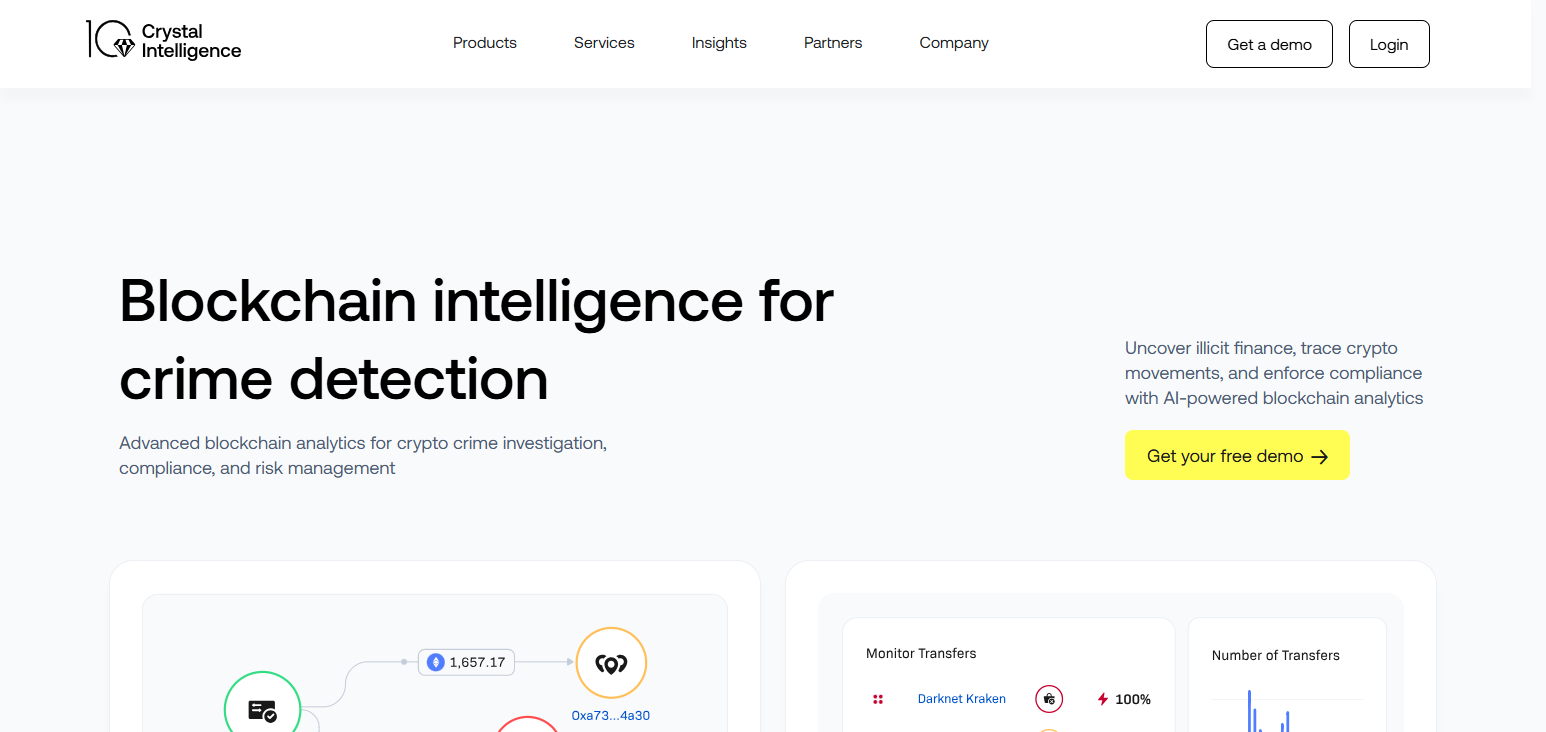
Crystal Intelligence’s advanced investigative tools enable businesses and financial regulators to better assess and understand crypto transactions. Crystal Intelligence also works to ensure transparency and operational enhancement across the digital asset marketplace.
Crystal Intelligence – Key Features
- AI-Based Blockchain Analysis: Computes risk in crypto using AI.
- Transaction Visualization: Simplifies complex transaction patterns.
- Compliance Monitoring: Aids efforts to meet AML, FATF, and other compliance needs.
- Risk Investigation Tools: Analyzes risk posed by crypto transaction.
- Global Blockchain Coverage: Comprehensive view of all crypto ecosystems.
| Pros | Cons |
|---|---|
| AI-powered blockchain risk analysis capabilities. | Advanced features may require technical knowledge. |
| Provides clear transaction visualization tools. | Pricing details are less transparent. |
| Supports global AML and compliance standards. | Better suited for professional organizations. |
| Helps investigate complex blockchain transactions. | Smaller businesses may find it expensive. |
| Covers multiple blockchain ecosystems effectively. | Initial setup may require customization. |
8. Global Ledger
Global Ledger offers blockchain monitoring and surveillance combined with an anti-money laundering risk assessment and analysis solution for illicit cryptocurrency focused services.
This platform allows organizations to monitor transactional behavior, identify and/or assess digital asset related risk and/or suspicious activity.
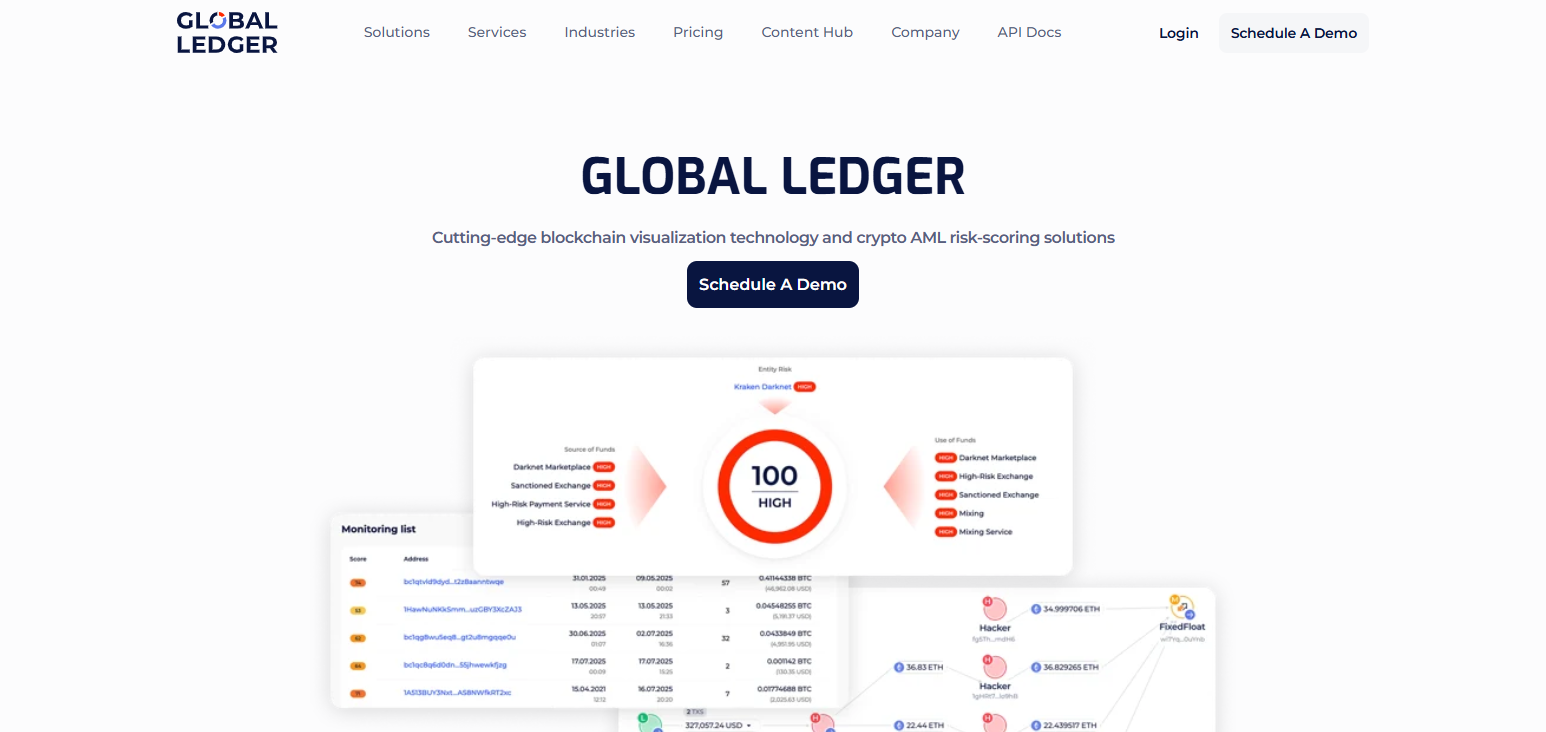
Global Ledger strives to enhance the transparency of blockchain technology to inhibit illicit movement or transfer of funds.
Global Ledger works with regulatory and compliance focused financial institutions and entities to enhance the safety and trusted use of cryptocurrency.
Global Ledger – Key Features
- AML Risk Assessment: Assessed compliance risk crypto transactions.
- Blockchain Surveillance: Monitors crypto for activity of a criminal nature.
- Financial Crime Prevention: Assists in the detection of crypto movements that are illicit.
- Regulatory Compliance Support: Helps companies meet all requirements.
- Threat Intelligence Sharing: Improves assessment and monitoring of threats to blockchain.
| Pros | Cons |
|---|---|
| Strong focus on AML and financial crime prevention. | Less widely recognized than major competitors. |
| Supports blockchain surveillance and risk assessment. | Limited public information about pricing. |
| Helps organizations meet compliance requirements. | May require integration support. |
| Works with international compliance organizations. | Features are mainly enterprise-focused. |
| Improves transparency in digital asset transactions. | Smaller companies may need simpler solutions. |
9. Blockpass
Blockpass focuses on providing digital identity verification and compliance for crypto, DeFi, and Web3 focused platforms. Blockpass streamlines the user onboarding experience by providing a KYC and AML verification in an automated fashion, while balancing security and privacy.
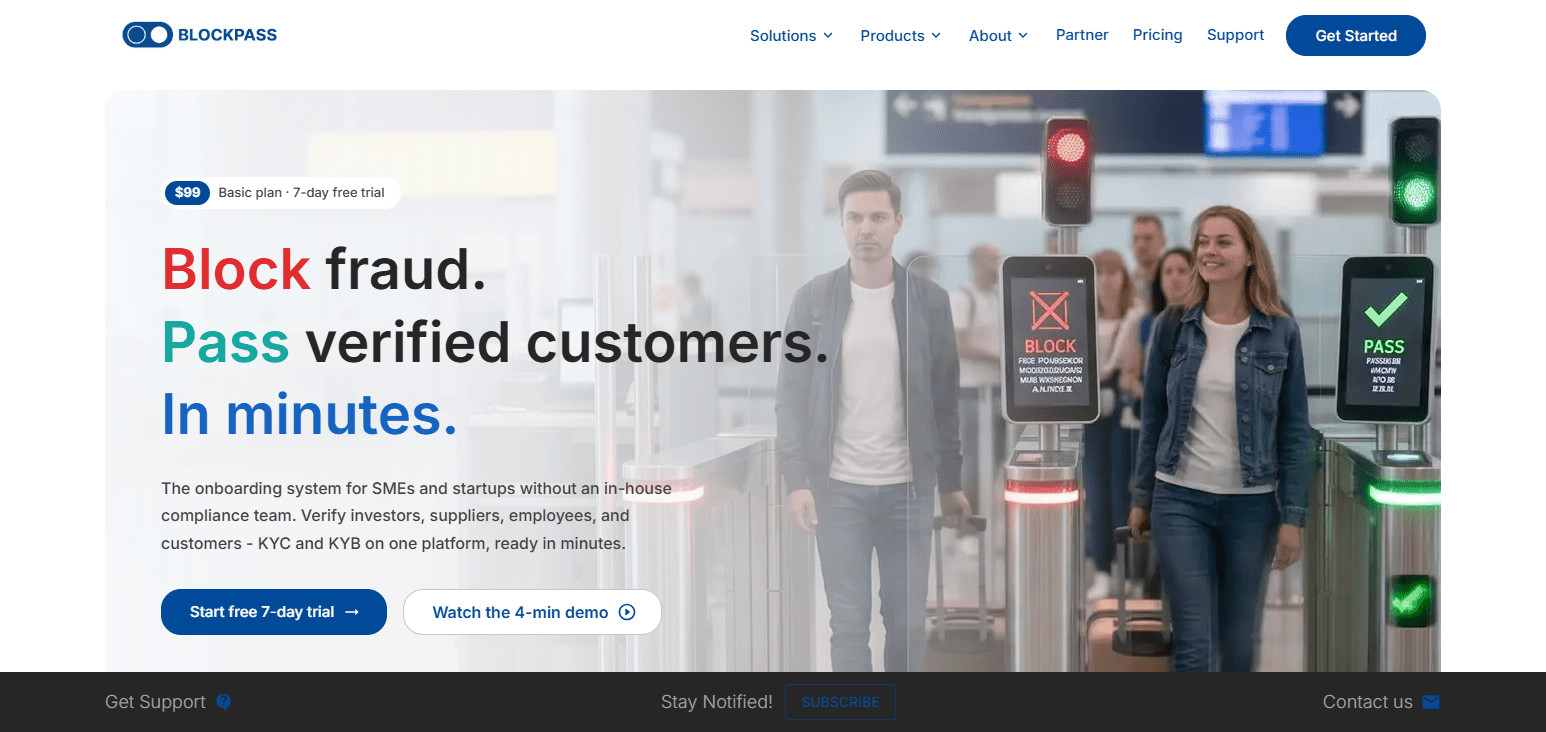
The flexibility and the use of reusable verification of identity compliance technology allows the user to transact with Blockpass multiple times without undergoing KYC verification, promoting an enhanced transactional experience within decentralized finance.
Blockpass – Key Features
- Digital Identity Verification: Secure KYC for crypto platforms.
- Automated AML Checks: Automatically screens users for compliance.
- Reusable Digital Identity: Allows user verification to be both faster and safer.
- DeFi Compliance Support: Assists decentralized platforms with compliance.
- Fraud Prevention Tools: Identity theft and onboarding fraud are reduced.
| Pros | Cons |
|---|---|
| Efficient KYC and digital identity verification platform. | Mainly focused on identity compliance use cases. |
| Simplifies user onboarding for crypto platforms. | Limited blockchain investigation capabilities. |
| Supports DeFi and Web3 compliance requirements. | Advanced features may require paid plans. |
| Provides reusable digital identity solutions. | Not a complete crypto risk analytics platform. |
| Helps reduce identity fraud risks. | Less suitable for large-scale blockchain investigations. |
10. Sumsub
Providing a means of secure scaling for crypto companies, Sumsub’s suite of services includes identity verification, fraud prevention, and compliance solutions. For KYC and AML protections, their platform integrates biometric verification, fraud verification, and financial crime transaction vetting.
For crypto companies, Sumsub helps streamline customer onboarding processes, while regulatory compliance protects against financial crime and identity fraud.
Using automated verification tech, and providing services worldwide, Sumsub helps digital asset companies build secure environments for their users.
Sumsub – Key Features
- KYC Verification Platform: Makes verifying customer identity easier.
- Biometric Authentication: Secure validation of users though technology.
- Fraud Detection Systems: Identifies fake identities and suspicious behavior.
- AML Screening Tools: Enables compliance for crypto companies.
- Global Verification Coverage: Ability to support users in multiple countries/regions.
| Pros | Cons |
|---|---|
| Complete KYC, AML, and fraud prevention solution. | Transaction monitoring features may be limited compared to specialists. |
| Supports global identity verification requirements. | Pricing can increase with business growth. |
| Provides automated onboarding workflows. | Requires integration for full functionality. |
| Strong fraud detection and biometric verification. | More focused on identity than blockchain analytics. |
| Suitable for crypto companies scaling globally. | Advanced compliance tools may need higher plans. |
Criteria for Choosing the Best Crypto Risk Platform
- Blockchain network coverage.
- Accuracy of risk detection.
- Compliance capabilities.
- AI and automation features.
- Integration options and API availability.
- Scalability for growing businesses.
- Data security and privacy standards.
- Pricing and overall value.
Conclusion
In Conclusion Best Crypto Risk Platforms Crypto Risk Platforms have been important for protecting digital resources, curbing financial crime, and assuring regulatory satisfaction in 2026.
The top solutions like Chainalysis, Elliptic, and TRM Labs help with their clients’ needs by providing a complete suite of sophisticated blockchain analysis, optimal transaction monitoring, and fraud detection.
The right choice of platforms allows businesses to enhance safety and reduce risk and, in doing this, develop trust as the cryptocurrency landscape continues to grow and change quickly.
FAQ
Which is the best Crypto Risk Platform in 2026?
Chainalysis, Elliptic, and TRM Labs are among the leading crypto risk platforms.
How do Crypto Risk Platforms detect fraud?
They use blockchain analytics, AI, and transaction monitoring to identify suspicious activities.
Who uses Crypto Risk Platforms?
Crypto exchanges, banks, governments, Web3 companies, and financial institutions use these platforms.
Do Crypto Risk Platforms support AML compliance?
Yes, they provide AML screening, sanctions checks, and regulatory compliance solutions.