In this article, I will present the best automated penetration testing software for Banking Infrastructure that assist financial institutions in proactively identifying weaknesses in their systems, mitigating the risk of cyberattacks, and enhancing the security of their digital offerings.
I will walk you through some of the leading solutions, their important functionalities, and the ways in which automation transforms threat detection, compliance, and the entire spectrum of banking cybersecurity in the rapidly evolving digital marketplace.
Why Automated Penetration Testing is Important for Banking Security
Rising Cyber Threats in Financial Systems
Banks are susceptible to many threats such as ransomware, phishing schemes, API exploits, and insider attacks.
Increasing Attack Surface in Digital Banking
Every day, digital banking systems are breaching more interfaces and harboring vulnerabilities that hackers can exploit.
Advanced Persistent Threats (APTs)
Long-term stealthy means of breaching systems that sophisticated attackers utilize pose major threats to banks.
API Exploitation Risks
Banking APIs provide pathways to allow bad actors to breach systems.
Insider Threat Detection
Automated testing can detect if a negligent or malicious user is attacking the system from within.
Need for Continuous Security Monitoring
Automated instruments reliably discover new security vulnerabilities and threats every day of the year.
Faster Threat Response Time
Automation of internal security enables systems to respond to threats as soon as they are discovered.
Key Points & Best Automated Penetration Testing Softwares for Banking Infrastructure
| Software | Explanation |
|---|---|
| Burp Suite | Automates web application security testing for banking APIs efficiently, always |
| Nessus | Nessus performs vulnerability scanning across banking infrastructure networks continuously and effectively |
| Metasploit Framework | Metasploit Framework enables exploit development and penetration testing automation processes |
| Acunetix | Acunetix detects web vulnerabilities in banking applications with automation tools |
| Qualys VMDR | Qualys VMDR provides continuous vulnerability management for banking systems security |
| Rapid7 InsightVM | Rapid7 InsightVM offers real-time risk visibility in banking infrastructure |
| OpenVAS | OpenVAS delivers open source vulnerability scanning for banking environments safely |
| Nmap | Nmap maps network assets and identifies banking infrastructure exposure quickly |
| Invicti | Invicti identifies web application vulnerabilities using dynamic scanning techniques accurately |
| Core Impact | Core Impact automates penetration testing for banking security validation processes |
10 Best Automated Penetration Testing Softwares for Banking Infrastructure
1. Burp Suite
Burp Suite is sophisticated software for performing web-banking application security analysis and is widely used in the banking application security industry.
It automates the detection, crawling, and scanning of security risks in web portals and APIs of online banking systems.
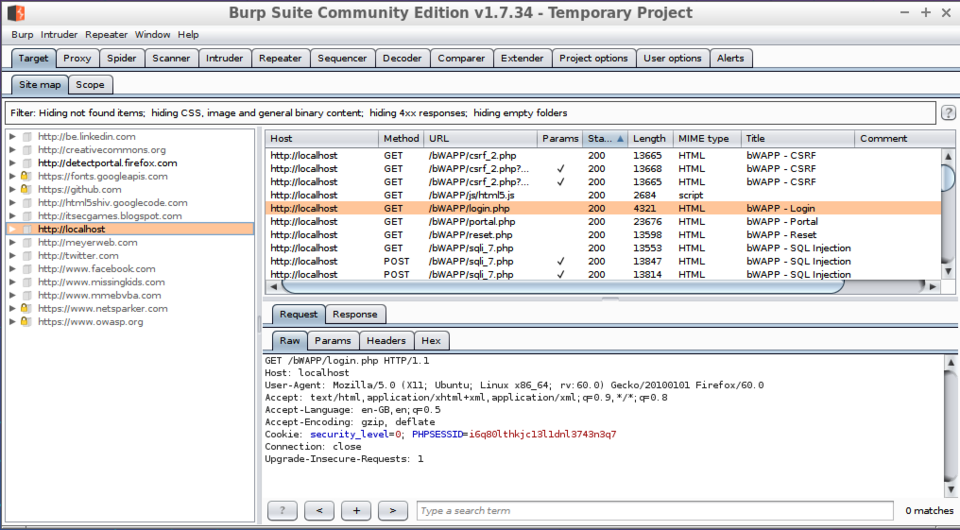
The augmented AI-driven scan of Burp Suite, along with its frequent updates, provides security teams with a better framework to identify issues pertaining to SQL injection, XSS, and authentication.
The tool’s ability and flexibility to integrate with CI/CD pipelines make it usable in financial organizations’ DevSecOps environments.
Burp Suite Features
- Scans banking applications and automates the web app crawling process
- Advanced detection for critical vulnerabilities (SQL injections, XSS, API issues)
- Integrates with CI/CD for DevSecOps practices
- Highlights potential issues using AI + crawling for less false positive output
2. Nessus
Nessus is a notable tool for performing vulnerability assessments and is widely used in banking due to its nearly real-time security monitoring capability.
It can scan the servers, networks, and even the fog and full cloud setups of a bank to identify security and compliance concerns, and software obsolete and out of support.

In recent releases, Nessus has developed enhanced security for the cloud and advanced forecasting for prioritizing vulnerabilities.
Due to Nessus’ extensive reporting and risk scoring, banking security teams are able to manage and mitigate risks in a more effective manner.
Nessus Features
- Automated scans for infrastructure vulnerabilities
- Identifies issues caused by misconfiguration, aged software, and lack of standards
- Uses risk-based scoring for prioritization of critical vulnerabilities
- Optimized for cloud, network, and hybrid banking solutions
3. Metasploit Framework
Metasploit is a cutting-edge software framework for penetration testing. It can be easily used for exploit automation in banking systems.
The recent enhancements in Metasploit Framework allow for testing against socially engineered threats like ransomware, phishing, and even today’s persistent advanced threats (APT).

Due to its modular structure, Metasploit Framework can be easily customized by banks and even financial technology and software companies to conduct tests against their complex financial systems.
Metasploit Framework Features
- Automated penetration testing to simulate exploits from an attacker’s view
- Simulates ransomware, phishing, and privilege escalation testing
- Modular testing framework
- Large collection of bank system exploits and payloads
4. Acunetix
Acunetix is a web vulnerability scanner with automation targeted at specific threats for banking applications and digital banking portals.
The newer iterations (or versions) are an improvement on previous ones and offer more in-depth scans and better API tests.
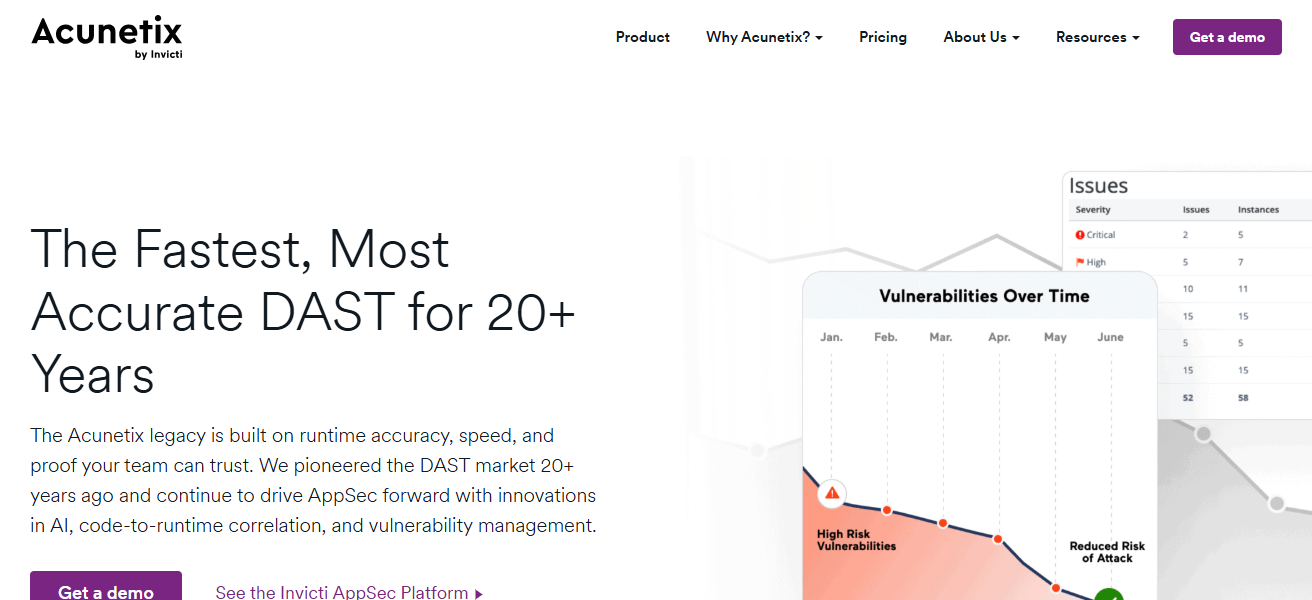
This is especially important for frameworks dealing with mobile banking systems. The automated features of Acunetix are very helpful time- and cost-wise since these features can be utilized repeatedly during the various stages of the development cycle.
Acunetix Features
- Focused on web and banking application automated deep scans
- Identifies SQL injections, XSS, and poor authentication
- Supports mobile banking API testing
- Supports CI/CD for security automation and verifications
5. Qualys VMDR
Qualys VMDR (Vulnerability Management, Detection, and Response) is a cloud-based system that offers secure banking infrastructure and advanced threat scanning for multiple systems.
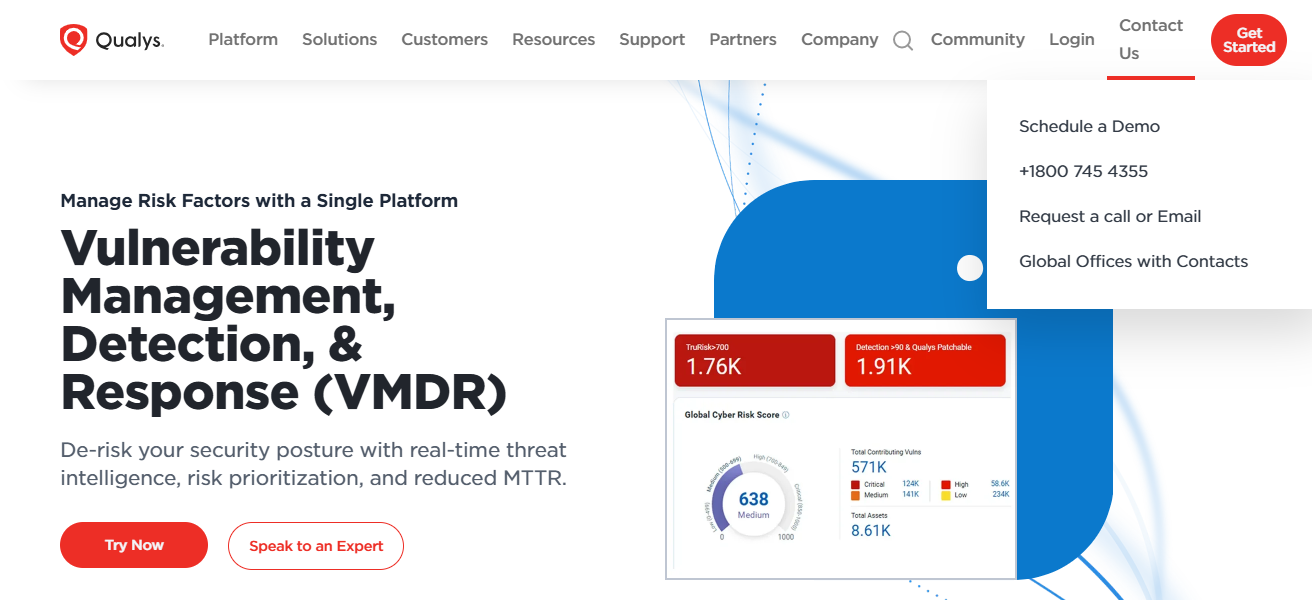
VMDR’s architecture utilizes real-time analytics, helping banks demonstrate compliance. The advanced analytics automation built into the system helps to seamlessly integrate security services across large financial institutions and helps to reduce threat response time considerably.
Qualys VMDR Features
- Automated discovery of assets and their vulnerabilities
- Supports banking infrastructure with real-time threat analysis
- Simplifies automated security compliance checks for regulations
- Cloud-architected security and compliance automation
6. Rapid7 InsightVM
With Rapid7 InsightVM, banking IT systems view vulnerabilities in real-time and can utilize automated Scan to Remediate services.
When a risk is identified, automated remediation recommendations are provided for servers, endpoints, and cloud systems.
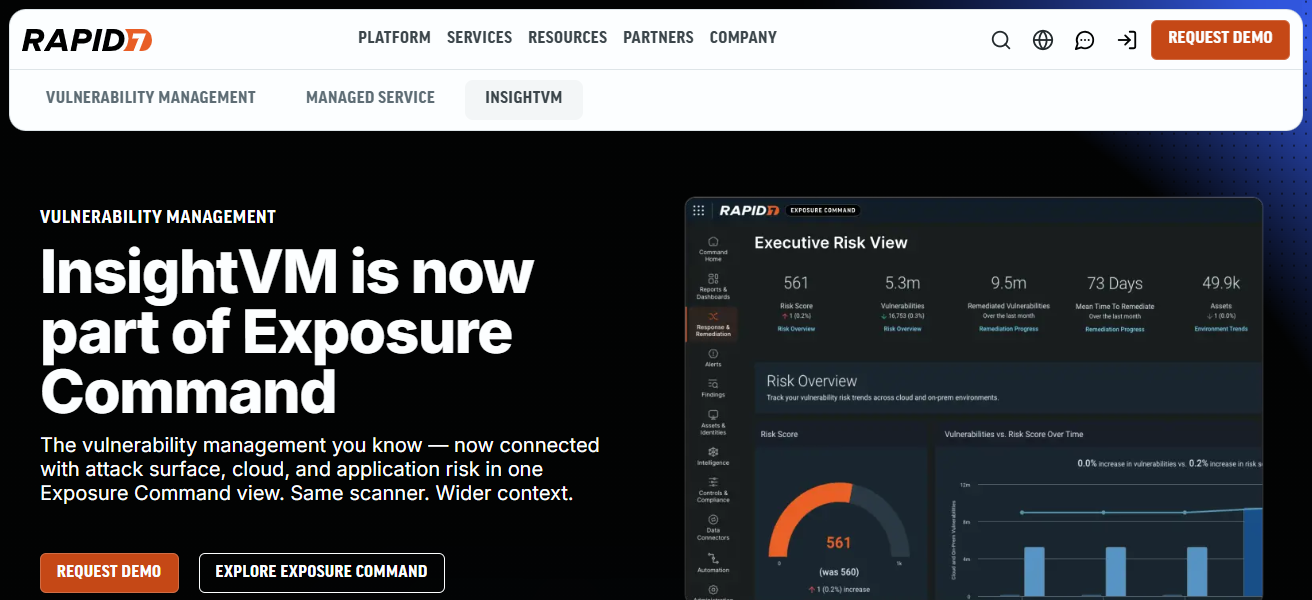
To assist customers in addressing risk, InsightVM employs live dashboards and scoring to prioritize risks.
Digital banking environments stress the importance of security automation, and InsightVM’s extensive DevOps and incident response integration makes it especially valuable.
Rapid7 InsightVM Features
- Automated remediation of vulnerabilities with real-time visibility of banking threats
- Live dashboards with risk-based prioritization and scoring
- Security and compliance checks for regulatory requirements
7. OpenVAS
Free to use and easy to implement, OpenVAS is great for use in banking infrastructure security for continuous monitoring of networks, servers, and applications.

OpenVAS is great for filling gaps and tuning to newly discovered vulnerabilities. Its cost and ease of use make OpenVAS a great option for performing internal security audits and compliance checks within the highly regulated financial markets.
OpenVAS Features
- Designed for scanning and identifying vulnerabilities for banking systems
- Includes rapidly evolving threat and vulnerability databases
- Scans for weaknesses in networks, servers, and applications
- Best for low-cost internal audits and compliance verifications
8. Nmap
Nmap is a great option for performing both network surveys and security audits and is deployed in nearly all banking environments for infrastructure surveys.
Nmap provides the capability to map out network hosts, open ports, and examine possible attack surfaces and vectors within financial networks.

Nmap is great for locating unknown devices and assessing network exposure. Because of this, Nmap is usually the first tool of choice in a penetration testing procedure.
Nmap Features
- Used for network and infrastructure mapping within banks
- Identifies active hosts on the network and the services open to them
- Finds unauthorized devices in banking networks
- One of the essential tools for penetration testing
9. Invicti
Invicti custom builds their advanced, automated web application security scanner for enterprise banking systems. Their methodology incorporates dynamic scanning and proof of vulnerability to reduce false positives.
Their latest engine, which includes an advancement in artificial intelligence, is capable of more complex and precise scoping of advanced vulnerabilities.

The advanced, automated nature of Invicti, as well as its seamless integration to DevOps to help safeguard the digital banking application deployment, is particularly important for banking clients.
Invicti Features
- Focuses on web application security testing and employs advanced scanning
- Proof-based vulnerability detection minimzes false positives
- Tailored for large-scale enterprise banking implementations
- Designed for seamless integration with DevOps for automated security testing
10. Core Impact
Core Impact is an automated, advanced penetration testing tool for banking systems that is designed to simulate advanced cyber attacks.
Core Impact allows security teams to evaluate cyber attacks using advanced phishing, lateral movements, and privilege escalation techniques.

Due to its automated penetration testing capabilities, Core Impact is popular among a variety of financial institutions as a tool for enhancing cyber defense and meeting the requirements of international standards for cyber defense.
Core Impact Features
- Creates real-world cyber attack scenarios to test banking security
- Advanced phishing, lateral movement and privilege escalation testing is automated
- Designed to find weaknesses in large enterprise banking systems
- Designed to assist in the fulfillment of compliance with the cybersecurity regulations and frameworks worldwide.
Conclsuion
In conclusion, protecting the security of modern banking systems from evolving cyber threats requires automated penetration testing software.
Programs like Burp Suite, Nessus, and Qualys VMDR find flaws, alert banks with security issues, and help banks comply with regulations.
Using tools with sophisticated automation helps banks minimize security concerns and improve cyber defenses. Choosing the right penetration test program helps banks defend against the loss of sensitive financial data and customer trust.
FAQ
Which is the best penetration testing tool for banks?
Tools like Burp Suite, Nessus, and Qualys VMDR are widely used in banking environments.
Why do banks need penetration testing tools?
Banks need these tools to protect financial data, prevent cyberattacks, and meet compliance requirements.
Is Nessus good for banking security?
Yes, Nessus is widely used for continuous vulnerability scanning and risk prioritization in banking systems.
What is the most powerful penetration testing framework?
Metasploit Framework is one of the most powerful tools for exploit-based penetration testing.