So in this article, I am going to write about the Ways To Receive International Payments Without Getting Currency Conversion Loss which will help freelancers or exporters and businesses to earn more money with hassle-free work.
In an era of $5 Trillion+ daily global transactions, it is vital to minimize hidden forex costs. Whether from multi-currency accounts, modern fintech and crypto solutions, the choice of method can help in bringing the prices down while also accelerating payment efficiency.
Key Points & Ways To Receive International Payments Without Currency Conversion Loss
Virtual Multi-Currency Accounts (Skydo/Payoneer/Wise) Virtual multi-currency accounts like Skydo allow receiving payments without conversion, holding funds in original currencies.
Skydo Skydo enables businesses to receive international payments directly in foreign currencies, avoiding unnecessary exchange rate losses.
Wise Business (formerly TransferWise) Wise Business enables local bank details globally, receiving payments in native currencies, avoiding exchange fees.
Airwallex Global Accounts Airwallex Global Accounts provide multi-currency IBANs, letting businesses collect payments without forced currency conversions international.
Payoneer Local Receiving Accounts Payoneer Local Receiving Accounts offer bank details worldwide, helping freelancers receive payments without conversion losses.
Xflow Xflow simplifies cross-border payments by allowing businesses to receive in preferred currencies, reducing conversion costs.
EEFC Accounts (Exchange Earners’ Foreign Currency) EEFC Accounts let exporters retain earnings in foreign currency, avoiding conversion and benefiting exchange timing.
Stablecoin Payments (USDC/USDT) Stablecoin payments using USDC or USDT enable transfers preserving value in dollars without conversion losses.
Razorpay MoneySaver Export Account Razorpay MoneySaver Export Account helps exporters receive international payments at competitive rates, minimizing forex margins.
Negotiated Bank-to-Bank SWIFT Transfers Negotiated bank-to-bank SWIFT transfers allow transactions with exchange rates, reducing fees and minimizing conversion losses.
10 Ways To Receive International Payments Without Currency Conversion Loss
1. Virtual Multi-Currency Accounts (Skydo/Payoneer/Wise)
One of the most effective ways to receive overseas payments with minimum conversion loss is through virtual multi-currency accounts.
Let your money work for you Skydo Payoneer Wise You can hold money in at least three currencies (USD, EUR and GBP) or receive funds.

As a result, businesses can save and eliminate any forced conversions and hidden forex margins. The users receive local bank details from within the country, so it is easier for clients to pay locally.
It also enhances transparency, lowers fees, and provides a better management control of when to convert funds.
| Pros | Cons |
|---|---|
| Hold multiple currencies without forced conversion, reducing forex losses significantly. | Account setup and compliance verification can take time for new users. |
| Provides local bank details, making payments easier for international clients. | Some platforms charge withdrawal or inactivity fees. |
| Better control over conversion timing to maximize exchange rate benefits. | Limited support for certain countries or niche currencies. |
| Transparent fee structures compared to traditional banking systems. | Requires understanding of forex management for optimal usage. |
| Faster settlements and seamless global payment experience. | Dependency on third-party fintech platforms instead of direct banking. |
2. Skydo
Skydo is built for Indian freelancers and exporters who wish to get international payments. The service offers virtual accounts in GBP, EUR, and USD which can be used for businesses to collect the payment where merchants are not required to do instant conversion.

This helps to save forex losses and concealed charges sometimes charged by conventional banks. Transparency and Swift settlements — JustSkydo is compliance with Indian regulations.
The platform streamlines the process of invoicing and payments tracking, which is why it sounds perfect for small businesses that want to get as much money into bank systems with minimal fuss around currency changes.
| Pros | Cons |
|---|---|
| Designed specifically for Indian freelancers and exporters. | Limited global brand recognition compared to bigger platforms. |
| Transparent pricing with no hidden forex margins. | Supports fewer currencies compared to some competitors. |
| Quick settlements directly to Indian bank accounts. | Still evolving features compared to mature fintech platforms. |
| Simplified invoicing and payment tracking tools. | May not suit large enterprises with complex needs. |
| RBI-compliant, ensuring regulatory safety for Indian users. | Limited integrations compared to global competitors. |
3. Wise Business (formerly TransferWise)
Wise Business is widely preferred by companies with customers across the globe. It gives you local bank account information in several countries that allows businesses to receive payments as if they were a local business.
You have access to funds without a forced conversion in more than 40 currencies, so that no currency-related loss occurs.

If conversion is needed, Wise uses the real exchange rates you would get on the open market when trading currencies so it brings transparency.
Its user-friendly dashboard, low fees, and rapid transfers make it perfect for startups and SMEs wanting to efficiently and cost-effectively manage international transactions.
| Pros | Cons |
|---|---|
| Real mid-market exchange rates with no hidden markup. | Charges small fees on currency conversion transactions. |
| Supports over 40 currencies for holding and receiving funds. | Not all features are available in every country. |
| Provides local bank details in major global markets. | Customer support response time can vary. |
| User-friendly dashboard for managing international payments. | Business account verification can be strict. |
| Fast transfers and highly transparent pricing model. | Some payment methods may have additional charges. |
4. Airwallex Global Accounts
Airwallex Global Accounts allow businesses to open multi-currency accounts in regions where no physical presence is required.
Companies can use currencies such as USD, EUR, AUD and more here they receive payments with out automatic conversions.

You can tailor this flexibility which enables businesses can have forex cut down and develop cash flow management. Airwallex also connects to payment gateways and accounting systems for a seamless experience.
The combination of competitive exchange rates and global reach makes it an excellent option for growing businesses that need effortless solutions to process international payments while holding control over currency exchange.
| Pros | Cons |
|---|---|
| Global multi-currency accounts without needing physical presence. | More suitable for businesses than individual freelancers. |
| Integrates with payment gateways and accounting tools. | Setup process can be complex for small businesses. |
| Competitive forex rates and reduced conversion costs. | Pricing structure may not be transparent for all services. |
| Supports multiple international currencies and regions. | Limited availability in some countries. |
| Ideal for scaling businesses with global operations. | Requires technical understanding for full utilization. |
5. Payoneer Local Receiving Accounts
Payoneer Local Receiving Accounts are your passport to being paid like a local freelancer, agency and business in the US, UK & EU.
In these regions, users are provided with bank information allowing clients to transmit domestic transfers as opposed to expensive international wires.
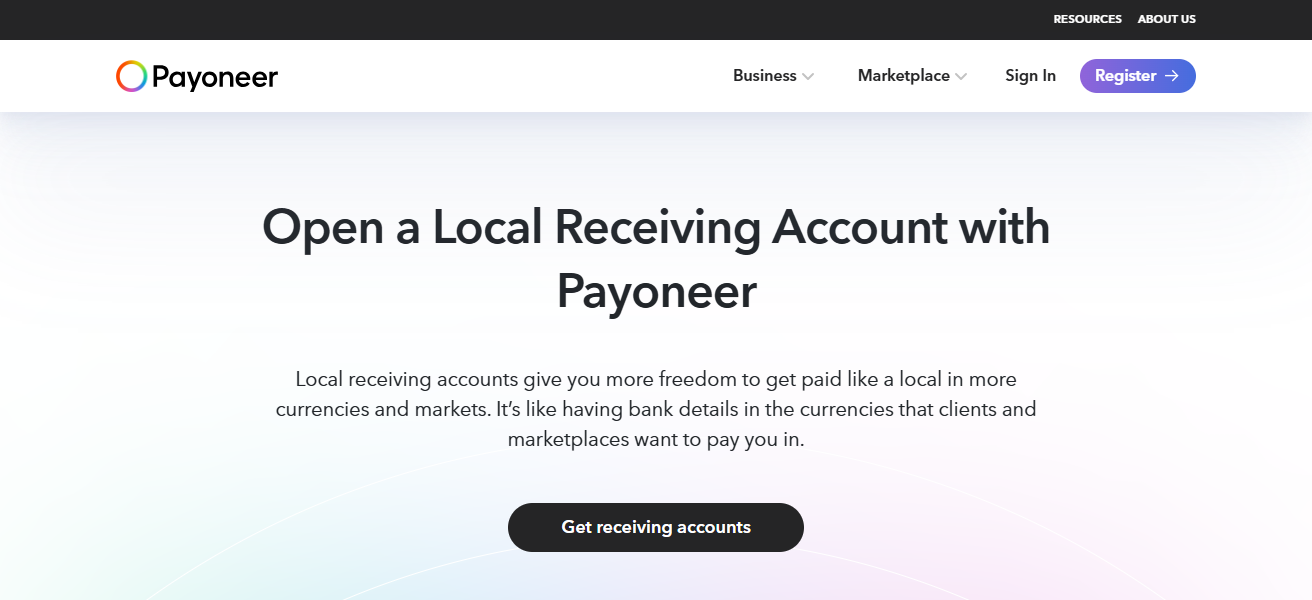
Institutions still can keep funds in foreign currencies, avoiding automatic conversion losses. Implementations of Payoneer-Impressively full and solid Withdrawals, global payments, sites applications that support integrations with marketplaces.
Therefore it is extremely beneficial for eCommerce sellers and freelancers who often encounter international clients and would like to eliminate payment friction as well as forex costs.
| Pros | Cons |
|---|---|
| Receive payments like a local in US, UK, and EU markets. | Withdrawal fees can be higher compared to some platforms. |
| Widely accepted by marketplaces and global clients. | Currency conversion fees may still apply when withdrawing. |
| Easy integration with freelance and eCommerce platforms. | Account approval and verification may take time. |
| Supports multiple currencies and global transfers. | Customer support can sometimes be slow. |
| Reliable and trusted fintech platform globally. | Limited control over exchange rates compared to some tools. |
6. Xflow
However, the focus of Xflow is to simplify international payments for Indian exporters and SaaS businesses. With a focus on minimizing forex losses, it helps users get paid directly in their desired foreign currencies without conversion.
Xflow offers transparency on pricing, real-time tracking, and compliance support for cross-border transactions.

And its platform has integrations with accounting and invoicing tools, resulting in fewer resource touches across the workflow.
This enables businesses to keep a higher proportion of their earnings, giving them the freedom to efficiently manage global payments at competitive exchange rates and lower fees.
| Pros | Cons |
|---|---|
| Focused on Indian exporters and SaaS businesses. | Relatively new platform with limited track record. |
| Transparent pricing and reduced forex conversion costs. | Fewer integrations compared to global competitors. |
| Real-time tracking and compliance support. | Limited currency options compared to major platforms. |
| Easy integration with invoicing and accounting tools. | May not suit very large enterprises. |
| Helps retain more revenue from international payments. | Availability and features still expanding. |
7. EEFC Accounts (Exchange Earners’ Foreign Currency)
Exporters & freelancers earning in foreign currency can open Exchange Earners’ Foreign Currency (EEFC) accounts with any Indian bank.
The accounts enable users to hold their income in foreign currency but not necessarily convert it into INR. This prevents conversion losses and enables businesses to convert these only when the exchange rates are going up.

Then, EEFC accounts are enabling you send and receive international payments and expenses directly in foreign currency.
Regulated by the Reserve Bank of India, they are a trusted vehicle for businesses wanting to hedge forex exposure effectively while being compliant.
| Pros | Cons |
|---|---|
| Hold foreign currency without immediate INR conversion. | Only available to exporters and foreign exchange earners. |
| Helps avoid forex losses and timing conversion strategically. | Limited flexibility compared to fintech platforms. |
| Regulated by RBI, ensuring safety and compliance. | Banks may charge maintenance or service fees. |
| Can be used for international payments and expenses. | Not ideal for frequent small transactions. |
| Reduces exposure to fluctuating exchange rates. | Requires proper documentation and compliance. |
8. Stablecoin Payments (USDC/USDT)
The use of stablecoin payments through USD Coin (USDC) and Tether (USDT), offers a more up-to-date solution from conventional banking systems.
They are cryptocurrencies backed by the US dollar to maintain a stable value and avoid currency conversion risks.

With incredibly low fees and near-instant settlement, businesses can now get paid around the world. This is ideal for everyone, but it works best for freelancers and digital businesses that deal with international clients.
Nonetheless, before you embrace this method, the user should ensure regulatory compliance, possible security issues with your wallet and risks over crypto volatility involving particular crypto platforms.
| Pros | Cons |
|---|---|
| Near-instant global transfers with minimal transaction fees. | Regulatory uncertainty in many countries. |
| Pegged to USD, reducing volatility compared to other crypto. | Requires knowledge of crypto wallets and security. |
| No traditional banking intermediaries involved. | Risk of platform hacks or wallet mismanagement. |
| Ideal for digital businesses and freelancers globally. | Limited acceptance among traditional businesses. |
| Eliminates currency conversion losses effectively. | Conversion to fiat may still incur fees. |
9. Razorpay MoneySaver Export Account
The Razorpay MoneySaver Export Account is design to help Indian exporters and freelancers receive global payments with less amount of forex charge.
You can benefit from favorable exchange rates, and contribute to transparency of processes since you won’t incur any undisclosed conversion fees — thus saving money for every transaction.
This platform accepts different currencies and enables fast settlements into Indian bank accounts.
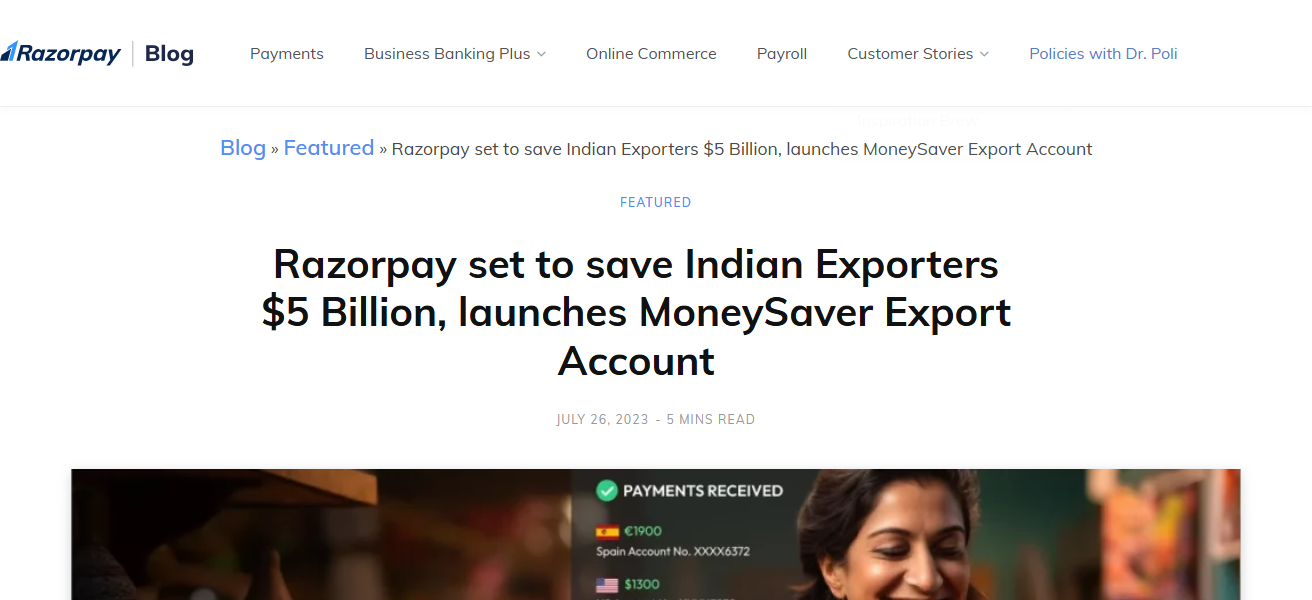
Razorpay is an all-in-one commerce solution, integrating invoicing and payment tracking along with compliance tools.
It is perfect for businesses needing a straightforward and inexpensive solution for handling cross-border payments secretly.
| Pros | Cons |
|---|---|
| Designed for Indian exporters and freelancers. | Limited to businesses operating within India. |
| Competitive forex rates with no hidden charges. | Not as globally versatile as some fintech platforms. |
| Quick settlements into Indian bank accounts. | Limited currency holding flexibility. |
| Integrated invoicing and payment tracking tools. | May require Razorpay ecosystem usage. |
| Easy compliance and regulatory support. | Not ideal for large multinational businesses. |
10. Negotiated Bank-to-Bank SWIFT Transfers
Optimisation of traditional SWIFT transfers can also be done on conditions with the bank related to a better exchange rate and lower fees.
As a result, large businesses/frequent exporters negotiate with banks to obtain better forex rates; conversion losses are thus reduced considerably.

Companies can also enhance outcomes by keeping funds in foreign currency accounts or postponing conversion.
Although SWIFT transfers are quite secure and extremely reliable, they also require using intermediaries that charge fees and tend to take longer.
With effective negotiation and strategic planning, this can be a more cost-effective method for businesses that regularly deal with high-value international transactions.
| Pros | Cons |
|---|---|
| Highly secure and globally accepted payment method. | Can involve high intermediary and processing fees. |
| إمكانية negotiating better forex rates for large transactions. | Slower processing times compared to fintech solutions. |
| Suitable for high-value international transactions. | Requires strong banking relationships for best rates. |
| Reliable for corporate and institutional payments. | Limited transparency in fee structures. |
| Widely supported by banks worldwide. | Less flexibility in holding multiple currencies. |
How We Choose Ways To Receive International Payments Without Currency Conversion Loss
Low or No Forex Markup – We prefer platforms that provide actual exchange rates and reasonable hidden charges.
Support for Multiple Currencies – You can store, accept, and pay with different currencies without having to convert.
Transparent Fee Structure – You should know the price you have to pay, without any hidden fees on receiving, holding or withdrawal of the funds.
Support for Global Payments – Local bank details offered for where it matters, US, UK and EU countries.
Settlement Speed – Fast processing and rapid fund transfers to betters the cash flow management.
Regulatory Constraints – Must follow national laws (for example, RBI in India) regulated and secured transfers.
User-Friendliness – Easy-to-navigate dashboard, invoicing and tracking capabilities allow seamless usage experience.
Integration Capabilities– With Accounting tools, Payment Gateways, And Business Platform.
Security & Reliability — Robust encryption, anti-fraud and the reputation of an overall trusted platform.
Conclsuion
In summary, selecting the best way to get foreign currency settlements without money conversion vermin can make a remarkable difference in your total revenues.
Multi-currency accounts, EEFC accounts and stablecoin payments can be used to prevent any additional forex charges.
Freelancers and businesses can choose transparent, affordable, and customizable options to structure global transactions more efficiently, enhance their bottom line, and gain better control over when money is exchanged between different currencies.
FAQ
What is currency conversion loss in international payments?
Currency conversion loss occurs when payments are automatically converted at unfavorable exchange rates, reducing the final received amount.
How do multi-currency accounts help avoid conversion loss?
They allow you to receive and hold funds in foreign currencies, avoiding forced conversion and hidden forex margins.
Which platforms offer multi-currency accounts?
Popular platforms include Wise, Payoneer, and Skydo.
Are EEFC accounts useful for Indian exporters?
Yes, EEFC accounts allow Indian exporters to retain foreign earnings without immediate INR conversion, reducing forex losses.