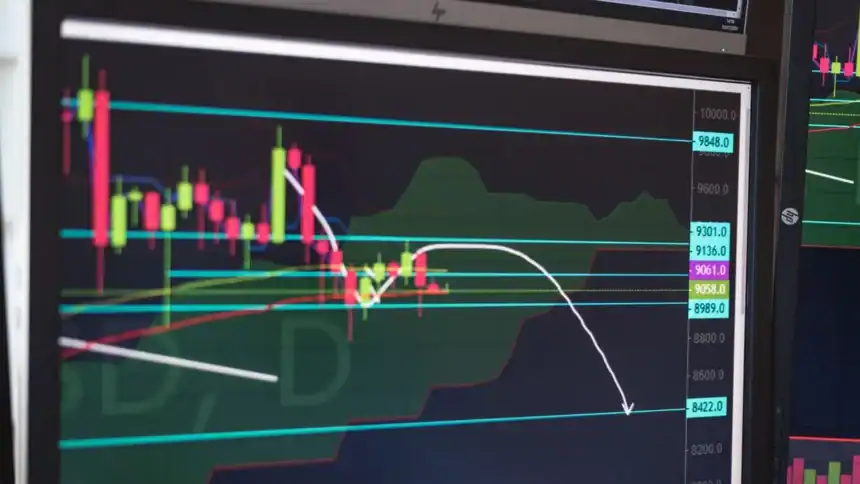
In this article, I will talk about the best crypto trading desks that employ artificial intelligence and automate trades. We will analyze how trading desks utilize AI to analyze markets and develop strategies to automate trades and manage orders and risk.
I will also analyze the features, advantages and disadvantages, and usage scenarios of these trading desks so that you can decide which trading desk is most appropriate for you.
What are autonomous AI crypto trading desks?
Automated AI crypto trading desks implement artificial intelligence to analyze market conditions and make trades on behalf of users. These trading systems allow traders to build strategies, analyze performance, place trades, and backtest strategies.
Trading bots execute orders for traders, allowing them to work with multiple markets at once. These systems allow traders to make money while they sleep and can automate time-consuming strategy and data-oriented tasks.
Traders can rely on these trading systems to provide them with real time updates, allowing them to trade at optimal times.
Key Points & Best Autonomous AI Agent Crypto Trading Desks
| Trading Desk | 1explanation |
|---|---|
| Hypertrade | AI trades crypto autonomously with deterministic risk controls protecting funds. |
| Binance Agent OS | Connects AI agents with Binance trading, market data, wallets, infrastructure. |
| OKX Agent Trade Kit | Lets AI analyze markets and execute spot, futures, margin, options. |
| GT Protocol | AI agents build, backtest, and execute strategies across major exchanges. |
| JW3.ai | Multi-chain autonomous agents execute trades with risk gates and safeguards. |
| YouFi | AI builds, backtests, paper-trades, and deploys onchain strategies non-custodially. |
| Stratium | AI trading desk analyzes markets, paper-trades, then enables controlled execution. |
| Bybull | AI agents monitor markets, backtest strategies, and optionally execute trades. |
| Walbi | AI agents trade crypto continuously using prompts or ready-made strategies. |
| Engine | Self-improving AI agents trade crypto continuously with non-custodial vaults. |
10 Best Autonomous AI Agent Crypto Trading Desks
1. Hypertrade
Hypertrade provides the ability to connect any relevant AI model like Claude or GPT and automate trading. The focus at Hypertrade is on perpetual markets through Hyperliquid.
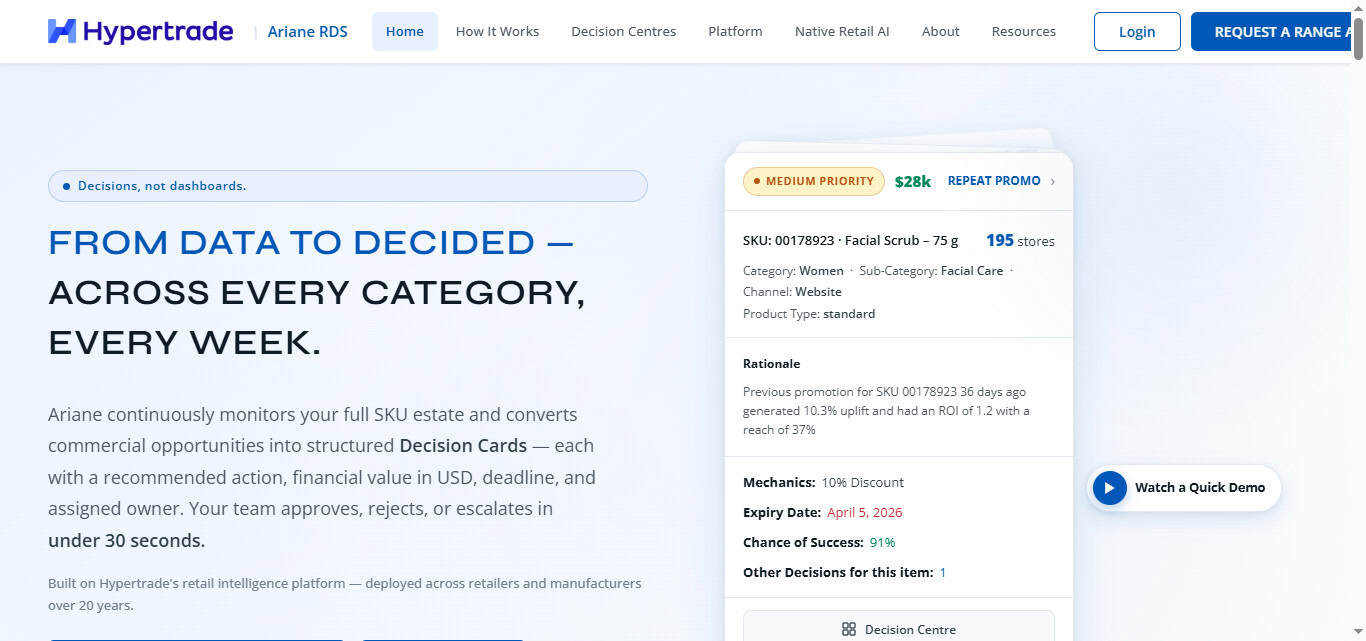
AI-based decision making is kept separate from enforcement of risk on trades by a deterministic risk engine which enables approval of orders plus the ability to resize or reject trades.
Users can set upper limits on their position and exposure plus daily loss limits. In addition, the trading agent’s funds wallet is set up so funds can’t be withdrawn.
Hypertrade — Pros & Cons
| Pros | Cons |
|---|---|
| Supports autonomous AI-powered trading workflows. | Primarily focused on perpetual trading markets. |
| Uses deterministic risk controls for trades. | Requires understanding of leverage and derivatives. |
| Supports AI models such as GPT, Claude, and Gemini. | Advanced features may be better suited to experienced traders. |
| Provides position and daily-loss controls. | AI decisions can still perform poorly in volatile markets. |
| Agent wallets restrict unauthorized fund withdrawals. | Platform availability and supported integrations can change. |
2. Binance Agent OS
Binance Agent OS is Daas (Data as a Service) and an infrastructure layer for AI Agents to interface with Binance’s financial offerings. This includes services for trading as well real-time market data and integrations of wallets and payments and on-chain services.

Users are able to build AI Agents that can operate within defined boundaries to perform trading. Users have the ability to set the available product offerings and funding limit, offering a more safe and defined environment surrounding the use of AI for financial autonomy.
Binance Agent OS — Pros & Cons
| Pros | Cons |
|---|---|
| Connects AI agents with Binance infrastructure. | More developer-oriented than beginner-focused. |
| Provides access to market and trading capabilities. | Requires careful configuration of agent permissions. |
| Supports programmable AI trading workflows. | Binance availability varies by jurisdiction. |
| Can integrate trading, wallets, and other financial functions. | Greater flexibility can introduce additional technical complexity. |
| Useful for developers building custom agents. | Users remain exposed to crypto-market volatility and execution risks. |
3. OKX Agent Trade Kit
The OKX Agent Trade Kit enables AI assistants to engage directly with the OKX trading system, thereby enabling access to market information and execution of orders.
OKX Agent Trade Kit supports a broad variety of order types – spot, futures, margin, options, grid, DCA, and algorithms. The specific order type supported varies depending on the account and region.

Developers can utilize the MCP server and command-line tools to create automated workflows. Demos and read-only modes offer safety features while users become familiar with real-world trading capital use.
OKX Agent Trade Kit — Pros & Cons
| Pros | Cons |
|---|---|
| Supports AI-assisted trading through natural-language commands. | Requires an OKX account and appropriate permissions. |
| Supports spot, futures, margin, and options capabilities. | Some features may vary by region. |
| Offers MCP and command-line integration options. | Derivatives introduce significant financial risk. |
| Provides demo and read-only possibilities. | Technical setup may challenge non-developers. |
| Suitable for building automated trading workflows. | AI-generated decisions are not guaranteed to be profitable. |
4. GT Protocol
One-stop solutions for crypto trading automation in AI strategy generation, backtesting, optimization, and execution are offered by GT Protocol. Before strategies are executed in real-world trading, traders can describe the systems and let AI generate strategies for assessment.
The backtesting is done in the context of strategies and historical data. GT Protocol provides tools for optimizing strategies and offers deployment of strategies on Binance and Hyperliquid.
The AI trading infrastructure demonstrates multi-agent decision-making and challenges trading. This makes GT Protocol interesting for users interested in agent-based portfolio management and strategy automation.
GT Protocol — Pros & Cons
| Pros | Cons |
|---|---|
| Combines AI strategy creation and backtesting. | Strategy results depend heavily on testing assumptions. |
| Supports strategy optimization. | Historical performance cannot guarantee future returns. |
| Can connect strategies with major trading platforms. | Automated strategies can fail during unusual market conditions. |
| Uses AI-based approaches to evaluate trading decisions. | Advanced functionality may require technical understanding. |
| Useful for experimenting with systematic strategies. | Platform integrations and supported exchanges may change. |
5. JW3.ai
JW3.ai has the spot markets covered while other platforms focus on futures markets. JW3.ai’s autonomous trading agents offer trading across CEXs and DEXs through decentralized market infrastructure such as Hyperliquid and dYdX.
JW3.ai incorporates risk and loss limits as well as trading execution controls while still having a non-custodial execution environment.

Users retain control of their wallet signing. JW3.ai supports risk management and provides grids and other trading strategies. AI market analysis tools and automated DeFi tools are available.
JW3.ai — Pros & Cons
| Pros | Cons |
|---|---|
| Supports multi-chain AI trading agents. | Multi-chain systems can introduce additional complexity. |
| Provides multiple automated strategy types. | Users need to understand DeFi and exchange risks. |
| Includes daily-loss limits and circuit breakers. | Automated trading still carries substantial market risk. |
| Offers kill-switch functionality. | Supported chains and exchanges may change over time. |
| Emphasizes non-custodial wallet control. | More advanced than a simple buy-and-hold platform. |
6. YouFi
YouFi does not require traditional programming to create on-chain trading strategies. Users can describe a trading strategy, and the AI transforms the description into on-chain trading strategies using pre-built trading blocks.
YouFi supports historical backtesting, paper trading with live prices, and non-custodial execution through its decentralized routing infra.
Its risk system integrates walk-forward testing, Monte Carlo analysis, out-of-sample verification, and overfitting checks. Users currently find the platform in closed alpha.
YouFi — Pros & Cons
| Pros | Cons |
|---|---|
| Allows strategies to be created using plain language. | Platform development stage may limit availability. |
| Supports historical strategy backtesting. | Backtests can differ significantly from live performance. |
| Provides paper-trading functionality. | On-chain execution introduces blockchain-related risks. |
| Includes multiple methods for evaluating strategy robustness. | Advanced testing concepts may require learning. |
| Designed for non-custodial strategy execution. | Closed-alpha availability can restrict accessibility. |
7. Stratium
Stratium has developed an AI crypto trading desk focused on transparent paper trading before real capital is brought into play. It uses the Coinbase data stream for BTC, ETH, SOL, and XRP synchronously, allowing its AI to assess short term market movements and flow.
Stratium writes justifications for paper trades for each agent execution, offering users the reason for trade entry and exit.
Traders set a daily loss limit, position size, and maximum risk per trade before funding the account. Live trade is available, but requires the user to activate funding.
Stratium — Pros & Cons
| Pros | Cons |
|---|---|
| Emphasizes paper trading before live execution. | Live trading requires additional user setup. |
| Provides explanations for AI-generated trades. | Current market coverage may be relatively limited. |
| Offers configurable risk controls. | Short-term trading can generate frequent losses. |
| Uses live market information for analysis. | AI analysis does not guarantee accurate predictions. |
| Useful for testing AI trading ideas cautiously. | Less suitable for traders seeking extensive multi-exchange functionality. |
8. Bybull
Bybull is an AI trading desk which combines strategy creation, market monitoring and trading automation and backtesting, and natural language rule-based strategy creation. Users define rules and create workflows involving triggers, conditions, alerts, and actions.
Building on user control, Bybull places its agents in notification-only mode, meaning automated agents wait for user instruction to execute a trade. Traders define maximum risk per trade, position size, daily loss limit, and record activity for all automated actions.
Bybull’s backtesting tool allows users to study historical trade activity, assess drawdown, win rate, trade performance before executing trades.
Bybull — Pros & Cons
| Pros | Cons |
|---|---|
| Allows strategies to be described conversationally. | Automated execution should be configured carefully. |
| Supports backtesting before deployment. | Backtesting cannot perfectly replicate live markets. |
| Provides market monitoring and alerts. | Beginners may need time to understand strategy conditions. |
| Includes configurable trading and risk parameters. | AI strategies can behave unexpectedly in extreme markets. |
| Auto-execution can be enabled deliberately. | Availability of integrations and features may change. |
9. Walbi
Walbi is an AI-based crypto trading platform that lets users create strategies involving market monitoring in autonomous trading scenarios.
Users either choose an agent from Walbi’s marketplace or build their own using natural language commands. Walbi calls their agents adaptive systems because instead of following predefined rules, they make decisions based on real-time market data.
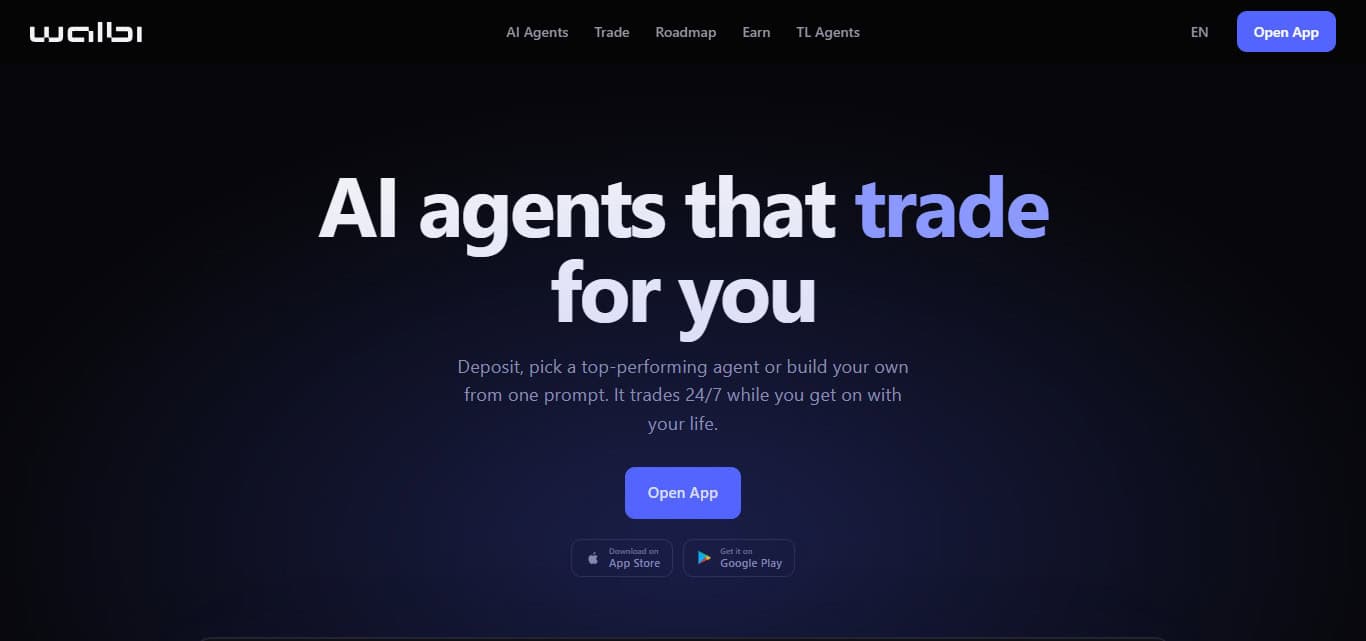
Customizable time frames, risk limits, exit and entry conditions, and asset configuration are provided. Users’ agents can work continuously, and the platform supports backtesting. Walbi also provides an option to pause the automation and make changes on-the-fly.
It also provides users with a platform to continuously analyze market data and trade execution commands. Ensuring that trading decisions are not solely made based on market data, Walbi provides users the ability to stop their agents and withdraw funds at any time.
Walbi — Pros & Cons
| Pros | Cons |
|---|---|
| Uses AI agents for continuous market monitoring. | Continuous trading can increase transaction costs. |
| Allows users to create strategies with natural language. | AI strategies may perform differently across market conditions. |
| Provides ready-made trading agents. | Users should independently evaluate agent performance. |
| Supports strategy customization and automation. | Crypto volatility can result in significant losses. |
| Designed for users wanting less manual monitoring. | Automated trading still requires ongoing supervision. |
10. Engine
Engine is a continuous AI trading platform for crypto and other financial markets. Users can trade using ready-made agents or by creating their own using simple trading descriptions for market, signals, and risk. Engine offers a unique vault system where users‘ funds are deposited, and within the vault the agents are free to trade, but cannot withdraw funds.

This leaves a non-custodial structure. Engine works to analyze and execute orders in markets continuously. Users can stop agents or choose to withdraw funds at any time. Rather than focusing on exhaustively monitoring trading markets, Engine focuses on automated decision making.
Engine — Pros & Cons
| Pros | Cons |
|---|---|
| Designed for continuously operating AI trading agents. | Autonomous execution increases the importance of risk controls. |
| Supports user-created trading strategies. | AI strategies can produce unexpected results. |
| Uses individual vaults for trading capital. | Availability and supported markets can evolve. |
| Agents cannot independently withdraw deposited funds. | Users still face market, liquidity, and execution risks. |
| Reduces the need for constant manual monitoring. | Requires careful evaluation before depositing significant capital. |
How We Choose The Best Autonomous AI Agent Crypto Trading Desks
- AI Autonomy: We look for market analysis and trade execution done by agents on their own.
- Trading Features: We check the features for supported strategies, assets, exchanges, and trading features.
- Risk Management: We analyze the safety measures as well as limits, controls, and emergency systems.
- Backtesting: We check the tools provided for strategy testing against historical market data.
- Security: We look for protection on trading wallets, permissions, custody, and trading platform security.
- Ease of Use: We check the trading interface and how easy the trading features and setup are.
- Automation: We check if trading is automated with continuous monitoring and trading execution, and trading alerts.
- Performance Transparency: We check for trading performance with reporting, trade history, and trading strategy performance.
Conclusion
The Best Autonomous AI Agent Crypto Trading Desks include useful tools for market analysis automation, automation of trading strategy and execution, and management of trading risk. Each platform provides different tools and automation levels for traders at different stages.
AI trading, however, is not a money-making machine. There are security and fee considerations, as well as the markets and trading risk controls supported. You also need to consider your trading needs and preferences.
FAQ
How do AI trading agents make crypto trading decisions?
AI agents can analyze market prices, technical indicators, trading signals, historical data, and predefined risk parameters to identify potential trading opportunities and determine when to enter or exit positions.
Are autonomous AI trading desks profitable?
No platform can guarantee profits. AI trading systems can improve automation and market monitoring, but cryptocurrency markets are highly volatile, and trading strategies can experience losses.
What are the best autonomous AI agent crypto trading desks?
Popular platforms and infrastructure include Hypertrade, Binance Agent OS, OKX Agent Trade Kit, GT Protocol, JW3.ai, YouFi, Stratium, Bybull, Walbi, and Engine. Their features, markets, automation levels, and availability differ.
Can AI agents trade cryptocurrency automatically?
Yes, some platforms allow AI agents to execute trades automatically once users provide appropriate permissions, trading capital, strategies, and risk controls. Other platforms may require confirmation before execution.