This article focuses on the best parallel EVM DEXs for ultra-fast trading. Next generation decentralized exchanges use parallel execution, high throughput networks, and optimized AMMs.
Each of them offers ultra-fast trading swaps and redefines the standards for decentralized trading across several blockchains. They offer traders unfettered speed, superior efficiency and seamless liquidity movement across all orders of concerns.
Key Points & Best Parallel EVM DEXs for Ultra-Fast Trading
- Uniswap v3 — Concentrated liquidity enables ultra‑efficient swaps with minimal slippage and fees.
- SushiSwap — Multi‑chain AMM offering fast trading, yield farming, and cross‑network liquidity.
- Balancer — Customizable weighted pools optimize parallel execution and high‑speed trade batching.
- Curve Finance — Stablecoin‑focused AMM delivering extremely low slippage and rapid settlement efficiency.
- PancakeSwap — BNB Chain DEX enabling fast swaps, staking rewards, and scalable liquidity.
- Trader Joe — Avalanche‑native DEX combining rapid swaps, lending, and parallel liquidity routing.
- QuickSwap — Polygon DEX offering ultra‑fast trades through low‑cost parallel EVM execution.
- SpookySwap — Fantom‑based AMM enabling high‑speed swaps with efficient parallel transaction processing.
- Velodrome — Optimism DEX using ve‑model incentives for fast, deep, stable liquidity.
- Camelot — Arbitrum‑native DEX providing rapid trades via modular, parallel liquidity architecture.
10 Best Parallel EVM DEXs for Ultra-Fast Trading
1. Uniswap v3
One of the Parallel EVM DEXs for Ultra-Fast Trading is Uniswap v3. Uniswap v3’s use of concentrated liquidity allows LPs to focus their capital on specific ranges thus leading to increased capital efficiency.
This design leads to less slippage, increased execution speed, and increased support for fast parallel transactions on different EVM chains. Swap execution on Uniswap v3 is faster and costs less due to the optimized routing of swaps.

The use of permissionless deployment across multiple trading ecosystems draws custody to Uniswap v3, and the design of different fee tiers supports varied trading strategies. Multi-chain deployment with the aim of providing precision, minimal overhead on trades, as well as scalability, makes Uniswap v3 a valuable trading asset.
Uniswap v3 – Features
- Concentrated liquidity – LPs can allocate capital to only specific price ranges which leads to increased capital efficiency.
- Low slippage – Decreased price impact on large trades due to optimised liquidity bands.
- Parallel execution – Fast and scalable trading is possible thanks to the deployment of Uniswap across multiple EVM-based chains.
- Multiple fee tiers – Different types of trading and different fee structures can be used to meet different demand.
| Pros | Cons |
|---|---|
| Concentrated liquidity improves capital efficiency within selected price ranges. | LPs must actively manage positions when prices move outside ranges. |
| Multiple fee tiers accommodate different trading strategies and market conditions. | Complex liquidity management can be difficult for inexperienced users. |
| Permissionless deployment supports broad EVM ecosystem adoption. | Liquidity can become fragmented across different chains and deployments. |
| Optimized swap routing can help reduce unnecessary execution overhead. | Highly competitive pools may offer limited returns for liquidity providers. |
2. SushiSwap
One of the Parallel EVM DEXs for Ultra-Fast Trading is SushiSwap. SushiSwap’s AMM design coupled with strong multi-chain support places it among the fastest and most efficient trading platforms across multiple EVM networks.
Thanks to SushiSwap’s cross chain liquidity provision, trading is less congested and more efficient. Capital efficiency amplified by BentoBox and Kashi lending systems facilitates parallel trading in multiple ecosystems.
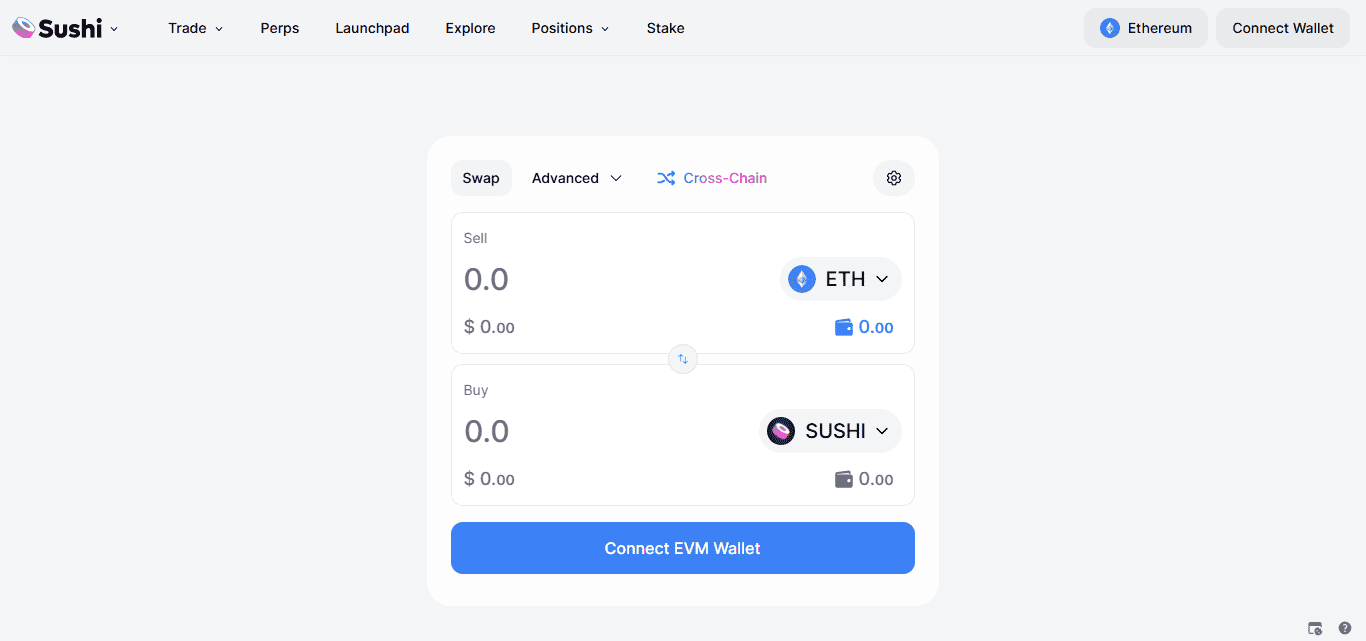
SushiSwap’s strong community-centered design and continued product innovation positions it as a top trading platform for high speed trading, multi-flow trading, and cross-platform trading. Multi-chain and cross-platform design is SushiSwap’s focus.
SushiSwap – Features
- Cross-chain liquidity – Trading across multiple EVM networks is possible with reduced congestion.
- BentoBox efficiency – An improvement in capital efficiency for parallel operations is thanks to the smart vault system.
- Kashi lending – Isolated lending markets provide flexibility for leverage trading.
- Multi-chain expansion – An improvement in speed and accessibility is thanks to an ecosystem that has a huge presence across multiple networks.
| Pros | Cons |
|---|
| Multi-chain availability gives traders access to diverse EVM ecosystems. | Liquidity depth can differ considerably between supported networks. |
| BentoBox expands capital utilization across supported DeFi applications. | Multiple products can make the platform harder for beginners to navigate. |
| Community-driven development encourages continuous ecosystem expansion. | Cross-chain activity can introduce additional transaction and bridging considerations. |
| Broad DeFi functionality supports trading, lending, and yield strategies. | Smaller markets may experience wider spreads than deeper pools. |
3. Balancer
Balancer utilizes customizable weighted pools and state-of-the-art dynamic AMM design to make it one of the best Parallel EVM DEXs for ultra-fast trading. Taking advantage of design flexibility, traders can batch trades across multiple EVM networks.
Worrying about which routes will save trade execution time and risk slippage is a concern of the past thanks to Balancer’s smart routing system. With an eye towards institutional use, Balancer’s system is architected to be easily integrated with other DeFi components.

The use of features like boosted pools and integration with large chains creates an environment optimized to exceed the demands for high throughput and quickly execute complex multi-asset trades.
Balancer – Features
- Custom pool weights – Advanced multi-asset trading strategies are possible thanks to flexible ratios.
- Smart routing – Slippage is minimized thanks to a system that finds the best possible swap paths.
- Boosted pools – Pools with higher liquidity are available for institutions and large traders.
- DeFi composability – Integrates with most other protocols to enable complex trading strategies.
| Pros | Cons |
|---|
| Custom pool weights enable flexible multi-asset portfolio construction. | Weighted pools require greater understanding than simple 50/50 AMMs. |
| Smart routing can identify efficient paths across available liquidity. | Complex routing may involve several pools and increase execution complexity. |
| Boosted pools can improve capital utilization for supported assets. | Pool performance depends heavily on available underlying liquidity. |
| Architecture integrates effectively with broader DeFi applications. | Advanced pool configurations may increase risks for inexperienced LPs. |
4. Curve Finance
Curve Finance is recognized as one the best Parallel EVM DEXs for ultra-fast trading because of its strong focus on stablecoins. Curve’s innovative AMM slips are almost imperceptible when trading stablecoins, thus improving trades during periods of higher market volatility.
Through the use of sophisticated algorithms, Curve is able to achieve rapid trade execution and consistent performance across multiple EVM networks. The high level of liquidity in Curve’s pools brings in market participants to trade in this environment.

Curve’s integration of various networks and it’s veCRV model also improves the stability of the ecosystem. For those demanding the highest efficiency when trading stable coins, Curve still leads the pack when speed and low transaction costs are paramount.
Curve Finance – Features
- Stablecoin‑optimized AMM – Pegged assets and stablecoin trades can be executed with extremely low slippage.
- High liquidity depth – Predictable pricing is maintained even during price volatility thanks to very deep pools.
- veCRV incentives – Strong liquidity is encouraged thanks to a governance model.
- Multi-chain performance – Execution speeds are consistent across many EVM networks.
| Pros | Cons |
|---|
| Specialized AMM curves are designed for efficient stablecoin trading. | Performance is less suited to highly volatile asset pairs. |
| Deep stablecoin liquidity can support substantial trading volumes. | Pool exposure may involve stablecoin-specific depeg risks. |
| veCRV governance aligns liquidity incentives with ecosystem participation. | Understanding Curve’s governance and incentive structure can be complex. |
| Multi-network deployment expands access to stablecoin markets. | Liquidity and available pools vary across individual networks. |
5. PancakeSwap
Due to its deployment on BNB Chain, PancakeSwap is one of the best Parallel EVM DEXs for ultra-fast trading. BNB Chain has low fees and high throughput. All PancakeSwap liquidity pools are easy for developers to scale, so trading, staking and yield farming have no issues with quickly changing user demand.

In fact, PancakeSwap’s AMM design is the best on the market because it minimizes slippage during huge spikes in trading activity. Beyond its core product, its DEX, PancakeSwap has built an ecosystem of prediction markets, lotteries, and NFTs.
It continues to develop its product and expand to other parallel EVM infrastructures. This means traders will continue to have a very fast trading environment to execute trades against on theParallel EVMs.
PancakeSwap –Features
- Fast, low cost swaps – BNB Chain high throughput means fast and efficient trades.
- Scalable pools – pools can handle trade, stake and farm activity at volume.
- AMM slippage minimization – minimize slippage as peak market activity occurs.
- Expanded ecosystem – further includes predictions, lotteries, NFTs and cross chain.
| Pros | Cons |
|---|
| BNB Chain provides a low-cost environment for frequent transactions. | Heavy dependence on BNB Chain exposes users to network-specific conditions. |
| Large ecosystem supports swapping, farming, staking, and other DeFi activities. | The broad feature set may distract users seeking a simple trading interface. |
| Extensive liquidity supports trading across numerous token pairs. | Less-liquid tokens can still experience substantial price impact. |
| Continued multi-chain expansion increases accessibility across networks. | Cross-chain usage can introduce additional operational complexity. |
6. Trader Joe
Due to its native integration with Avalanche, Trader Joe is one of the best Parallel EVM DEXs for ultra-fast trading. Avalanche has sub-second finality and a high degree of parallel processing. This means Trader Joe is able to provide fast swaps and efficient liquidity routing.

Trader Joe has integrated trading, lending, and yield farming to provide a unified and simplified interface. Its Liquidity Book AMM innovates on the design of traditional AMMs with dynamic fees, tighter spreads, and concentrated liquidity.
Trader Joe is an excellent option for traders who want a fast and efficient trading environment but also want to utilize advanced DeFi features.
Trader Joe – Features
- Sub-second finality – Avalanche enables ultra fast settlement and parallel execution.
- Liquidity Book AMM – Dynamic fees and concentrated liquidity improve efficiency.
- Unified DeFi suite – trading, lending, and farming in one place.
- Smart routing – further enhance speed of execution.
| Pros | Cons |
|---|
| Liquidity Book uses bins to provide a more granular liquidity structure. | Liquidity providers need to understand bin-based liquidity management. |
| Dynamic fees can adapt to changing market conditions. | Fee changes can make expected trading costs less predictable. |
| Integrated lending and yield products create a broader DeFi ecosystem. | Advanced features increase the learning curve for new users. |
| Avalanche infrastructure supports rapid transaction confirmation. | Trading activity can vary significantly between Avalanche markets. |
7. QuickSwap
Whereas most DEXs are constrained by hardware limitations, QuickSwap is the best Parallel EVM DEX for ultra-fast trading, as it was built on Polygon which greatly reduces time and cost for transactions.
QuickSwap’s AMM ensures fast and cost efficient trading for retail or institutional investors. QuickSwap’s efficient routing system allows parallel execution for transactions on Polygon and leverages Polygon’s scalable technology.

QuickSwap has deep liquidity, offers yields for users by farming, and integrates a comprehensive list of DeFi protocols, making it ideal forusers looking for the best trading platforms.
With how quickly Polygon is growing, and with how quickly QuickSwap is upgrading its offerings, traders benefit from fast, reliable trading at low costs, and allows for a high level of trading with the platform and DeFi activities.
QuickSwap –Features
- Low cost trading – Polygon scaling drastically lowers gas costs.
- AMM for fast trades – retail and institutional swaps are executed at maximum speed.
- Advanced routing – transactions executed in parallel across Polygon’s platform.
- Optimal yield farming – deep liquidity across active DeFi integrations.
| Pros | Cons |
|---|---|
| Polygon infrastructure enables relatively low-cost DeFi transactions. | Network congestion can still affect execution during periods of high demand. |
| Broad token and liquidity support gives traders multiple market choices. | Smaller pools may provide less competitive execution. |
| Farming and other DeFi integrations increase capital-use opportunities. | Yield opportunities can carry additional smart-contract and market risks. |
| Routing infrastructure helps users access available Polygon liquidity. | Users primarily active outside Polygon may face additional bridging steps. |
8. SpookySwap
Because of Fantom’s DAG architecture, SpookySwap is easily one of the best Parallel EVM DEXs for ultra-fast trading.SPookySwap facilitates fast, efficient transactions. SpookySwap uses an AMM (automated market making) model which means transactions will be executed fast and there will be low slippage.

In addition to fast trading execution and top level liquidity, SpookySwap has yield farming and integrated cross-chain transaction technology. As long as a trading platform has a dedicated user base like SpookySwap’s, users can rely on SpookySwap for their high-speed trading needs.
Finality on Fantom is very fast and allows SpookySwap’s optimized routing technology to process transactions fast and facilitates SpookySwap’s spot as the go-to for ultra-fast DeFi based trading.
SpookySwap – Features
- DAG architecture – Fantom’s architecture enables transactions to be fast and low latency.
- AMM – designed for fast swaps with minimum price impact.
- Cross chain – multiple trading and liquidity movements supported.
- Community – engaged users enable liquidity and activity.
| Pros | Cons |
|---|---|
| Fantom infrastructure supports rapid transaction confirmation. | Platform activity is closely tied to the Fantom ecosystem. |
| AMM-based trading provides a straightforward swap mechanism. | Lower-volume pairs can experience greater price impact. |
| Yield farming adds additional opportunities beyond token swaps. | Farming returns can fluctuate significantly with token prices and incentives. |
| Cross-chain functionality expands access beyond the native network. | Cross-chain transactions introduce additional technical and execution considerations. |
9. Velodrome
Velodrome is a top-rated Parallel EVM DEX for ultra-fast trading due to its deployment on Optimism, a leading Layer-2 scaling solution. Velodrome’s ve-model drives deep constant liquidity that enables Velodrome to facilitate fast and efficient trades.
Velodrome’s AMM design supports low-slippage swaps and optimized routing within Optimism’s high-speed infrastructure. Velodrome’s governance system encourages long-term liquidity alignment that positively impacts the overall market stability of Velodrome.

Together with its strong partnerships and rapid settlement services, Velodrome provides a fast, cost-effective environment for high-frequency trading on the Parallel EVM framework.
Velodrome – Features
- ve‑model liquidity — Real liquidity improves order execution.
- Optimism scaling — The advantage of trading on Optimism is significantly lower costs on a network that is significantly faster.
- Low-slippage swaps — An AMM (Automated Market Maker) has been optimized to provide efficient routing.
- Strong partnerships — Strong partnerships incentivize liquidity providers to offer greater liquidity.
| Pros | Cons |
|---|---|
| Optimism provides a low-cost environment for frequent DeFi transactions. | Users remain exposed to the operational characteristics of the Optimism network. |
| ve-based incentives encourage liquidity participation around selected markets. | Governance-based incentives can make returns difficult to predict. |
| AMM infrastructure supports efficient swaps within the ecosystem. | Liquidity concentration may vary substantially between trading pairs. |
| Strong Optimism ecosystem integration provides access to related DeFi applications. | Users operating acros |
10. Camelot
Camelot is one of the top Parallel EVM DEXs for ultra-fast trading due to its deployment as a native app on Arbitrum along with its modular architecture.
Arbitrum uses rollup technology to execute fast, low-cost transactions, and Camelot’s customizable liquidity pools allow efficient parallel executions. Camelot offers advanced DeFi users a platform with dynamic AMM, yield farming, and permissionless liquidity pool creation.

Trade performance is further enhanced by Camelot’s Nitro upgrades. Together with strong community governance and ecosystem integrations, Camelot offers a fast, high-capacity trading environment ideal for users looking for the best trading conditions on the Parallel EVM networks.
Camelot –Features
- Rollup-enabled speed — Arbitrum makes parallel and cheap transactions possible.
- Modular liquidity — Flexible pools allow complex trading scenarios.
- Nitro routing — Improves efficiency of swaps and liquidity depth.
- Permissionless pools — DeFi builders have pool creation flexibilty.
| Pros | Cons |
|---|---|
| Arbitrum provides scalable infrastructure for lower-cost transactions. | Trading activity depends substantially on Arbitrum ecosystem demand. |
| Permissionless pools allow projects to create markets without centralized approval. | Newly created pools may have limited liquidity and higher price impact. |
| Dynamic AMM features provide flexibility for different liquidity requirements. | Advanced pool mechanics require additional knowledge from liquidity providers. |
| DeFi integrations support trading alongside farming and liquidity strategies. | Smart-contract and liquidity risks remain relevant across its DeFi products. |
Conclusion
In Conclusion The Best Parallel EVM DEXs for Ultra-Fast Trading are designed for next-generation decentralized trading optimized for modern multi-chain ecosystems. Built upon optimized AMMs, deep liquidity, and parallel execution, such platforms are designed to redefine high-performance trading in the decentralized world.
Their cutting-edge designs provide seamlessSwap, lower slippage, and constant high throughput, and for that reason, they are irreplaceable for the DeFi ecosystem for high-velocity trading. Key point: Next generation decentralized trading is built upon high-speed parallel execution.
FAQ
What are Parallel EVM DEXs?
They are decentralized exchanges optimized for concurrent blockchain transaction processing.
Why use Parallel EVM DEXs for fast trading?
They can improve transaction throughput, reducing delays during busy periods.
Which DEXs support concentrated liquidity?
Uniswap v3 uses concentrated liquidity to improve capital efficiency significantly.
Why is SushiSwap suitable for multi-chain trading?
SushiSwap supports multiple EVM networks, expanding available trading opportunities globally.