In this article, I will discuss the SaaS Platforms Helping Fintech Startups Launch Without a Tech Team, highlighting how modern no-code and API-driven solutions simplify product development.
These platforms enable founders to build, launch, and scale financial services without heavy engineering, reducing costs and time-to-market while ensuring compliance, security, and seamless user experiences in today’s competitive fintech landscape.
Key Points & SaaS Platforms Helping Fintech Startups Launch Without a Tech Team
- Unit enables fintech startups to launch banking features without coding or infrastructure.
- Swan provides embedded banking APIs, helping startups build financial products without engineers.
- Galileo offers scalable payment processing and card issuing solutions for fintech startups.
- Marqeta delivers a card issuing platform with flexible APIs enabling rapid product launches.
- SDK.finance supplies a modular core banking platform for building products without in-house developers.
- Blaze. Tech is a no-code platform letting startups create fintech apps without technical teams.
- Bubble allows visual programming to build fintech applications without writing traditional code.
- FlutterFlow helps design and launch mobile fintech apps using drag-and-drop tools easily.
- Persona provides identity verification and compliance tools for fintech onboarding without engineering.
- Signzy offers AI-powered KYC and onboarding solutions for fintech startups to scale operations effortlessly.
10 SaaS Platforms Helping Fintech Startups Launch Without a Tech Team
1. Unit
By providing a completely embedded financial platform that eliminates the need for complex engineering, Unit is revolutionizing the way fintech firms begin.
Using pre-built white-label banking components, such as accounts, cards, and bill payment, startups can go online in as little as two to three weeks.
Unit’s “zero-build” methodology, which requires little code but permits customization through APIs, is what makes it appealing.

SaaS firms are rapidly integrating financial services, leveraging Unit to open up new income streams, including interchange fees, according to recent usage patterns.
Scalability for non-technical entrepreneurs is further improved by its real-time analytics dashboard and interfaces with programs like Plaid and QuickBooks.
| Pros | Cons |
|---|---|
| Fast launch within weeks using pre-built financial infrastructure components | Limited flexibility for highly complex custom fintech use cases |
| No heavy engineering required, ideal for non-technical founders | Pricing may be higher for early-stage startups with low volume |
| Strong integrations with tools like Plaid and QuickBooks | Dependency on partner banks may limit global expansion |
| Real-time analytics dashboard improves financial visibility | Customization still requires some API understanding |
2. Swan
As a Banking-as-a-Service platform for entrepreneurs without internal developers, Swan is quickly gaining popularity in Europe.
It allows companies to handle regulatory issues like licensing and compliance while integrating accounts, cards, and payments straight into their offerings.

Swan’s European IBAN infrastructure, which enables companies to operate effortlessly across various nations, is its most notable feature.
Swan’s attractiveness for SaaS systems and marketplaces looking to monetise financial flows is highlighted by recent fintech trends.
Swan is one of the easiest ways to enter embedded banking nowadays because of its modular API stack and pre-built compliance layers, which lower technical and regulatory barriers.
| Pros | Cons |
|---|---|
| European IBAN support enables seamless multi-country operations | Primarily focused on Europe, limited global availability |
| Handles compliance, licensing, and regulatory complexities automatically | Less flexibility compared to fully custom banking stacks |
| Easy-to-use APIs for embedding banking features quickly | Pricing structure may not suit very small startups |
| Strong for SaaS and marketplace monetization models | Primarily focused on Europe, with limited global availability |
3. Galileo
One of the most well-known fintech infrastructure suppliers in the world, Galileo powers significant neobanks.
By providing APIs for account management, card issuance, and payments, it enables companies to create financial solutions without having to start from scratch with backend systems.
Because of its cloud-native architecture and excellent scalability, it is perfect for finance companies that are expanding quickly.

Recent developments from Galileo concentrate on fraud detection and real-time transaction processing, allowing companies to swiftly introduce safe solutions.
Its collaborations with top banks and processors provide non-technical founders with access to enterprise-grade infrastructure, cutting time-to-market while upholding performance and compliance standards typical of contemporary fintech ecosystems.
| Pros | Cons |
|---|---|
| Highly scalable infrastructure used by leading global neobanks | Requires some technical setup despite simplified APIs |
| Real-time transaction processing and fraud prevention features | Can be expensive for early-stage startups |
| Strong partnerships with banks and payment processors | Not fully no-code, needs developer involvement |
| Reliable and enterprise-grade fintech backend systems | Longer onboarding time compared to newer platforms |
4. Marqeta
Marqeta has emerged as a leader in contemporary card issuance, enabling companies to design unique payment cards without requiring extensive technical knowledge.
Its Just-in-Time (JIT) funding function, which allows for dynamic transaction approvals and improved spending control, is very creative.
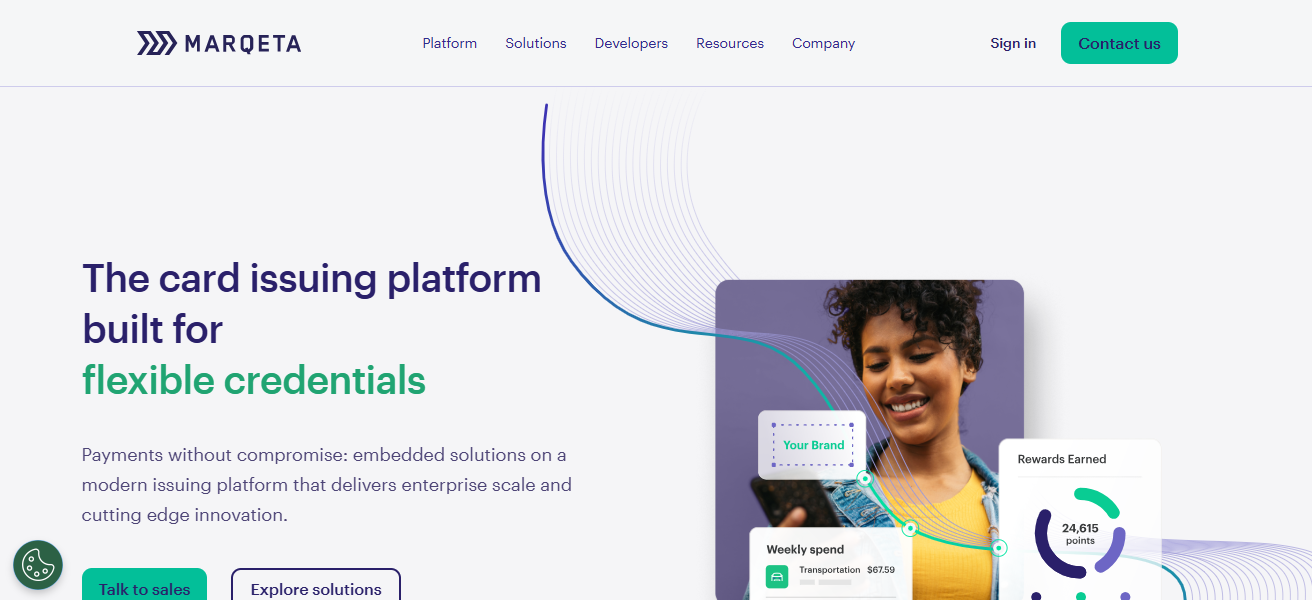
Fintech apps and gig economy platforms make extensive use of this feature. Infrastructure complexity is eliminated by Marqeta’s ecosystem’s smooth integration with banking partners.
Startups are depending more and more on Marqeta to quickly build card programs with an emphasis on user experience as integrated finance expands.
It is an effective tool for fintech companies looking to grow globally because of its scalability and widespread acceptability.
| Pros | Cons |
|---|---|
| Advanced card issuing with Just-in-Time funding capabilities | Primarily focused on card issuing, not full banking stack |
| High flexibility in controlling transactions and spending rules | Requires integration effort for full functionality |
| Global acceptance and scalability for growing fintechs | Pricing may increase with transaction volume |
| Strong ecosystem of banking and payment partners | Limited features beyond payments and card solutions |
5. SDK.finance
A strong white-label core banking platform is provided by SDK.finance to assist entrepreneurs in launching comprehensive financial solutions without the need to develop infrastructure.
It offers more than 60 modules and more than 470 APIs that cover everything from wallets and payments to compliance and reporting.
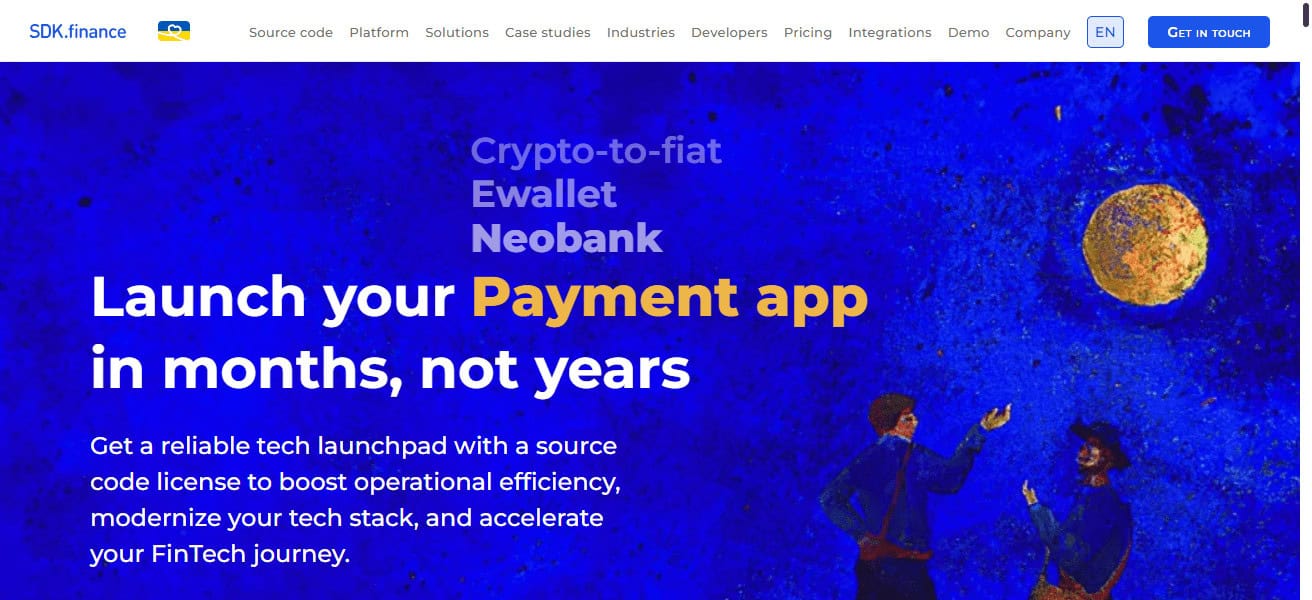
Startups can use source code for complete customisation or deploy it as SaaS for rapid launches. Its capacity to handle thousands of transactions per second while facilitating multi-currency operations is a significant benefit.
Companies are leveraging SDK.finance to create digital wallets, neobanks, and remittance platforms in weeks rather than years, drastically cutting costs, according to recent fintech adoption.
| Pros | Cons |
|---|---|
| Offers 470+ APIs and 60+ modules for full fintech solutions | Initial setup can be complex for non-technical users |
| Supports high transaction volumes and multi-currency operations | Requires configuration effort for customization |
| Available as SaaS or source code for flexibility | Higher cost for full-scale deployment |
| Ideal for building neobanks, wallets, and remittance platforms | Needs technical support for advanced features |
6. Blaze.tech
Blaze. Tech is a no-code platform that is revolutionizing the development of finance applications, allowing entrepreneurs to introduce scalable and secure solutions without the need for coders.
It is perfect for non-technical entrepreneurs because it enables teams to construct web apps ten times faster than traditional coding.

Blaze guarantees security while streamlining development thanks to its integrated compliance features and SOC 2 certification.
Blaze is already being used by more than 200 financial institutions to replace outdated systems and boost operational effectiveness.
It is particularly appealing to companies seeking to rapidly evaluate concepts and iterate without engineering bottlenecks because of its drag-and-drop interface and database interfaces.
| Pros | Cons |
|---|---|
| No-code platform enabling rapid fintech app development | Limited customization for highly complex applications |
| SOC 2 compliant ensuring strong security standards | Not a dedicated fintech infrastructure provider |
| 10x faster development compared to traditional coding | May require integrations for advanced fintech features |
| Easy-to-use drag-and-drop interface for non-tech users | SOC 2 compliant, ensuring strong security standards |
7. Bubble
Fintech entrepreneurs may create fully functional online applications without knowing how to write code, thanks to Bubble, a top no-code development platform.
It facilitates quick prototyping and deployment by providing database administration, workflow automation, and visual programming tools.
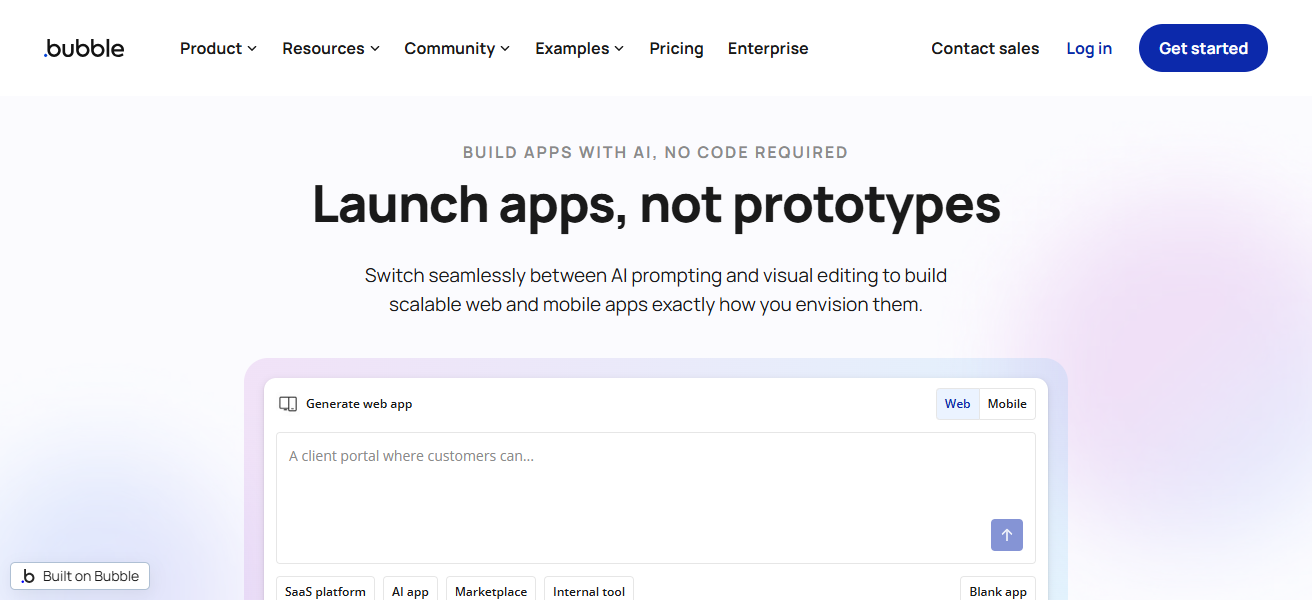
Bubble’s robust ecosystem of third-party integrations and plugins sets it apart, making it simple for fintech innovators to link payment gateways, KYC tools, and APIs.
Bubble has gained popularity recently among finance businesses in their early stages for creating MVPs and testing concepts before expanding.
It is a great option for entrepreneurs who wish to evaluate company models without making significant investments in technical teams because of its price and flexibility.
| Pros | Cons |
|---|---|
| Fully no-code platform ideal for MVP and prototype development | Performance limitations for large-scale applications |
| Strong plugin ecosystem for fintech integrations | Scaling complex apps may become challenging |
| Affordable for startups with limited budgets | Dependency on Bubble’s hosting environment |
| Enables rapid experimentation and iteration | Limited backend control compared to custom development |
8. FlutterFlow
Google’s Flutter framework powers FlutterFlow, a low-code platform that assists startups in creating and launching mobile banking apps.
It allows Firebase connectivity, backend integration, and real-time UI development without requiring extensive coding skills.
Startups can maintain great performance and native-like experiences while producing production-ready apps much more quickly.
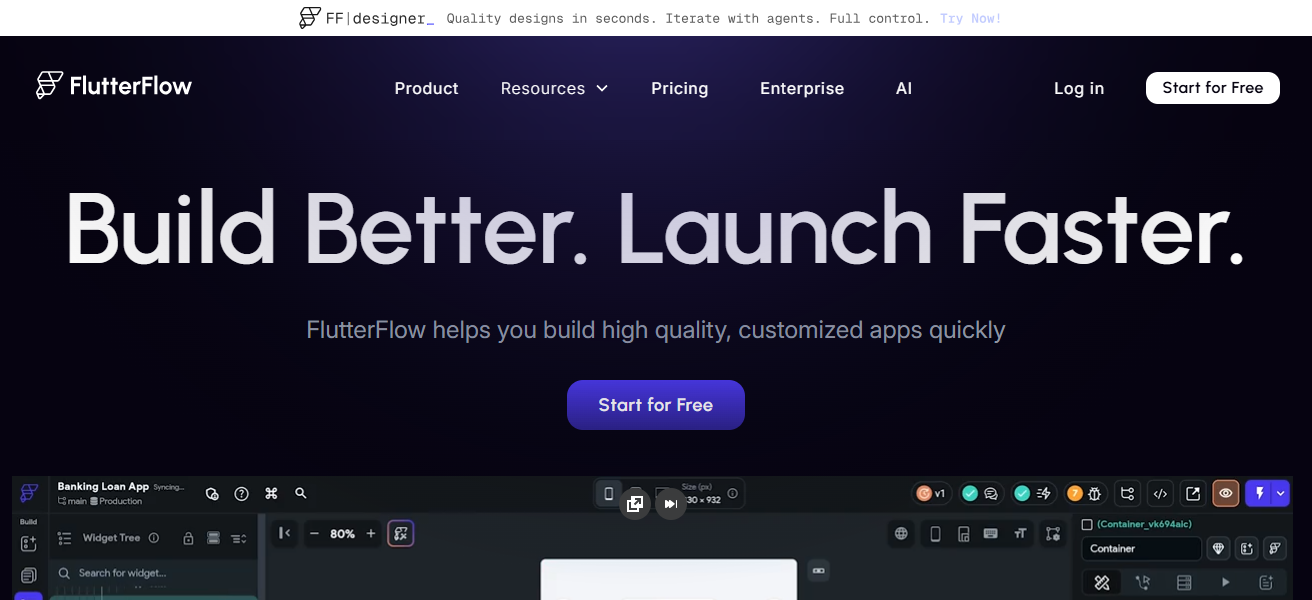
Its capacity to export clean Flutter code is a major benefit that enables future scaling as technical teams expand.
FlutterFlow is a powerful link between no-code simplicity and professional-grade development, and fintech innovators have been using it more and more recently to create customer-facing apps like wallets and payment platforms.
| Pros | Cons |
|---|---|
| Low-code platform for building high-performance mobile apps | Requires some learning curve for non-technical users |
| Exports clean Flutter code for future scalability | Limited backend capabilities without integrations |
| Seamless Firebase integration for real-time data handling | Not fully no-code, some logic setup needed |
| Faster app development with visual UI builder | Advanced features may need developer support |
9. Persona
Persona focuses on identity verification and compliance, a critical component for fintech startups launching without technical teams.
It provides customizable workflows for KYC, fraud detection, and user onboarding, enabling businesses to meet regulatory requirements effortlessly.
Persona’s strength lies in its flexibility—startups can tailor verification flows based on geography, risk levels, and product needs.

With increasing global regulations, tools like Persona are becoming essential for fintech scalability.
Its automation reduces manual verification costs while improving user experience, making onboarding faster and more secure. This allows startups to focus on growth while maintaining trust and compliance from day one.
| Pros | Cons |
|---|---|
| Advanced identity verification and KYC compliance tools | Focused only on onboarding, not full fintech stack |
| Customizable workflows based on geography and risk levels | Pricing may vary depending on verification volume |
| Improves security and reduces fraud risks significantly | Integration required with other fintech tools |
| Enhances the user onboarding experience with automation | Limited use outside identity verification use cases |
10. Signzy
Signzy helps fintech firms swiftly onboard consumers without developing internal compliance systems by using AI to expedite KYC, KYB, and AML procedures.
It uses AI models and biometric checks to increase the accuracy of fraud detection while verifying users in less than five seconds.
Signzy has demonstrated scalability for expanding finance platforms, processing more than 100 million verifications. Instant onboarding and regulatory compliance are made possible by its APIs’ easy app integration.
Signzy’s sophisticated verification technologies offer a competitive advantage as fraud risks rise internationally, enabling firms to launch safely and grow with confidence without requiring specialized compliance engineering teams.
| Pros | Cons |
|---|---|
| AI-powered KYC, KYB, and AML automation for fast onboarding | Mainly focused on compliance, not full fintech infrastructure |
| Verifies users in seconds with high accuracy | Requires integration with other systems for full stack |
| Scalable solution with millions of verifications processed | Pricing may increase with usage scale |
| Strong fraud detection using biometrics and AI models | Limited flexibility outside compliance workflows |
Conclusion
SaaS platforms have revolutionized the way finance companies launch by eliminating the need for sizable technical teams and intricate infrastructure.
Founders can concentrate on innovation and customer experience rather than development issues thanks to no-code tools, embedded finance APIs, and integrated compliance solutions.
Startups may launch more quickly, scale effectively, and maintain their competitiveness with the help of platforms like Unit, Marqeta, and Signzy.
Leveraging these SaaS solutions is becoming crucial for quick, economical expansion as fintech continues to develop.
FAQ
What are SaaS platforms for fintech startups?
They are cloud-based tools that help build fintech products without coding.
Can I launch a fintech startup without developers?
Yes, no-code and low-code SaaS platforms make it possible easily.
Which platforms are best for embedded finance?
Unit, Swan, and Marqeta are popular for embedded finance solutions.
Are these platforms secure for financial applications?
Yes, most offer compliance, encryption, and regulatory security features.